

MPCC sponsors involved in the future of cycling
The credibility of cycling not only depends on such topics as riders' health or the fight against doping. That's the message a dozen sponsors with a widespread international presence wanted to convey in a MPCC meeting held early this month in Paris. The representatives of these companies that invest in our sport call on their alter egos to join the movement to express their vision on the future of cycling: as proven by recent debates on the professional cycling reform, the MPCC remains the body you can have the most constructive discussions with.
On December 6th, the MPCC College of sponsors
met in Paris on the initiative of the movement's President Roger Legeay.
To date, 10 companies into a sponsoring partnership with professional cycling are part of the MPCC. Half of them have been loyal to cycling for more than 20 years.

AG2R La Mondiale
Adhésion :
11/03/2013
Président :
Yvon Breton

Bora Holding GmbH
Adhésion :
08/01/2015
Président :
Willi Bruckbauer

Cofidis
Adhésion :
21/03/2013

Direct Energie
Adhésion :
19/07/2016
Président :
Martin Bertran (Directeur Marque, Sponsoring et Communication)

FDJ
Adhésion :
01/02/2013

IAM
Adhésion :
28/02/2013
Président :
Michel Thétaz

Loterie Nationale Belge
Adhésion :
05/02/2013

Carrefour
Adhésion :
11/03/2016

LCL
Adhésion :
04/03/2013

PMU
Adhésion :
21/03/2013
The membership of these companies is alrealdy translated into very concrete actions:
> To embrace the philosophy of the MPCC (i.e. to promote the image of cycling by fighting against doping and all other forms of cheating)
> Not to hire riders or staff suspended in the past for communication purposes (commercials, PR, consulting)
The representatives of the sponsors also volunteer their services to enhance the communications of the movement.
During this meeting, the sponsor members stated the credibility of cycling not only depends on such topics as rider's health or fight against doping anymore. Our attention now should be also paid to the control of the financial (money laundering, risks of corruption related to sports betting services) and technical aspects (technological fraud) - not forgetting the riders and spectators safety. The representatives ask the MPCC to consider new forms of commitment in those areas.
As members of the MPCC, the companies investing in our sport call on their alter egos (sponsors, race organizers) to join the movement. The call is also addressed to the bicycle industry which needs to be highly credible to face technological fraud suspicions.
The representatives attending the meeting lamented that the UCI did not think it was worth inviting them to join the professional cycling reform discussions. They also noted this new deal was still to be shaped only a few weeks before the beginning of the next season. That's why the sponsor members wanted to thank the movement. They see the MPCC as the only professional cycling stakeholder that is actually willing to fully involve them and take their wishes and expectations about the future of cycling into consideration.
The sponsors also expressed their satisfaction to see the double world champion Peter Sagan now carrying the colours of Bora, a company committed to the MPCC since early 2015.
At the meeting's conclusion, the College of sponsors renewed its confidence to Rodolphe Boulinguez (Responsible for Cycling Programs - FDJ) and Marc Frederix (Marketing Director - Belgian Lottery) as Board members.

Thierry Vittu (Cofidis): "The more members we are..."
Cofidis Competition President Thierry Vittu is the representative of the northern France's company to the MPCC. He calls for an increase of the number of members in order to better "eradicate problems" in cycling.
As the company Direct Energie joined the Movement for a Credible Cycling (MPCC) this year, 10 team or race sponsors are now members of the movement. It was and still is very important that partners investing in this sport have their own representatives connected with us, regarding topics directly affecting them.
By committing to the MPCC, a firm such as Cofidis Solutions Crédit agrees to respect specific rules as a complement of the rules their cycling team abide to for 21 years now. As a member of the MPCC, the company undertakes not to work for communication puroposes with a rider - or former rider - who has been related to any doping scandal in the past.
To date, the 10 companies part of the MPCC are:
Direct Energie
Membership :
19/07/2016
President :
Martin Bertran (Directeur Marque, Sponsoring et Communication)
Carrefour
Membership :
11/03/2016
Bora Holding GmbH
Membership :
08/01/2015
President :
Willi Bruckbauer
Cofidis
Membership :
21/03/2013
LCL
Membership :
04/03/2013
PMU
Membership :
21/03/2013
Loterie Nationale Belge
Membership :
05/02/2013
FDJ
Membership :
01/02/2013
IAM
Membership :
28/02/2013
President :
Michel Thétaz
AG2R La Mondiale
Membership :
11/03/2013
President :
Yvon Breton
Thierry Vittu and all the other representatives of companies committed to the MPCC want the college of members to continue to grow. He also alerts of the need to remain vigilant against topics which go beyond the area of antidoping, for example the technological fraud. In 2017, the MPCC will move in that direction by welcoming a new kind of company members: bike manufacturers.
On Tuesday 6 December, the representatives of the companies which are part of the MPCC will be meeting in Roissy in order to determine the actions to be taken in the future in hand with the movement.
How many teams are part of MPCC?
The answer is: 7 World Tour teams, 17 Pro Continental teams, 14 Continental teams, 7 women teams, 8 national teams, totalling more than 50 teams. The riders we interviewed - almost - knew by heart the number! But it is important to add that MPCC members are not all teams.
Roger Legeay clarifies: the MPCC is also about federations, organizers, sponsors, sporting agents, a wide variety of supporters, and even tomorrow the bicycle manufacturers. Through a video, he explains what makes each member category special.
SEE ALL THE MPCC MEMBERS :
World Tour teams
AG2R La Mondiale
Membership :
11/03/2013
Representative :
Yvon Breton
Website

Cannondale-Garmin
Membership :
24/10/2007
Representative :
Jonathan Vaughters
Doctor :
Prentice Steffen & Kevin Sprouse
Website

Dimension Data
Membership :
07/02/2013
Representative :
Brian Smith
Doctor :
Jon Patricios
Website
Equipe FDJ
Membership :
05/07/2007
Representative :
Marc Madiot
Doctor :
Jacky Maillot
Website

Giant-Alpecin
Membership :
06/12/2007
Representative :
Iwan Spekenbrink
Doctor :
Anko Boelens
Website

IAM Cycling
Membership :
07/02/2013
Representative :
Serge Beucherie
Doctor :
Jacques Menetrey
Website

Lotto-Soudal
Membership :
26/10/2012
Representative :
Marc Sergeant
Doctor :
Servaas Bingé
Website
Continental Pro teams
Androni Giocattoli - Venezuela
Membership :
07/02/2013
Representative :
Gianni Savio
Doctor :
Maurizio Vicini
Website
Bora-Argon 18
Membership :
23/10/2012
Representative :
Ralph Denk
Doctor :
Ute Lange
Website

Caja Rural
Membership :
07/02/2013
Representative :
Juan Manuel Hernandez
Doctor :
Giuliano Peruzzi
Website
CCC Sprandi Polkowice
Membership :
17/02/2015
Representative :
Robert Krajewski
Doctor :
Piotr Kosielski
Membre probatoire
website

Cofidis
Membership :
05/07/2007
Representative :
Yvon Sanquer
Doctor :
Arthur Molique
Website
Delko Marseille Provence KTM
Membership :
07/02/2013
Representative :
Frédéric Rostaing
Doctor :
Claude Marble
Website
Direct Energie
Membership :
28/09/2007
Representative :
Jean-René Bernaudeau
Doctor :
Hubert Long
Website

Drapac
Membership :
06/06/2013
Representative :
Jonathan Breekveldt
Doctor :
Peter Fuller
Website

Fortuneo - Vital Concept
Membership :
05/07/2007
Representative :
Emmanuel Hubert
Doctor :
Jean-Jacques Menuet
Website

Gazprom - Rusvelo
Membership :
18/03/2013
Representative :
Renat Khamidulin
Doctor :
Ekaterina Malinovskaia
Website
Novo Nordisk
Membership :
07/02/2013
Representative :
Vassili Davidenko
Doctor :
Castol Rafael
Website

Roompot Oranje Peloton
Membership :
08/12/2014
Representative :
Michael Zijlaard
Doctor :
Guido Vroemen
website

Stötling Service Group
Membership :
02/12/2014
Representative :
Christian Grosse Kreul
website
Topsport Vlaanderen
Membership :
07/02/2013
Representative :
Christophe Sercu
Doctor :
An Konings
Website

United HealthCare
Membership :
04/02/2014
Representative :
Mike Tamayo
Doctor :
Michael Roshon
website
Vini Fantini - Nippo - De Rosa
Membership :
25/01/2014
Representative :
Hiroshi Daimon
Doctor :
Patrizio Ripari
website

Wanty - Groupe Gobert
Membership :
07/02/2013
Representative :
Jean-François Bourlart
Doctor :
Nathalie Francq
Website
Continental teams
Armée de Terre
Membership :
11/02/2015
Representative :
David Lima da Costa
Doctor :
Tanguy Malgoyre
website

Color Code - Arden Beef
Membership :
07/02/2013
Representative :
Julie Wavrelle
Doctor :
Emmanuel Blairvacq
Website

GM - Europa Ovini
Membership :
14/01/2015
Representative :
Gabriele Marchesani
Doctor :
Angela de Stefano
website

HP BTP Auber 93
Membership :
07/02/2013
Representative :
Stéphane Javalet
Doctor :
Jérôme Bouche
Website
Join's - De Rijke
Membership :
27/08/2014
Representative :
Cor Van der Wel
website

Rally Cycling Continental
Membership :
07/02/2013
Representative :
Jonas Carney
Doctor :
Kelby Bethards
Website

SEG Racing
Membership :
27/01/2015
Representative :
Bart Van Haaren
Doctor :
Camiel Aldershof
website

Sparebanken-Sør
Membership :
07/02/2013
Representative :
Atle Kvalsvoll
Doctor :
Bjorn Thomas Kjolsrud
Website

Synergy Baku
Membership :
12/02/2015
Representative :
David McQuaid
Doctor :
Vasyl Vovchanskyi
website

Team Coop - Øster Hus
Membership :
07/02/2013
Representative :
Jan Erik Fjotland
Doctor :
Orn Stein
Website

Tirol Cycling Team
Membership :
18/02/2014
Representative :
Thomas Pupp
Doctor :
Sebastian Kohl
website

Vérandas Willems
Membership :
02/03/2016
Representative :
Ivan De Schamphelaere
Doctor :
Servaas Bingé
Membre provisoire
Website

Wallonie Bruxelles - Groupe Protect
Membership :
07/02/2013
Representative :
Christophe Brandt
Doctor :
Eddy Mourmans
Website

Whirlpool Author
Membership :
31/01/2014
Representative :
Vladimir Vavra
Doctor :
Tomas Ondracek
website
Women teams

Liv-Plantur
Membership :
04/02/2014
Representative :
Iwan Spekenbrink
Doctor :
Anko Boelens
website
Lotto-Soudal Ladies
Membership :
13/11/2013
Representative :
Dany Schoonbaert
Doctor :
Servaas Bingé
website
Poitou-Charentes Futuroscope 86
Membership :
04/02/2014
Representative :
Nicolas Marche
Doctor :
Philippe Rolland
website
Rally Cycling Women
Membership :
07/02/2013
Representative :
Jonas Carney
Doctor :
Kelby Bethards
website

Tibco - Silicon Valley Bank
Membership :
25/04/2014
Representative :
Linda Jackson
Doctor :
-
website
Topsport Vlaanderen - Pro-Duo - Ridley
Membership :
27/02/2015
Representative :
Christel Herremans
website
United HealthCare Women Team
Membership :
04/02/2014
Representative :
Mike Tamayo
Doctor :
Michael Roshon
website
Sympathizing with us

Velobs
Membership :
15/03/2016
Representative :
Patrick Chassé
website

Gran Fondo New York
Membership :
15/03/2016
Representative :
Uli Fluhme
website
DCM Cycling Team vzw
Membership :
24/12/2014
Representative :
Bob De Cnodder
website

Team Asada
Membership :
02/12/2014
Representative :
Akira Asada
website

MSV Le Mans Sarthe Vélo
Membership :
02/12/2014
Representative :
Roger Bordeau
website

AC2000
Membership :
31/01/2013
Representative :
Yvon Sanquer
Website

ACCDN
Membership :
15/04/2013
Representative :
Charlie Leconte
website

Mondovélo Le Mans Sud
Membership :
11/03/2013
Representative :
Christophe Paulve

24 heures Vélo Le Mans
Membership :
11/03/2013
Representative :
Claude Gasnal
Website
LNC
Membership :
30/10/2012
Representative :
Marc Madiot
Website
Société du Tour de France
Membership :
30/10/2012
Representative :
Christian Prudhomme
Website

UCI
Membership :
30/10/2012
Representative :
Pat McQuaid
Website
Federations members
Bund Deutscher Radfahrer
Membership :
03/11/2015
Representative :
Rudolf Scharping
website

KNWU
Membership :
11/06/2014
Representative :
Marcel Wintels
website
Norway Cycling Federation
Membership :
20/12/2013
Representative :
Harald Tiedemann Hansen
website
Fédération Française de Cyclisme
Membership :
20/12/2012
Representative :
David Lappartient
Website

Swiss Cycling
Membership :
08/01/2013
Representative :
Franz Gallati
Website

Cycling Ireland
Membership :
05/12/2012
Representative :
Denis Toomey
Website

Belgian Cycling
Membership :
30/10/2012
Representative :
Tom van Damme
Website
Union Européenne de Cyclisme
Membership :
06/11/2012
Representative :
David Lappartient
Website
Organizations members
Tour of Japan
Membership :
11/01/2016
Representative :
Katsumi Ishiguro
website
Tour de l'Ain
Membership :
25/04/2013
Representative :
Philippe Colliou
Website

Route Adélie
Membership :
27/04/2013
Representative :
Roland Montenat
Website
Route du Sud
Membership :
20/03/2013
Representative :
Pierre Caubin
Website

TRW Organisation
Membership :
18/03/2013
Representative :
Jean Eylenbosch
Website
Chrono des Nations
Membership :
26/03/2013
Representative :
Jacques Pineau
Website

Circuit de la Sarthe
Membership :
29/03/2013
Representative :
Gérald Feuvrier
Website
Sponsors members

Direct Energie
Membership :
19/07/2016
President :
Martin Bertran (Directeur Marque, Sponsoring et Communication)

Carrefour
Membership :
11/03/2016
Bora Holding GmbH
Membership :
08/01/2015
President :
Willi Bruckbauer

Cofidis
Membership :
21/03/2013

LCL
Membership :
04/03/2013

PMU
Membership :
21/03/2013

Loterie Nationale Belge
Membership :
05/02/2013

FDJ
Membership :
01/02/2013

IAM
Membership :
28/02/2013
President :
Michel Thétaz
AG2R La Mondiale
Membership :
11/03/2013
President :
Yvon Breton
Agents

SEG Cycling
Membership :
27/01/2015
Representative :
Eelco Berkhout
website
Agentur Baumer
Membership :
13/10/2014
Representative :
Christian Baumer

LC Management
Membership :
07/10/2014
Representative :
Joona Laukka
website

LC Management
Membership :
06/10/2014
Representative :
Michel Gros
website

R'Sportsconseil
Membership :
29/09/2014
Representative :
Philippe Raimbaud
website
>
Under what circumstances was the MPCC created?
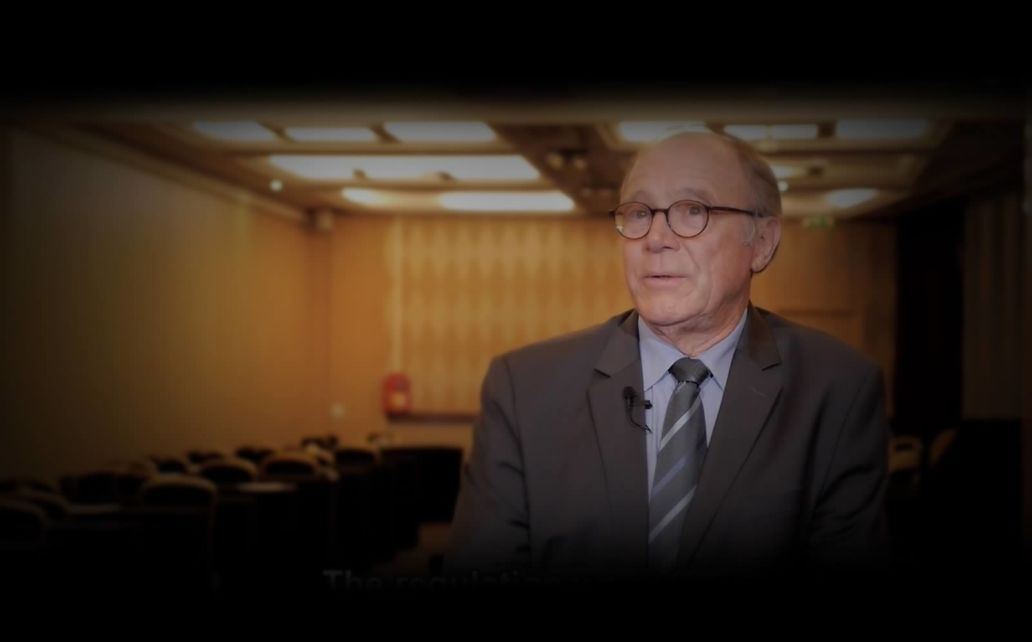
We put this question to the players (athletes, staff) of the MPCC. But this is Roger Legeay, President of the movement, who share the official story by relating this founding act.
Not everyone has the answer to this question. Yes, the massive arrival of new members seen in 2013, due in part to the Armstrong scandal, might have suggested it was the beginning of the movement, but the inception of the MPCC is dated more than six years before this turning point. The decision to create the MPCC had been motivated by a very particular episode:
Founding members of the MPCC - committed on a voluntary basis in July 2007 - were:
> AG2R Prévoyance (now called AG2R La Mondiale)
> Agritubel (Cessation of activity in the late 2009)
> Bouygues Telecom (now called Direct Energie)
> Cofidis
> Crédit Agricole (Cessation of activity in the late 2009)
> Française des Jeux (now called FDJ)
> Gerolsteiner (Cessation of activity in the late 2008)
MPCC random testing... of the movement knowledge!
The MPCC went to meeting its members in order to share on the rules of the movement - especially with the riders, who most frequently embraced the principles. They will discuss it during off-season in future video episodes.
With the participation of:
Simon GESCHKE (Giant-Alpecin), Jurgen ROELANDTS (Lotto-Soudal), Bryan COQUARD (Direct Energie), Geoffrey SOUPE (Cofidis),
Ignatas KONOVALOVAS (FDJ), Benoît VAUGRENARD (FDJ), Matteo MONTAGUTI (AG2R La Mondiale), Samuel DUMOULIN (AG2R La Mondiale),
Leah KIRCHMANN (Liv-Plantur), Amélie RIVAT (Poitou-Charentes - Futuroscope 86), Aude BIANNIC (Poitou-Charentes - Futuroscope 86),
Emmanuel HUBERT (Fortuneo-Vital Concept) et Jean-René BERNAUDEAU (Direct Energie)
October 18, 2016 press release
The day after its annual general meeting and a few hours after the presentation of the 2017 Tour de France - during which Christian Prudhomme vigorously argued the movement is the vision to share - it's time for the MPCC to publish its views on the past year.
The members of the MPCC met in Paris on 17 October 2016. They looked back with satisfaction on the past year. Improved relationships have been established with the UCI, which led to the acceptance of the introspection-period principle the movement's members abide by in the event of several doping cases.
The MPCC also welcomed the full respect for the rules shown by the members on a voluntary basis. Now the movement only consists of members which met their commitments. More than half of the professional divisions' teams remain under MPCC membership and this people is dedicated.
The physicians representing the member teams reaffirmed the following principle: when a rider is sick as it requires a treatment with corticoid drugs, he is prevented from riding for 8 days and resumes competition only if his cortisol level is above the norm. The physicians also requested to continue to set up random cortisol level tests within the framework of health. They even expressed the wish to increase the number of tests carried out on races outside France. This is why the movement is going to contact its national association members to this end.
In addition to these measures all the members adhere to, the MPCC reiterated its request to the World Anti Doping Agency (WADA) to include corticoids on the list of banned substances.
The health risk presented by tramadol use has long been studied by the attending physicians. The reality of the situation around this antalgic drug led them to renew the request to the WADA, exactly as the UCI did, to ban the use of the medication in competition.
Within MPCC, the team physicans undertook not to prescribe tramadol to their riders in competition. In accordance with them, the MPCC examines the technical validity of a test detecting the use of tramadol, achieved thanks to saliva or urine tests. In the context of health, the use of tramadol would lead the concerned rider to apply no-start policy.
During the general assembly, the MPCC also invited its members to vote for the constitution of the board, which is now:
- President : Roger LEGEAY
- Vice-President : Iwan SPEKENBRINK
- Secretary : Philippe SENMARTIN
- Assistant secretary : Christophe BRANDT
- Treasurer : Yvon SANQUER
- Assistant treasurer: Marc SERGEANT
- Members : Gianni SAVIO, Sébastien HINAULT, Vincent LAVENU
Lastly, the MPCC attended on Tuesday 18 October the presentation of the 2017 Tour de France.
During his introduction speech, the director of the race Christian Prudhomme made some statements the movement welcomed:
« I wanted to say it again here: the MPCC's raison d'être still remains. Self-imposed regulations, stricter than international ones, can avoid many concerns, debates or controversial issues. I like the watchword of the MPCC: to leave the light on. This is the key to our future. »
Doping in 2016 was not only about Russia
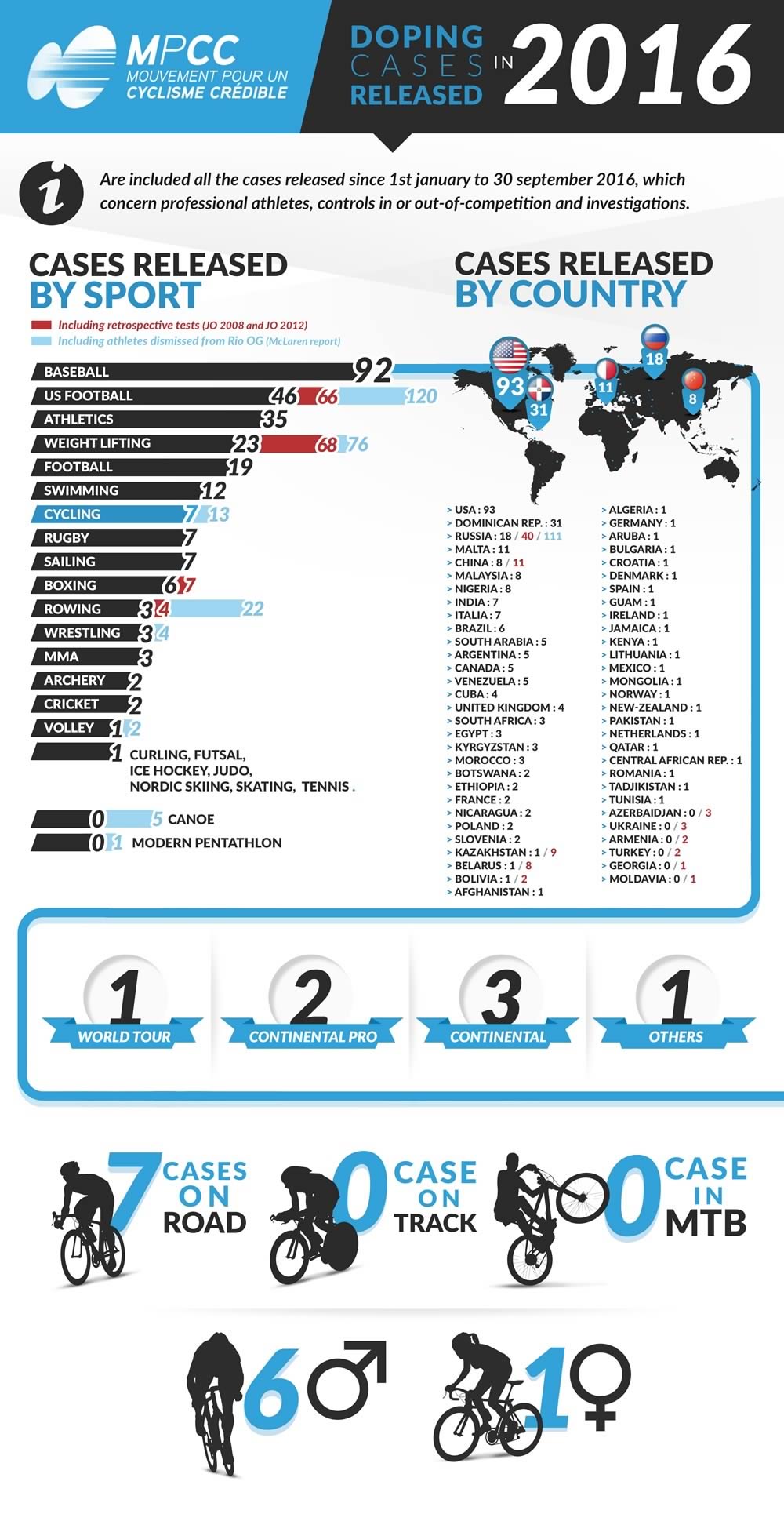
That is unprecedented: since the beginning of the year, a baseball player has been busted every three days. Thanks to the headlines focusing on the Russian athletes suspected of doping, the fact has remained unnoticed. Our quarterly infography is made to highlight that the figures actually collected aren't the illustration of the scandals with a high impact on the media.
Today there is no simple way to collect the figures of the doping cases released accross the world. To paint a credible picture of the fight against doping, we had to deal with some events that sometimes were subject to contradiction within the whole olympic "family". For various reasons:
- prohibition of the use of the Meldonium since 1 January 2016 ;
- retrospective tests of 2008 Beijing and 2012 London OGs' samples ;
- WADA's decision to dissmiss many Russian athletes from 2016 Rio OGs because of the suspected organized doping spotted by the McLaren report.
The particular case of Meldonium
We have made the decision not to include those Meldonium positive tests released at the beginning of the year. The reason is that as early as the spring, WADA stated that the medication was not eliminated of the urine on the basis of a reliable period. In an important number of cases, that means we cannot demonstrate the Meldonium would have been taken in 2016 and not in 2015.
330 athletes - mostly from Eastern Europe - had been provisionally suspended for Meldonium use. The majority of them have since received from their respective federations the authorization to resume competition. To date, we cannot ensure a signifiant share of the open procedures will lead to actual sanctions. This applies to, amongst others, the three Russian cyclists involved in Meldonium cases.
We have however included in our table the high-profile case of Maria Sharapova because her 2-years ban - then reduced to 15 months by the CAS - has been officialy expressed by the ITF. In her very first statements, the tennis player admitted she was still under Meldonium treatment at the beginning of 2016. To public knowledge, she today remains the only athlete under a ban for a use of Meldonium (which will stay on the 2017 WADA's list of prohibited substances).
The Russian athletes out of Rio Olympic Games
On the other hand, we wanted to see in our infography (blue figures) the 111 McLaren-reported Russian athletes who have been dismissed from the Rio OGs from their respective sporting federations. We have to make it clear that not all of those exclusions led to disciplinary sanctions against involved athletes. Some of them had been dismissed from the OGs on the grounds that they had already been banned for earlier doping facts.
To quote a recent declaration from the report author Richard McLaren, who recently clarified that he would need several additional months to draft the final document: "This second phase focuses on the information regarding the athlete". The Canadian jurist also said he intends to provide this information to the federations.
Beijing and London samples reanalyzeD
If we focus on the 2008 Beijing and 2012 London samples reanalyzed by WADA, Russia is still the most affected nation. Among these retrospective tests (covering 1,200 samples), 98 positive results have been detected including 55 directly named athletes. These cases are highlighted in red in our infography. 43 subject-to-discretion cases remain: we don't know who are the concerned athletes, nor even which sports they are related to.
That is unfortunate because MPCC sees transparency as a guarantee of credibility in terms of fight against doping engaged by the international federations. Cycling is a very good example. It has the kind of behaviour our movement encourages: the UCI publishes all the provisional or definitive sanctions it imposes.
The major trends
The McLaren report thus brought Russia's suspected organized doping to light. But this scandal, too exposed by the media in a pre-olympic period, may have masked the fact that a major health problem also affected the American leagues. It has been a few years since the MLB strengthened his anti-doping policy by developing a toolbox of sanctions. It is symptomatic that the amount of disciplinary procedures hasn't stop increasing for 7 years, but also that for the very first time in MLB history, a player has been banned for life because of a third infraction in a row. Baseball is sufficient to make both United States and Dominican Republic the two most affected nation per positive tests.
Today it seems the NFL wants to follow the steps of the baseball league by implementing a program which weakness is the non-dissuasive penalty system. An athlete busted for the first time is suspended for 4 games. For the second time, the sanction ups to... 10 games! There is so much more we could say about the NHL (which includes 800 professional players): in a decade, only 4 doping cases touched this league!
Yet it is not unlikely that Russia may catch and drop the leading group when the McLaren final report will finally be released. The three sports which centralise the most suspicions - rowing, weightlifting, athletics - are very practiced at high level by Russian athletes. Athletics is the most denatured sport into the olympic landscape even if the number of positives tests is decreasing in 2016 - it was already the case in 2015. The decrease is the same for cycling. Both in 2014 and 2015, our sport faced about fifteen cases per year, classified itself in the 4th position of our table. This year, cycling is 7th with only 7 released cases. But it is going to to take three more months before stating the confirmation of this momentum.
TAKE A LOOK AT OUR doping cases INFOGRAPHY
TAKE A LOOK AT THE INFOGRAPHIES AS OF 31 MARCH AND 31 MAY
TUEs for corticosteroids? The problem isn't known within MPCC!
Within MPCC, there is no need to reflect on the corticosteroids TUEs issue. This is an automatic proccess: the rider who need to be treated with this medicine ceases to work for a 8-days period. The measure is effective and followed to the letter by the movement's members.
The 9th article of MPCC's regulation is clear since the inception of the movement.
This regulatory feature is one of the key commitments of MPCC, which have been able to lead many teams to membership.
IT STATES THAT :
> TUE must be validated by the physician in charge of the team.
> It is mandatory for any racer who, due to his health condition, may need a cortisone treatment given systemically -via oral, rectal, intramuscular or intraveinous administration – to be prescribed a sick leave and a competition leave for a minimum of 8 days.
> It is mandatory for such cortisone treatments given systemically as reminded above to be validated by the physician in charge of the team.
> Competition participation will resume, subject to a cortisol levels control yielding normal results.
> Corticoïd infiltrations, which do not require AUT, will imperatively be validated by the physician in charge of the team, who will imperatively prescribe a minimum of 8 days of sick leave and competition leave, as well as a cortisol levels control.
> In case of unusually low cortisol levels, competition will resume after an additional 8-day rest minimum, and back-to-normal cortisol levels.
« Corticosteroid is still a legitimate medicine if you need it but you need to take a period of time to get well, says Anko Boelens, Giant-Alpecin's physician. It’s the same with corticosteroid injections. It’s a valid way of dealing with tendon problems, for example, but if you need to take it then you need to take eight days off from racing. The most important reason in all of this is because we want to eliminate the grey area. Some people might feel like that and it might seem like we’re putting ourselves at a disadvantages, he continued. I don’t see it like that because I think it gives us clarity and it gives us clear boundaries to compete in sport. Also the systems in place by WADA are there to stop people abusing the system but in order to eliminate all doubt we as the MPCC have our rules. »
Over the past few years, MPCC repeatedly asked WADA to add corticosteroids - but also tramadol - on the list of prohibited substances. To date no developments are to be reported. Such requests have been made to the UCI in order to support this goal, which is to recognize that a low cortisol level requires to stop competing.
As a reminder, MPCC carried out 2,315 cortisol level tests since 2010 (659 un 2016) in collaboration with the French National Association (FFC) and the French National League (LNC). 13 work stoppages have been notified. MPCC continues to invite all the teams to join the movement and its philosophy, by committing to its clear and immutables rules, which are stricter than international ones.
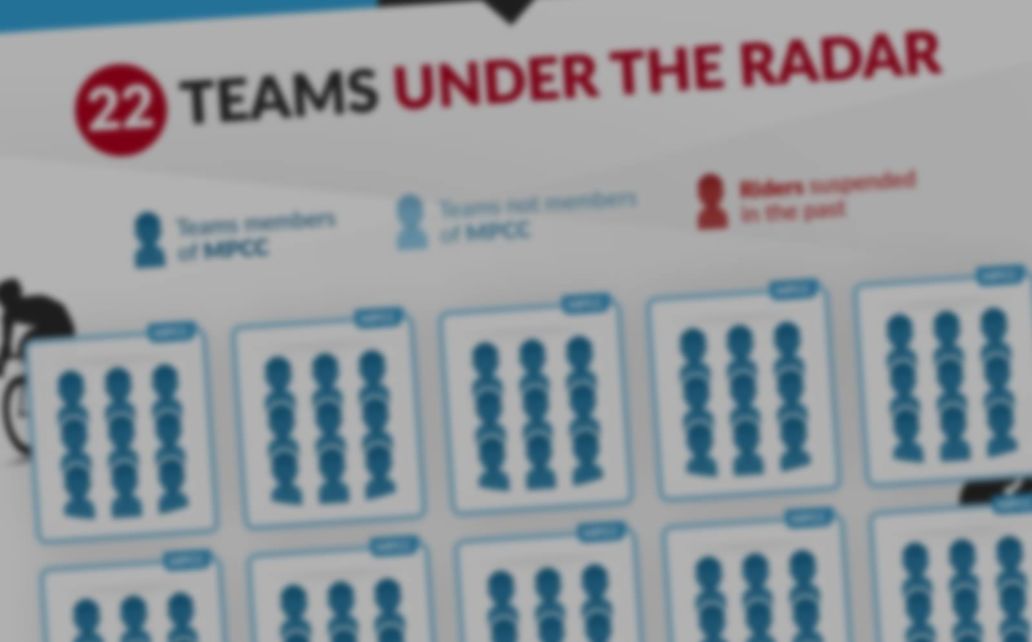
Vuelta a Espana: 22 teams under the radar
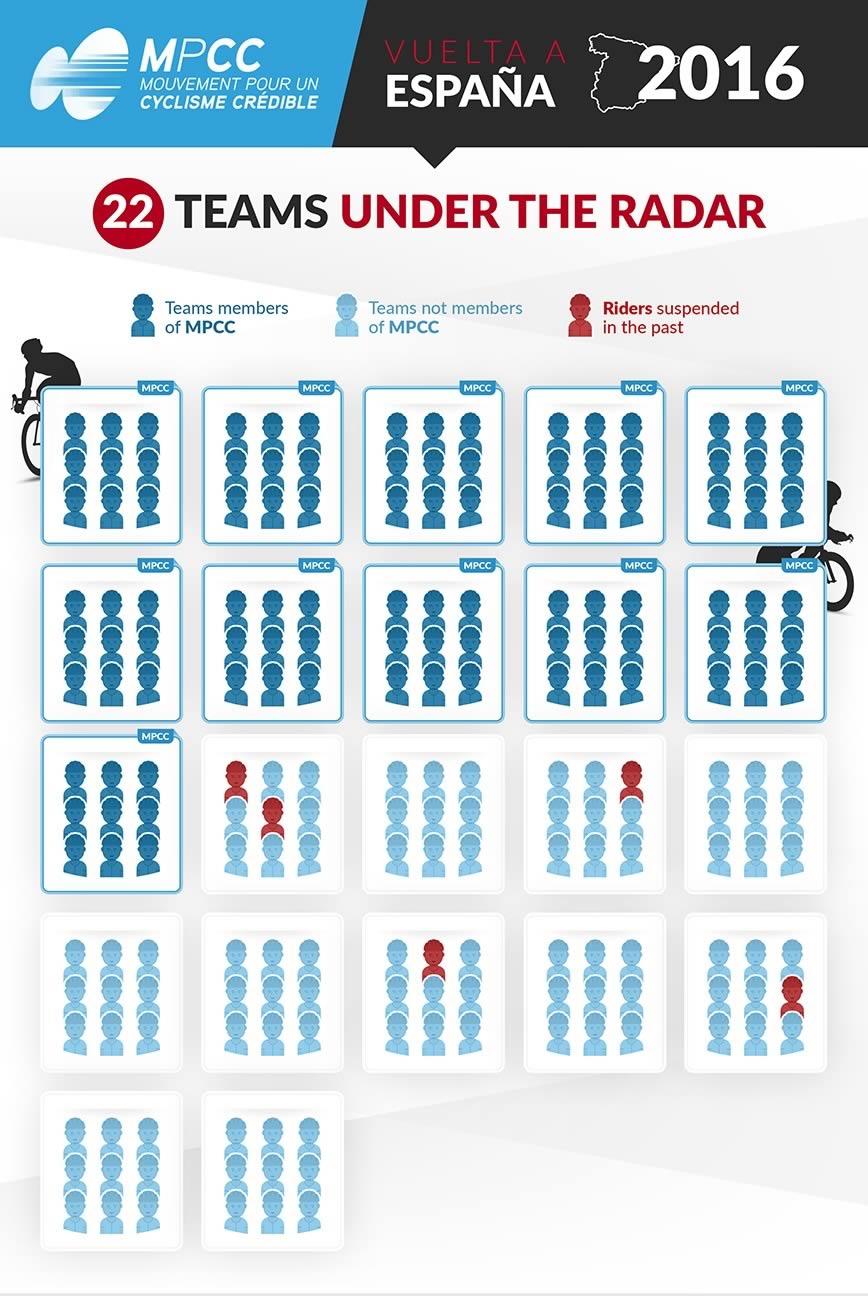
In an infography, we have represented the 2016 Vuelta a España peloton, distinguishing member teams and non-member teams of MPCC. Amongst member teams, no riders have ever been suspended. Within non-members, 5 already have!
In the event of every grand tour race or big championships, the Movement for a Credible Cycling (MPCC) highlights how many riders are part of the movement but also how many riders have been suspended for doping in the past.
The spirit of the MPCC is to regroup teams which on a voluntary basis define stricter rules than international organizations. Amongst those, this one: « Don’t hire riders involved in doping cases and banned for more than 6 months, except no-shows, in the two years following the suspension. »
On a long term, the requirement not to select in its team or national selection a rider with such an history reflects much more of a movement’s philosophy than the strict application of a regulation. IOC’s position - which asked Russian sporting associations to remove its athletes from the Olympic Games due to all kinds of scandals that previously occurred - complies with the rules the MPCC set up in 2007.
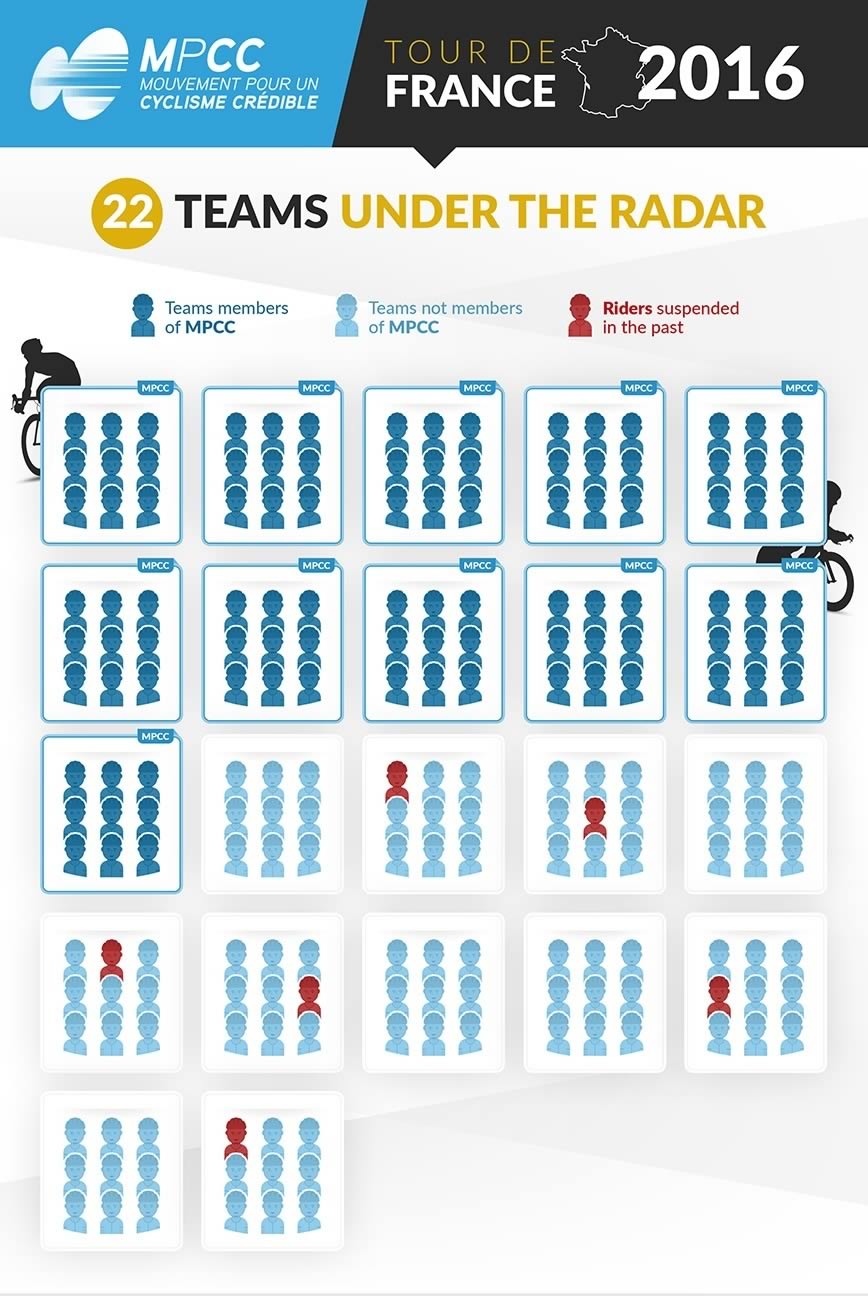
Olympiad after olympiad, all the national associations which are members of MPCC supported this philosophy. 8 athletes suspended in the past took part in 2016 Rio’s road races, none of them rode for MPCC associations. On the last Tour de France, MPCC teams had done the same: 6 riders suspended in the past competed in the race ; they all were members of non-MPCC teams. It was no different with the Vuelta a España: 5 riders concerned, all part of non-MPCC teams.
2016 Vuelta a España infography
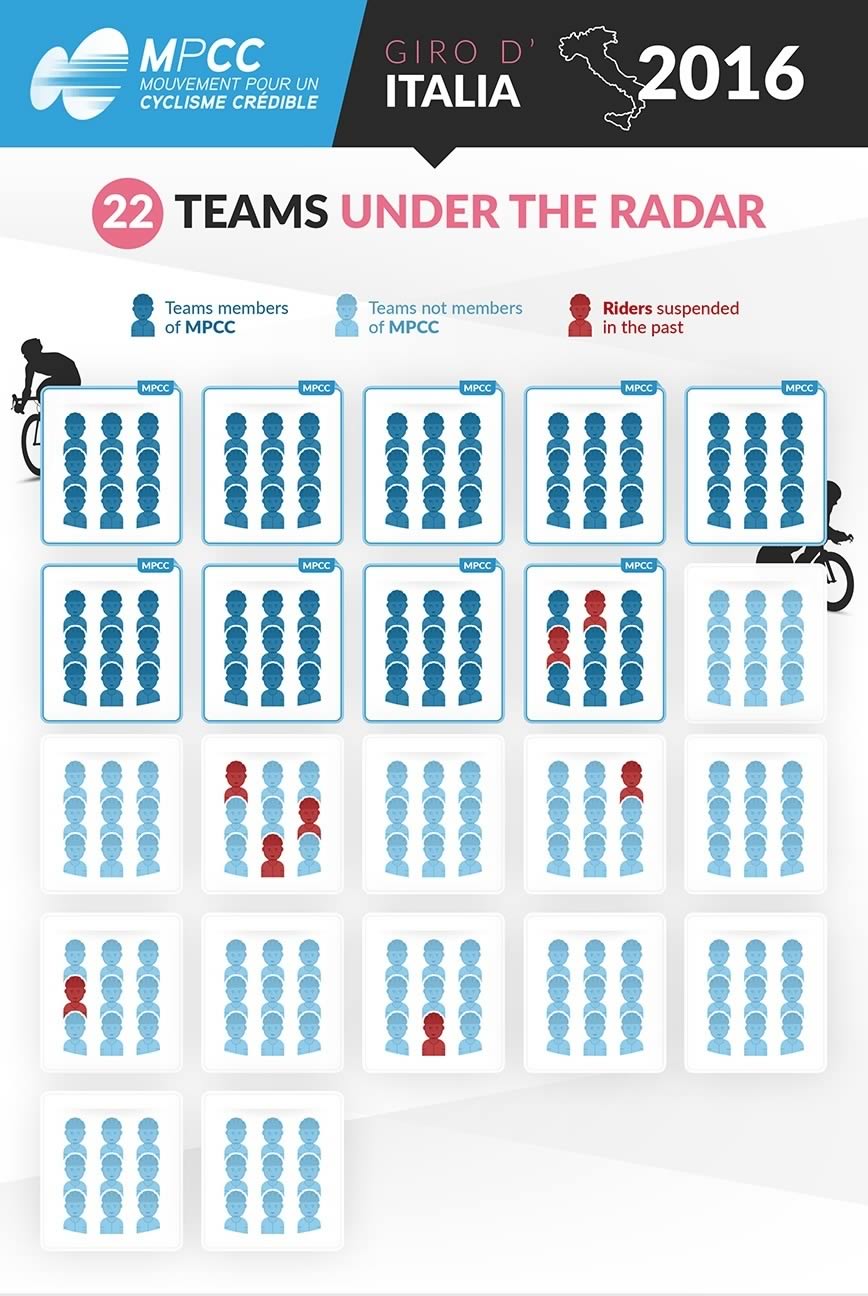
See below 2016 Giro d'Italia and Tour de France infographies
 |
 |
|||
Bernaudeau : « MPCC is even more relevant today »
While his title partner Direct Energie has decided to join the MPCC’s college of sponsors, Jean-René Bernaudeau is going to complete his 10th year as a member of the movement. He explains why he considers that the MPCC remains a relevant actor in the cycling landscape.
Successively at the top of Bonjour - the team he created in 2000 -, Brioches La Boulangère, Bouygues Telecom, Europcar and now Direct Energie, Jean-René Bernaudeau has been a professional cycling team manager for 17 years. His team was one of the original members at the inception of the MPCC in London in July 2007. For nearly a decade, he has been renewing his commitment to the MPCC ; now he considers the purpose of the movement not only as remaining true but also as even more reasoned than before. Bernaudeau says in our interview that the MPCC maintains a « friendly pressure ».
Our interview of Jean-René Bernaudeau
One special aspect of Direct Energie this year is that the title sponsor is now member of the MPCC as well as the cycling team. This summer, the company Direct Energie chose to join the mouvement. At this moment, the Branding, Sponsoring and Communications Director Martin Bertran stated that this membership « appeared as an obvious move ». Direct Energie CEO Xavier Caïtucoli added: « We share common values with Jean-René Bernaudeau’s team. It is thus quite naturally that we have decided to be part of the MPCC. In this regard we invite all the others cycling teams’ sponsors to join our call. »