


Fédrigo: "It's up to the rider to screw up or not"
Pro rider since 2000, Pierrick Fédrigo, 37, 4-times stage winner on the Tour de France, spoke to the MPCC in an interview. He explains what he has experienced during his career and what feeds his disappointment.
Fédrigo feels, however, a fresh wind into the team staffs and the riders, especially the young ones who are able to get major results on the Tour de France.
But Pierrick Fédrigo reminds that « there will always be cheaters ». He recalls that « the responsibility to take enhancing drugs is up to the rider ». Riders tested positive have no good excuse, even if they argue that they did it because their contract is about to expire.
Team member of Fortuneo – Vital Concept, former rider of Crédit Agricole, Bouygues Telecom and FDJ, he has always done his job under MPCC memberships. « They are trying to set up things that allow us to demonstrate that cycling is cleaner and cleaner », he explains.


Technological cheating: MPCC Press Release
Deeply impacted and shocked by « Moteurs, ça tourne », report broadcasted by the french sports TV programme Stade 2, the MPCC adresses a number of requests to cycling players.
Deeply impacted and shocked by « Moteurs, ça tourne », report broadcasted by the french sports TV programme Stade 2, the MPCC (Movement for a credible cycling) :
- Notes that the report offers a precise demonstration and accurately denounces some acts which can be regarded as truly scandalous cheating ;
- Examines – in the light of the provided information - all possibilities of legal actions in order to punish the cheaters and protect cycling’s integrity ;
- Strongly urges official agencies as well as national and international organisations representing riders to initiate the necessary procedures in order to uncover the truth and protect the rider profession - as MPCC does ;
- Calls on the UCI to immediately open an internal investigation and to take the necessary action so that the fight against technological cheating will be strengthened. As such, the MPCC stresses that the contribution made by the European Cycling Union (UEC), which is member of MPCC, offers several proposals able to be established very quickly. For example, setting up in-race random testing areas with the help of thermal cameras, etc ;
- Requests again to have all the bikes of the riders selected for doping controls systematically tested. The MPCC also requests to step up the sanctions against teams and riders found guilty for technological cheating ;
- Reminds that the maintenance of cycling's credibility requires strong and drastic measures against the cheaters but also their entourage. This king of cheating cannot be seen as the action of a single person.
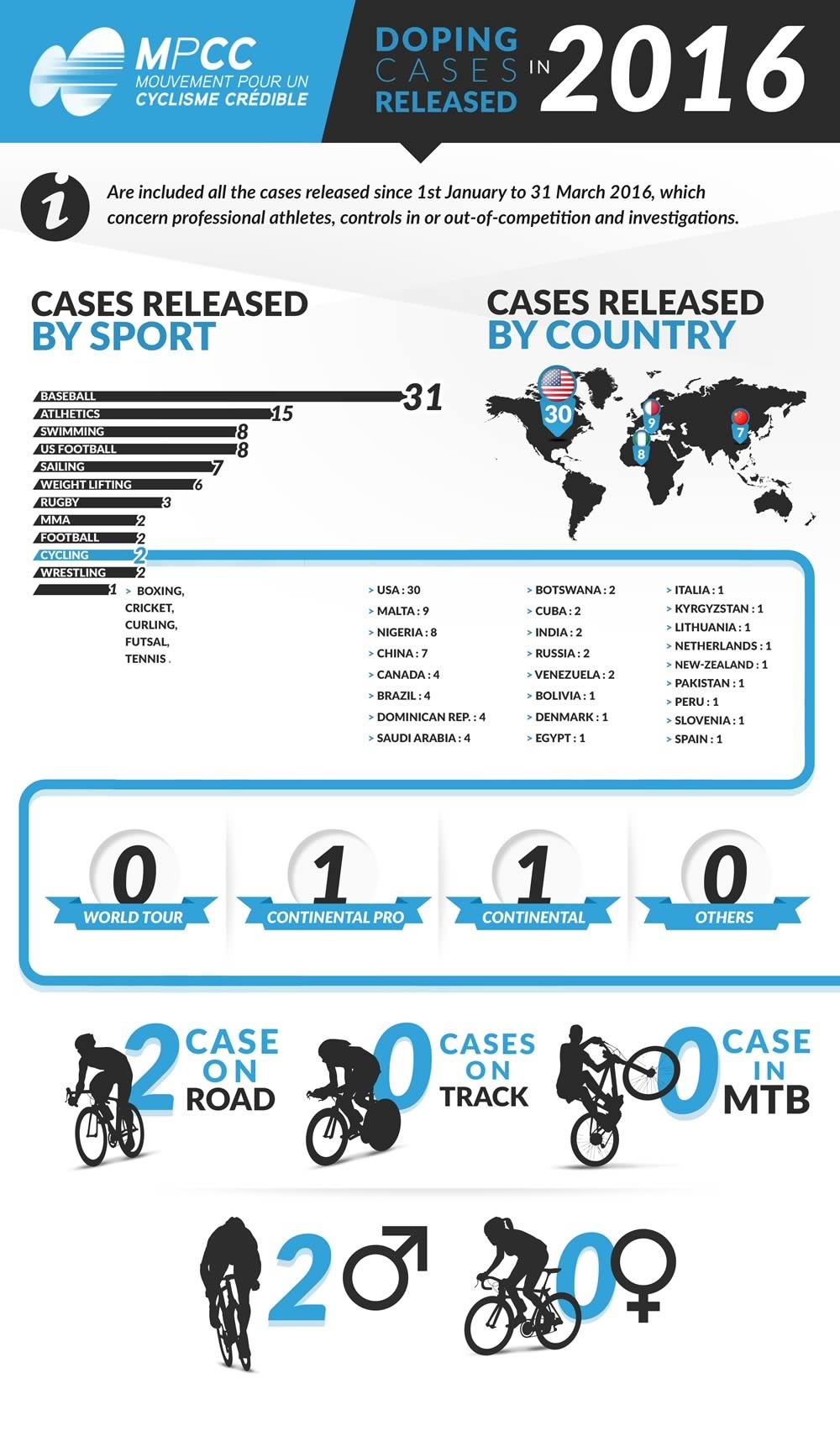
Doping figures as at March 31
Identifying cases of doping is not an easy task and is subject to discretion if required by their respective international federations, some do not advertise doping cases in their discipline. Cycling, in contrast, reveals each positive test. Our numbers are therefore based on proven cases in 2016, according to official communications federations and anti-doping agencies, etc..
In 2015, athletics was the sport most affected by positive tests (62), ahead of weightlifting (55). As at 31 March 2016, athletics are at the front again, among olympics sports with already 15 positive tests. Swimming is living its worst beginning of year with 8 cases. Cycling, 4th most affected sport in both 2014 and 2015, is 8th with two cases.
The most affected country is USA, which is far, far ahead of the other countries : 30 cases i.e. 21 more than Malta!
MPCC counting includes:
- Road cycling: two cases identified for this most publicised discipline.
- Track cycling: no case
- Mountain bike: no case
Update : 24/04/2017

73 cortisol level tests conducted on Paris-Roubaix and Circuit de la Sarthe
This Saturday 9 April, at the start of Paris-Roubaix, 11 team members registered for the Paris-Roubaix submitted their riders to a cortisol level test as part of their commitment to the Movement for a Credible Cycling (MPCC). Those tests have been conducted both in France and Belgium hotels.
This is the first time that the MPCC conducts tests of this kind in the case of a one-day race.
Earlier in the week, 13 team members registered for the Circuit de la Sarthe also submitted their riders to a cortisol level.
These voluntary tests have been performed in collaboration with French Cycling Association (FFC) and French Cycling League (LNC). All values were above the voluntary MPCC norm. The Board notes with satisfaction that the riders of these MPCC member teams registered for the Tour de France have scrupulously respected the clauses of their standing orders.
Background on cortisol tests by the MPCC
The objective of the MPCC and its member teams is to contribute to restoring the credibility of cycling. One of the organisation’s activities are voluntary cortisol tests amongst the riders of the member teams of the MPCC. In case the results of the test present an abnormally low value, the rider concerned will not race for a period of minimum eight days until the cortisol value has recovered again above that minimum value.
For the sake of clarity: it concerns a voluntary norm and the test does not concern an anti-doping control. Under WADA rules, athletes across all sports, with a cortisol level abnormally low, are entitled to perform their sport in competition (unless an anti-doping test has revealed the unauthorized use of the cortisol hormone).
The reason for the MPCC member teams to introduce this voluntary norm (below which the rider concerned will withdraw from competition for that minimum period of eight days), is an effort towards all stakeholders and fans of the sport of cycling and to confirm its commitment to clean sport and to show that cycling and MPCC member teams wish to be a frontrunner in that.
Why cortisol tests?
Although cortisol hormones are an allowed medicine when pre-scribed by a physician, the use of that medicine has frequently been abused in the history of sports (including in cycling) for the purpose of increasing the performance. Besides, a low level of cortisol can potentially endanger the health of athletes in certain circumstances when he/she is in competition while the athletes perform under high intensity or under stress.
For both reasons and with the objecitve to contribute to restoring the credibility of cycling, the Mouvement pour un Cyclisme Crédible and its member teams have introduced that voluntary norm below which its riders will temporarily withdraw from competition.

73 tests de cortisolémie sur Paris-Roubaix et le Circuit de la Sarthe
Conformément à leur engagement en faveur du Mouvement Pour un Cyclisme Crédible (MPCC), 11 équipes membres engagées pour Paris-Roubaix ont soumis leurs coureurs à un contrôle de cortisolémie ce samedi 9 avril, dans les hôtels en France et en Belgique.
C’est la première fois que le MPCC procède à des tests de ce type sur une course d’un jour.
Plus tôt dans la semaine, 13 équipes membres engagées pour le Circuit de la Sarthe ont également soumis leurs coureurs à un contrôle de cortisolémie.
Ces tests ont été pratiqués dans le cadre de la santé des athlètes, en collaboration avec la Fédération Française de Cyclisme (FFC) et la Ligue du Cyclisme Français (LNC). Tous ont été conformes à la norme établie par MPCC sur la base du volontariat. Le conseil d'administration de MPCC constate avec satisfaction que les coureurs de ces équipes ont scrupuleusement respecté les dispositions de son règlement interne.
Contexte des tests de cortisolémie réalisés par MPCC
L’objectif de MPCC et de ses équipes membres est de contribuer à restaurer la crédibilité du cyclisme. L’une des actions du mouvement est de mener des tests de cortisolémie parmi les coureurs d’équipes membres de MPCC, sur la base du volontariat. Si le résultat d’un test présente une valeur anormalement basse, le coureur concerné ne doit pas courir pendant une période de huit jours minimum, jusqu’à ce que le taux de cortisolémie soit revenu à une valeur normale.
Dans un souci de clarté : ces tests sont basés sur le volontariat, ce ne sont pas des contrôles antidopage. D’après les règlements de l’AMA les athlètes de tous sports ont le droit de prendre part à une compétition même avec un taux de cortisolémie anormalement bas sauf si un contrôle antidopage a révélé l’usage interdit de cortisone.
Les équipes membres de MPCC ont introduit ce principe du volontariat (selon lequel le coureur concerné doit renoncer à prendre part aux compétitions pendant au moins huit jours) afin de marquer l’effort de toutes les parties prenantes, confirmer leur engagement pour un sport propre et montrer que le cyclisme et les équipes membres de MPCC veulent être précurseurs à ce sujet.
Pourquoi ces tests de cortisolémie ?
Bien que la cortisone soit un médicament autorisé quand il est prescrit par un médecin, son utilisation a fréquemment été abusive dans l’histoire du sport, cyclisme compris, dans le but d’améliorer la performance. De plus, un faible taux de cortisolémie peut potentiellement mettre en danger la santé des athlètes, quand les circonstances en compétition font qu’ils sont exposés à de grandes intensités ou des périodes de stress.
Ce sont pour toutes ces raisons et dans l’objectif de contribuer à restaurer la crédibilité du cyclisme que le Mouvement Pour un Cyclisme Crédible (MPCC) et ses équipes membres ont donc introduit ce principe du volontariat amenant à l’arrêt temporairement de compétition.
Madiot: "What to think about the teams not supporting MPCC?"
The 2016 World Tour bunch includes 7 MPCC teams: AG2R La Mondiale, Cannondale, Dimension Data, FDJ, Giant-Alpecin, IAM and Lotto-Soudal. Both Astana, Lampre-Merida, Orica-Greenedge, Katusha and LottoNL-Jumbo have been members in the past ; some of those chose to leave, while others have been excluded. 6 teams - BMC, Etixx-Quick Step, Movistar, Sky, Tinkoff and Trek-Segafredo – never considered to join the MPCC.
Former twice winner of Paris-Roubaix and Equipe FDJ’s team manager since its creation in 1997 Marc Madiot doesn’t understand why those teams don’t want to join MPCC: « He who can do more can do less! » He calls on big races organizers to get more involved towards cycling credibility and « to put an even bigger pressure on these unaffiliated teams. » He also urges the media to bring into light that some teams are not members of the MPCC yet.
However Marc Madiot agrees that the MPCC regulation can make team members deal with complex situations. For instance in the case of a low cortisol level on the eve of a grand tour race. But he insists the main principle of the MPCC is the « action on free will », so the team members must honour their commitments. « Their credibility is at stake, not the one of the staying teams. »
To Marc Madiot, the purpose of the MPCC ought to avoid teams remaining out of the movement. It should also work towards having MPCC regulation’s outlines adopted by international bodies.

03/04 Press Release
The philosophy of MPCC hasn’t changed and will not change.
Thanks to the voluntary basis, the MPCC is an indispensable partner and a necessary complement to the international rules.
The recent withdrawal of several UCI World Tour team members from MPCC (KATUSHA, LAMPRE-MERIDA, ASTANA) cannot be explained by a problem of compatibility beetwen the rules governing our sport and the philosophy of the movement. To the MPCC, this is mostly related to these teams’ failure to keep their commitment, just 3 years after their accession.
Without a doubt, some of these teams – which have excluded themselves by not following the rules they committed to – had not hesitated to carry high their new MPCC flag in front of the media, the UCI licence commission and/or the Court of Arbitration for Sport (CAS) with the aim of preserving their image and their World Tour status. By not respecting their commitment, these teams did join MPCC by opportunism.
Find below the commitment letters the team managers sent when they applied to MPCC:
KATUSHA - LAMPRE-MERIDA - ASTANA
The rules the MPCC members voluntarly commit to:
> A rider facing a cortisol level irregularity can’t take part into a competition (8-days stop)
> A rider subject to an ongoing procedure due to a positive test can’t take part into a competition
> A rider banned for a minimum period of 6 months must be dismissed by his team
> A rider who has been banned for a minimum period of 6 months can’t be hired
> In the event of 2 positive tests over a period of 12 months1: 8-days team introspection period, no competition
> In the event of 3 positive tests over a period of 24 months1: 4-weeks team introspection period, no competition
MPCC also took note of the ORICA-GREENEDGE team’s decision
to quit the movement despite showing their support to the MPCC actions by way of a press release.
The Board of Directors has validated the accession of:
> The TOUR OF JAPAN
> The continental team VERANDAS WILLEMS as a provisional member
During the Board of Directors met on 2 March, the sponsor representatives spoke before the Board members, renewing their commitment to the movement and asking to continue to stricly apply its measures.
According to the reports of many independant experts – as requested by the MPCC – but also by the international scientific community, it is agreed that glucocorticoids are enhancing drugs. That is why all the doctor representatives of MPCC team members reaffirm the principle of cortisol level tests which do not allow a rider to compete in a race if an irregularity is detected for whatever reason. MPCC will continue to carry out these tests in 2016.
On the basis of this renewed confidence, the Board of Directors asks:
WADA:
> To add corticosteroids to the list of banned substances
> To add tramadol to the list of banned substances
UCI:
> To prevent a rider from taking part in a competition in the event of a cortisol level irregularity
> To formalize the principle of replacing a rider on the eve of a grand tour race in the event of a cortisol level irregularity
> To amend the UCI regulation in the event of a « team introspection » in case of several positive tests
> To increase the number of bike testings by making this systematic for all the riders tested for doping after an UCI race.
> To ban for a minimum period of 4 years (instead of the existing 6 months sanction) any rider who is convinced of the use of a non-regulatory technological assistance
> To establish a commission of experts on the topic of glucocorticoids
> To establish a monitoring cell on the topic of sporting bets
1 The principle of « team introspection » has been validated by the Professional Cycling Council (PCC) at the join request of MPCC & AIGCP.
If the UCI suspends a team, it should not go hand in hand with a voluntary team introspection
Voeckler: "MPCC teams are under different backgrounds"
On 5 July 2007 - at the dawn of the 94th Tour de France, 7 teams convened to found the Mouvement Pour un Cyclisme Crédible (MPCC). Amongst those was Bouygues Telecom, which then became Team Europcar and Direct Energie. One of its most important figures Thomas Voeckler claims the label of "founding member". In this interview, he expresses his reservations on the changed landscape of the movement highlighted by the admission of many new members three years ago.
On 24 October 2012, day of the Tour de France official route announcement in Paris, the race organizer and AIOCC chairman Christian Prudhomme stated: "We support what the managers of MPCC teams do. It is the future. The rules they commit to are stricter than those of the UCI's but also WADA's. Abiding to draconian rules is the high way to a cultural change."
Some of these new members have since left MPCC, either in their own volition or as a result of their non-compliance with the rules they committed to follow. Thomas Voeckler disagrees: "Those teams were required to come, this was no decision of their own."
In the face of the antidoping developments, the former Tour de France yellow jersey holder stays cautious: "This is great if cycling remains one step ahead of the others sports but if this is no longer the case, it means things are moving forward too in those fields." In 2015, Athletics, Weightlifting and Baseball faced more positive tests than Cycling. According to the latest available WADA testing figures, Athletics and Football were the only sports to control a greater volume of athletes than Cycling.
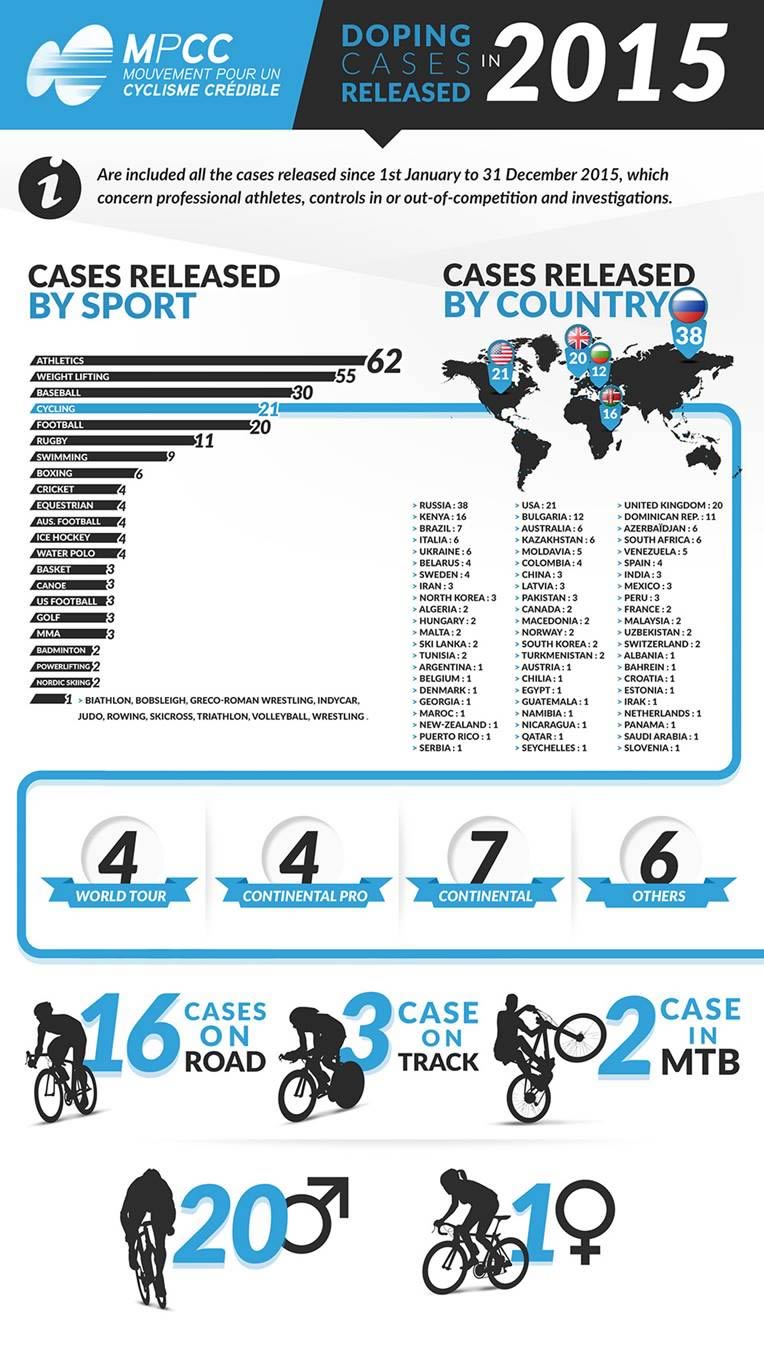
Final 2015 doping figures
Identifying cases of doping is not an easy task and is subject to discretion if required by their respective international federations, some do not advertise doping cases in their discipline. Cycling, in contrast, reveals each positive test. Our numbers are therefore based on proven cases in 2014, according to official communications federations and anti-doping agencies, etc..
Already ahead of this classification in 2014, athletics is the most affected sport in 2015 with a total of 62 positive tests, ahead of weightlifting with 55 cases and baseball with 30. As last year, cycling remains fourth with 21 cases, almost a third of athletics figures. Football is fith only one case behind cycling.
MPCC counting includes :
- Road cycling: sixteen cases identified for this most publicised discipline.
- Track-cycling : three case.
- Mountain-Bike : two cases.
Only 8 cases out of 21 concerned riders from World Tour or Continental Pro divisions, which are able to compete in the best races of the worldwide calendar.
"Ladies are less tested than men"
Women cycling teams are part of MPCC since 2013. The first were members as affiliates of their male counterparts, then exclusively women’s teams followed their lead which now allow MPCC to rely on seven members: Liv-Plantur, Lotto-Soudal, Optum, Poitou-Charentes Futuroscope 86, Tibco, Topsport Vlaanderen and United Healthcare.
These women’s teams must abide by the exact same commitment as men’s teams but until now, none of them has never encountered a single doping case. Recent cases into women cycling (1 in 2015, 1 in 2014) all involved teams which were not members of MPCC. However, some players of the discipline, such as Danny Schoonbaert - Lotto-Soudal Ladies General Director - warn that antidoping tests are rare, and points out that his riders have not been subject to any control during the last Giro d’Italia, the main race of their sporting calendar.
During its last meeting and for the very first time, MPCC’s Board of Directors adopted the principle of cortisol level tests on women team members. But as a first step, MPCC’s doctors representatives Servaas Bingé and Guillaume Sarre as well as the medical consultant of the movement Armand Mégret, will study the physiological and hormonal frameworks to make it happen.
Interview with Danny Schoonbaert, Lotto-Soudal Ladies General Director :
Interview with Pascale Jeuland, Poitou-Charentes Futuroscope 86 rider :