
Open letter to Wada
On this Friday 6 October 2017, MPCC's President Roger Legeay - and his Board - send an open letter to World Anti Doping Agency (WADA).
OPEN LETTER TO WADA :
Dear Director general,
WHAT ARE YOU WAITING FOR?!
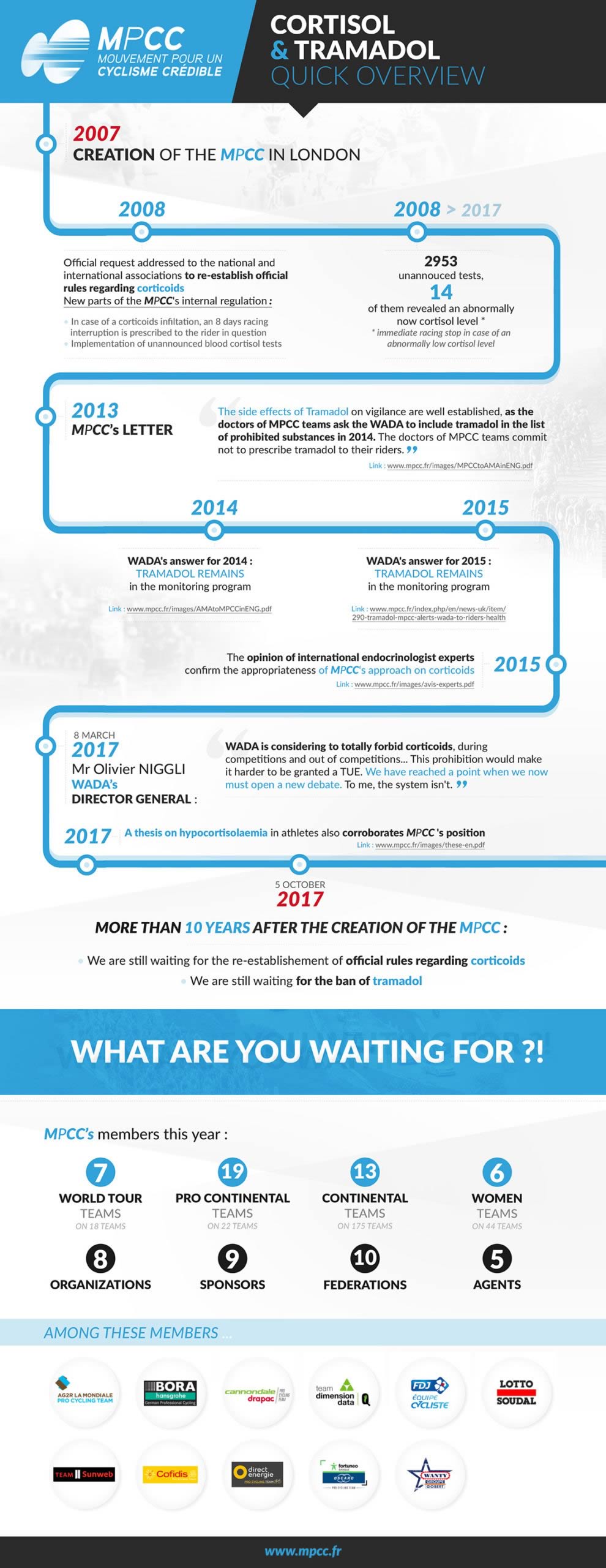
Since the creation of the Movement for a Credible Cycling (MPCC), we have been warning continuously your agency regarding the issues of corticoids and we have been advising the prohibition of Tramadol since 2013. Ever since, we have faced those same answers that seem to be the political will included in the phrase: "wait and see". Indeed, your answers never change: "we are setting up a commission", "we will make the working group aware of that", "we keep on monitoring"….
Here is a quick reminder of what have happened since the MPCC creation in 2007.
• Until 2007, there was a health journal where were listed all the medicines that were prescribed to the riders, including the TUEs.
• When the MPCC was created, the movement checked the riders' health journals, thanks to an external medical expert.
• In 2007, this journal disappeared, which lead the MPCC to decide in 2008 that:
> In case of a corticoids infiltration, an eight days racing interruption would be prescribed to the rider in question.
> Unannounced blood cortisol test would be created with immediate racing stop in case of an abnormally low cortisol level.> At the same moment, an official request was addressed to the national and international associations to re-establish official rules regarding corticoids, particularly thanks to cortisol level testing.
Blood testing is regularly performed on riders belonging to MPCC teams, which represents 70% of the world peloton. For your information, up to date, the MPCC have performed 2953 tests and only 14 of them revealed an abnormally low cortisol level, only one in 2017. This was made possible thanks to the MPCC teams’ involvement. All the medical experts, including Anglo-Saxons, agree to say that a real health problem can appear in case of an abnormally low cortisol level. Endocrinologists who wrote on that subject issued views that confirmed this. We keep those views at your disposal.
WHAT ARE YOU WAITING FOR?!
All the experts and chief doctors agree to say that an abnormally low cortisol level is dangerous for the athlete’s health in case crashes or high stress situations. International scientific literature confirms this risk. All of them notice and precise that an abnormally low cortisol level only can be provoked by an external corticoids intake, legal or not.
WHAT ARE YOU WAITING FOR?!
This issue regarding the athlete’s health comes along with the verified observation – that your agency confirmed – that glucocorticoids are performance enhancing. The WADA medical commission for health and research president’s correspondence issued on the 8th of September of 2015 is particularly indicative about this matter. According to your agency, today’s issue is that it is impossible to determine if an intake has been realized legally or not when testing. You also say that the experts disagree on total prohibition. This isn’t an acceptable situation. We can’t accept that, even if you are aware that those products are performance enhancing drugs, you still authorize their intake while racing under certain terms.
WHAT ARE YOU WAITING FOR?!
Will we have to wait for a severe problem due to corticoids intake that would have provoked an abnormally low cortisol level to see your agency take the appropriate measures? On a voluntary basis, MPCC has now been realizing tests on the world’s greatest races for 10 years now. This proves that there is a solution which preserves what matters the most: the riders’ health.
Time has come for WADA to take essential – and definitive – decisions. We remind you of what you said during an interview on the 8th of March of 2017:
« WADA is considering to totally forbid corticoids, during competitions and out of competitions… This prohibition would make it harder to be granted a TUE. We have reached a point when we now must open a new debate. To me, the system isn’t good. »
As your statements from the 8th of March of 2017 confirm, we all know that the TUEs system generates terrible perverse effects. Some people use those effects to enhance their performance.
WE CANNOT WAIT ANY LONGER, YOU AVE TO ACT
Since 2013, the MPCC has been drawing your attention – and UCI’s – on the issue regarding the use of a diverted medicine: TRAMADOL. This medicine, this product more precisely, is used to conceal pain. We all know that in sport, and particularly in cycling, using a medicine such as TRAMADOL to make pain disappear is a disguised performance enhancer.
Supported by medical experts, the college of professional cycling teams’ doctors and particularly MPCC members’ doctors have showed the existence of some very serious secondary effects which would justify the total prohibition of this drug. TRAMADOL is a level II analgesic with many dangerous secondary effects, especially for machine drivers’ athletes. Prescriptions with an analgesic objective create a strong dependency, even with therapeutic doses, weaning is difficult. MPCC member teams’ doctor committed not to use the TRAMADOL during races. Finally, last year, the UCI sent you a full record asking for the prohibition of TRAMADOL during competitions and your agency’s only answer was monitoring, “wait and see”.
ONCE AGAIN, WHAT ARE YOU WAITING FOR?
According to our movement and our members, 10 years is a long time to wait for dealing with subjects about which everybody agrees on their importance, regarding the riders’ health or stating that those medicines are performance enhancing drugs. Your agency is an anti-doping agency which must take the necessary measures to preserve the riders’ and athletes’ health. Third element of WADA’s missions, Health isn’t considered and WADA’s responsibility is committed.
I take this opportunity to ask questions about judicial consequences of the PUERTO case? What is WADA’s point of view?
Once more, cycling hasn’t been dealt with in the same way than all the other sports, particularly in this case. Whereas, let’s remind that, all of the world’s athletes are submitted to the same rules and sanctions with the list of forbidden products being almost the same.
WE CAN’T WAIT ANY LONGER, WE ARE TIRED
Convicted by the validity of our remarks and of our repeated requests and waiting for your answer, Best regards,
Quick Overview : Cortisol and Tramadol :

2017/09/16 Press Release
The Movement for a Credible Cycling (MPCC) held a meeting of its Board this Friday, September 15 in Roissy.
The MPCC asked the two candidates for the Presidency of the UCI Brian Cookson and David Lappartient to answer a set of questions related to central concerns of the movement. We wanted to thank them for their clear answers as we are pleased with their willingness to continue working with the MPCC. We also noted their wish to amend corticosteroids and tramadol regulations, within the athlete's health framework but also the antidoping one.
Mr Brian Cookson's LETTER :
Cher Roger,
Je vous remercie pour votre courrier du 17 juillet dernier qui a retenu toute mon attention.
Comme vous le savez, la crédibilité de notre sport reste mon principal engagement envers les acteurs du cyclisme, dont le MPCC fait partie et avec qui j’ai eu le plaisir de travailler à travers votre présence au sein du Conseil du Cyclisme Professionnel.
Pendant ces quatre dernières années, l’UCI a...
Read the full letter (only received in french)
MR David Lappartient's LETTER :
Dear Mr. President, Dear Roger,
I confirm I have received your letter dated 17 July 2017 and sent to the two candidates for the UCI 2017 Presidential election.
Firstly, I would like to congratulate your association for its commitment to support the respect of the code of ethics in cycling. Alongside the work done by the UCI, for many years now the MPCC has made tremendous contribution to the improvement of road racing. The manner by which your association has been able to bring various teams to work together on this matter is commendable.
Axe 5 of my presidential candidature manifesto for the UCI....
Read the full letter
In addition,
About the important subject of the technological fraud, the MPCC insists that all the means available and all possible technologies must be systematically deployed to result in less suspicion. All of these efforts must benefit from a better publicity to the general public to promote a better image of our sport. The MPCC proposes to inspect the bicycle of all the riders also submitted to the antidoping post-race protocol, a minima on the main events (3 first riders, 2 other random riders and the leader jersey holder).
After reviewing the implementation of its internal regulation, the Board is pleased that all the members met their commitment in 2017.
The Board decided to add to its internal regulation a paragraph on acts of racism or homophobia as unethical behaviours.
A few weeks before next Giro d'Italia's route presentation, the MPCC reiterates its wish to see all the grand tour organizers grant wild cards only to movement's members.
Vuelta: 22 teams under the radar
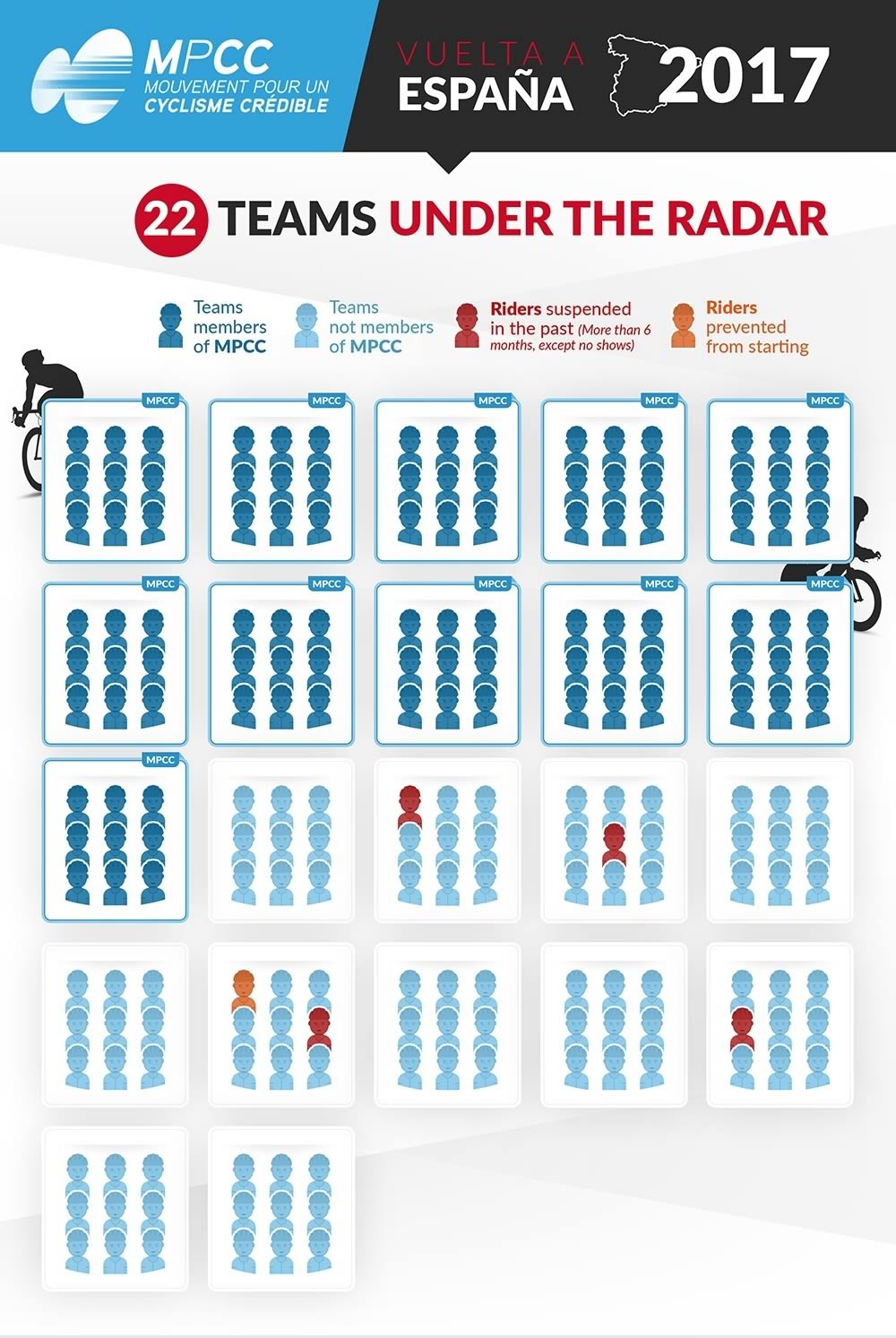
In an infography, we have represented the 2017 Vuelta a Espana peloton, distinguishing member teams and non-member teams of MPCC. Amongst member teams, no riders have ever been suspended. Within non-members, 5 already have!
In the event of every grand tour race or big championships, the Mouvement Pour un Cyclisme Crédible (MPCC) highlights how many riders are part of the movement but also how many riders have been suspended for doping in the past.
The spirit of the MPCC is to regroup teams which on a voluntary basis define stricter rules than international organizations. Amongst those, this one: « Don’t hire riders involved in doping cases and banned for more than 6 months, except no-shows, in the two years following the suspension. »
On the 2017 Vuelta a Espana, MPCC members chose not to pick any riders previously suspended for doping. This choice matches the philosophy of the movement, thus fostering cycling's credibility. There were 11 MPCC members on this year's Vuelta a Espana, representing half of the peloton.
Among the 198 riders who have started the race, four of them were suspended for doping in the past. They all took part in the Vuelta a Espana wearing the colors of non-MPCC members. A fifth rider have been prevented from starting the race because of a positive test just before Nimes' grand depart.
2017 Vuelta a Espana Infography
> See the Infography : 2016 Tour de France - 2017 Giro d'Italia - 2017 Tour de France <
Determination of cortisol on the Vuelta a España
The team members of the MPCC have submitted their riders to 99 cortisol level test on the Vuelta a España. All the riders have been allowed to start.
On the Vuelta a España, 11 member teams registered for the race submitted 99 riders to cortisol level tests as part of their commitment to the Movement for a Credible Cycling (MPCC).
These voluntary tests have been performed under the auspices of the Union Cycliste Internationale (UCI) on all participants. The UCI has forwarded to the MPCC the results of all riders of the member teams. All values were above the voluntary MPCC norm. The Board notes with satisfaction that the riders of these MPCC member teams registered for the Vuelta a España have scrupulously respected the clauses of their standing orders.
Background on cortisol tests by the Mouvement pour un Cyclisme Crédible (MPCC)
The objective of the MPCC and its member teams is to contribute to restoring the credibility of cycling. One of the organisation’s activities are voluntary cortisol tests amongst the riders of the member teams of the MPCC. In case the results of the test present an abnormally low value, the rider concerned will not race for a period of minimum eight days until the cortisol value has recovered again above that minimum value.
For the sake of clarity: it concerns a voluntary norm and the test does not concern an anti-doping control. Under WADA rules, athletes across all sports, with a cortisol level abnormally low, are entitled to perform their sport in competition (unless an anti-doping test has revealed the unauthorized use of the cortisol hormone).
The reason for the MPCC member teams to introduce this voluntary norm (below which the rider concerned will withdraw from competition for that minimum period of eight days), is an effort towards all stakeholders and fans of the sport of cycling and to confirm its commitment to clean sport and to show that cycling and MPCC member teams wish to be a frontrunner in that.
Why cortisol tests ?
Although cortisol hormones are an allowed medicine when pre-scribed by a physician, the use of that medicine has frequently been abused in the history of sports (including in cycling) for the purpose of increasing the performance. Besides, a low level of cortisol can potentially endanger the health of athletes in certain circumstances when he/she is in competition while the athletes perform under high intensity or under stress.
For both reasons and with the objective to contribute to restoring the credibility of cycling, the Mouvement pour un Cyclisme Crédible and its member teams have introduced that voluntary norm below which its riders will temporarily withdraw from competition.
Determination of cortisol on the Tour du Limousin
The team members of the MPCC have submitted 45 riders to a cortisol level test on the Tour du Limousin. All the riders have been allowed to start.
Before the third stage of the Tour du Limousin, 15 member teams registered for the race submitted 45 riders to a cortisol level test as part of their commitment to the Movement for a Credible Cycling (MPCC).
These voluntary tests have been performed in collaboration with French Cycling Association (FFC) and French Cycling League (LNC). All values were above the voluntary MPCC norm. The Board notes with satisfaction that the riders of these MPCC member teams registered for the Tour du Limousin have scrupulously respected the clauses of their standing orders.
Background on cortisol tests by the Mouvement pour un Cyclisme Crédible (MPCC)
The objective of the MPCC and its member teams is to contribute to restoring the credibility of cycling. One of the organisation’s activities are voluntary cortisol tests amongst the riders of the member teams of the MPCC. In case the results of the test present an abnormally low value, the rider concerned will not race for a period of minimum eight days until the cortisol value has recovered again above that minimum value.
For the sake of clarity: it concerns a voluntary norm and the test does not concern an anti-doping control. Under WADA rules, athletes across all sports, with a cortisol level abnormally low, are entitled to perform their sport in competition (unless an anti-doping test has revealed the unauthorized use of the cortisol hormone).
The reason for the MPCC member teams to introduce this voluntary norm (below which the rider concerned will withdraw from competition for that minimum period of eight days), is an effort towards all stakeholders and fans of the sport of cycling and to confirm its commitment to clean sport and to show that cycling and MPCC member teams wish to be a frontrunner in that.
Why cortisol tests ?
Although cortisol hormones are an allowed medicine when pre-scribed by a physician, the use of that medicine has frequently been abused in the history of sports (including in cycling) for the purpose of increasing the performance. Besides, a low level of cortisol can potentially endanger the health of athletes in certain circumstances when he/she is in competition while the athletes perform under high intensity or under stress.
For both reasons and with the objective to contribute to restoring the credibility of cycling, the Mouvement pour un Cyclisme Crédible and its member teams have introduced that voluntary norm below which its riders will temporarily withdraw from competition.
Determination of cortisol on the BinckBank Tour
The team members of the MPCC have submitted 33 riders to a cortisol level test on the BinckBank Tour. All the riders have been allowed to start in the 3rd stage.
Before the 3rd stage of the BinckBank Tour, 11 member teams registered for the race submitted 33 riders to a cortisol level test as part of their commitment to the Movement for a Credible Cycling (MPCC).
These voluntary tests have been performed in collaboration with the Royal Dutch Cycling Union (KNWU). All values were above the voluntary MPCC norm. The Board notes with satisfaction that the riders of these MPCC member teams registered for the BinckBank Tour have scrupulously respected the clauses of their standing orders.
Background on cortisol tests by the Mouvement pour un Cyclisme Crédible (MPCC)
The objective of the MPCC and its member teams is to contribute to restoring the credibility of cycling. One of the organisation’s activities are voluntary cortisol tests amongst the riders of the member teams of the MPCC. In case the results of the test present an abnormally low value, the rider concerned will not race for a period of minimum eight days until the cortisol value has recovered again above that minimum value.
For the sake of clarity: it concerns a voluntary norm and the test does not concern an anti-doping control. Under WADA rules, athletes across all sports, with a cortisol level abnormally low, are entitled to perform their sport in competition (unless an anti-doping test has revealed the unauthorized use of the cortisol hormone).
The reason for the MPCC member teams to introduce this voluntary norm (below which the rider concerned will withdraw from competition for that minimum period of eight days), is an effort towards all stakeholders and fans of the sport of cycling and to confirm its commitment to clean sport and to show that cycling and MPCC member teams wish to be a frontrunner in that.
Why cortisol tests ?
Although cortisol hormones are an allowed medicine when pre-scribed by a physician, the use of that medicine has frequently been abused in the history of sports (including in cycling) for the purpose of increasing the performance. Besides, a low level of cortisol can potentially endanger the health of athletes in certain circumstances when he/she is in competition while the athletes perform under high intensity or under stress.
For both reasons and with the objective to contribute to restoring the credibility of cycling, the Mouvement pour un Cyclisme Crédible and its member teams have introduced that voluntary norm below which its riders will temporarily withdraw from competition.
DOPING FIGURES AS AT 30 JUNE
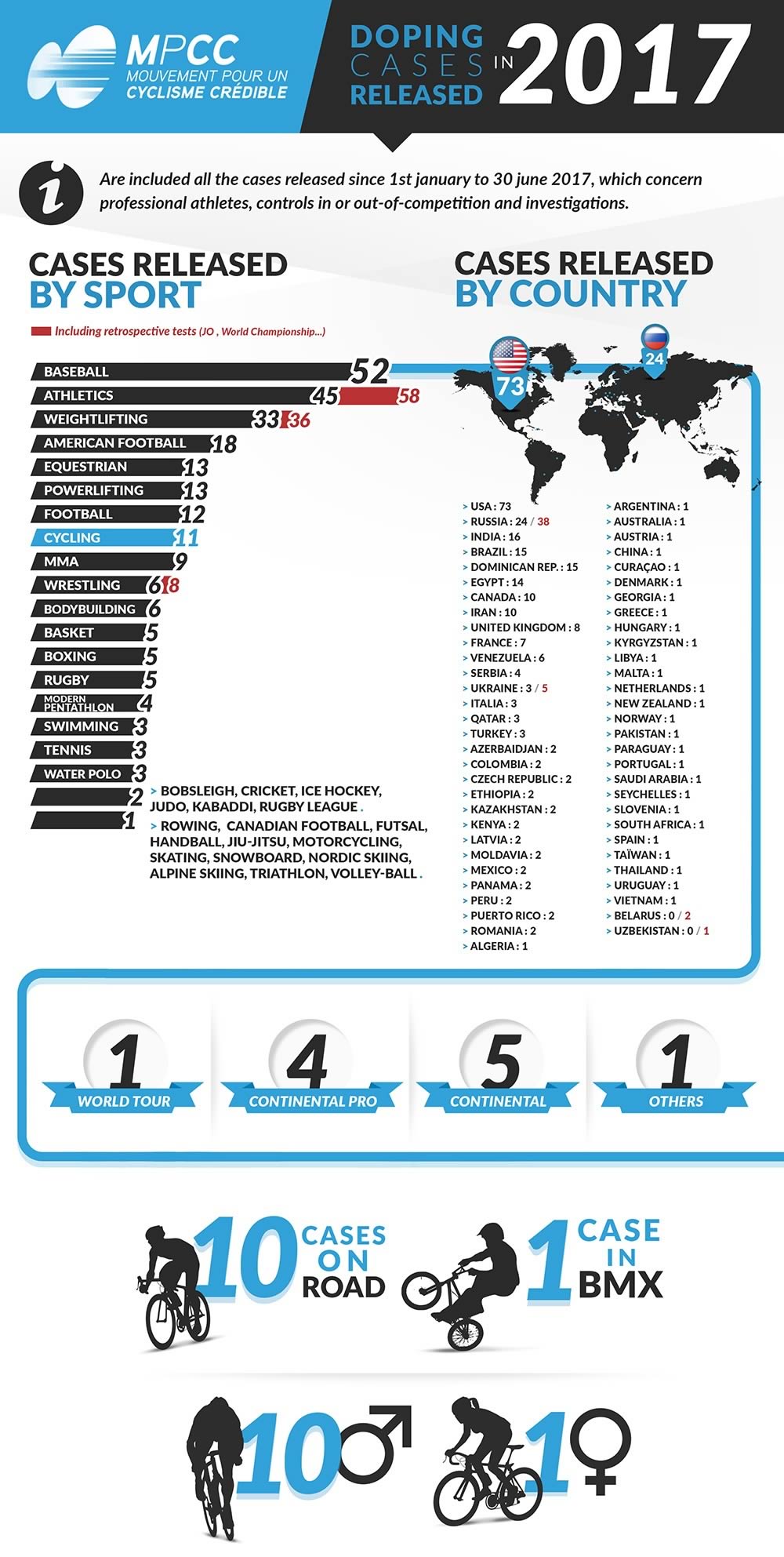
At the end of each quarter, MPCC lists the doping cases released sport by sport, in order to better situate the place cycling occupies in comparison to other sports. At mid-year, baseball, athletics and weightlifting lead the way.
The number of doping controls carried on in athletics or weightlifting still doesn't seem high enough to dissuade many cheaters. This remains true even if you exclude the samples retested by the WADA after a certain number of big events such as the World Championships or London and Beijing Olympic Games. Over the same period in 2016, the number of positive tests in athletics has almost doubled (45 vs 24) as it tripled in weightlifting (33 vs 12).
But the sport affected by the most important number of positive tests remains baseball : more than 50 cases after six months, total similar to last year. And this sport continues to give the athletes lower penalties than in the other sports which have really decided to fight against doping.
In the second quarter, cycling faced a sharp increase of provisional suspensions. 11 doping cases have been noted since the beginning of the season. Our sport is 8th in this sad ranking but we have to remind that over the same period in 2016, the number of positive tests was only 4.
Identifying cases of doping is not an easy task and is subject to discretion if required by their respective international federations, some do not advertise doping cases in their discipline. Cycling, in contrast, reveals each positive test. Our numbers are therefore based on proven cases in 2017, according to official communications federations and anti-doping agencies.
MPCC cycling counting includes:
- ROAD CYCLING: 10 Cases
- BMX : 1
- MTB : 0
- TRACK CYCLING : 0
DISCOVER THE DOPING CASES REVEALED
Cortisol level tests on the Tour de France
The team members of the MPCC have submitted their riders to 133 cortisol level test on the Tour de France. All the riders have been allowed to start.
On the Tour de France, 11 member teams registered for the race submitted their riders to cortisol level tests as part of their commitment to the Movement for a Credible Cycling (MPCC): 99 at the start in Düsseldorf, 34 in Marseille.
These voluntary tests have been performed under the auspices of the Union Cycliste Internationale (UCI) on all participants. The UCI has forwarded to the MPCC the results of all riders of the member teams. All values were above the voluntary MPCC norm. The Board notes with satisfaction that the riders of these MPCC member teams registered for the Tour de France have scrupulously respected the clauses of their standing orders.
Background on cortisol tests by the Mouvement pour un Cyclisme Crédible (MPCC)
The objective of the MPCC and its member teams is to contribute to restoring the credibility of cycling. One of the organisation’s activities are voluntary cortisol tests amongst the riders of the member teams of the MPCC. In case the results of the test present an abnormally low value, the rider concerned will not race for a period of minimum eight days until the cortisol value has recovered again above that minimum value.
For the sake of clarity: it concerns a voluntary norm and the test does not concern an anti-doping control. Under WADA rules, athletes across all sports, with a cortisol level abnormally low, are entitled to perform their sport in competition (unless an anti-doping test has revealed the unauthorized use of the cortisol hormone).
The reason for the MPCC member teams to introduce this voluntary norm (below which the rider concerned will withdraw from competition for that minimum period of eight days), is an effort towards all stakeholders and fans of the sport of cycling and to confirm its commitment to clean sport and to show that cycling and MPCC member teams wish to be a frontrunner in that.
Why cortisol tests ?
Although cortisol hormones are an allowed medicine when pre-scribed by a physician, the use of that medicine has frequently been abused in the history of sports (including in cycling) for the purpose of increasing the performance. Besides, a low level of cortisol can potentially endanger the health of athletes in certain circumstances when he/she is in competition while the athletes perform under high intensity or under stress.
For both reasons and with the objective to contribute to restoring the credibility of cycling, the Mouvement pour un Cyclisme Crédible and its member teams have introduced that voluntary norm below which its riders will temporarily withdraw from competition.
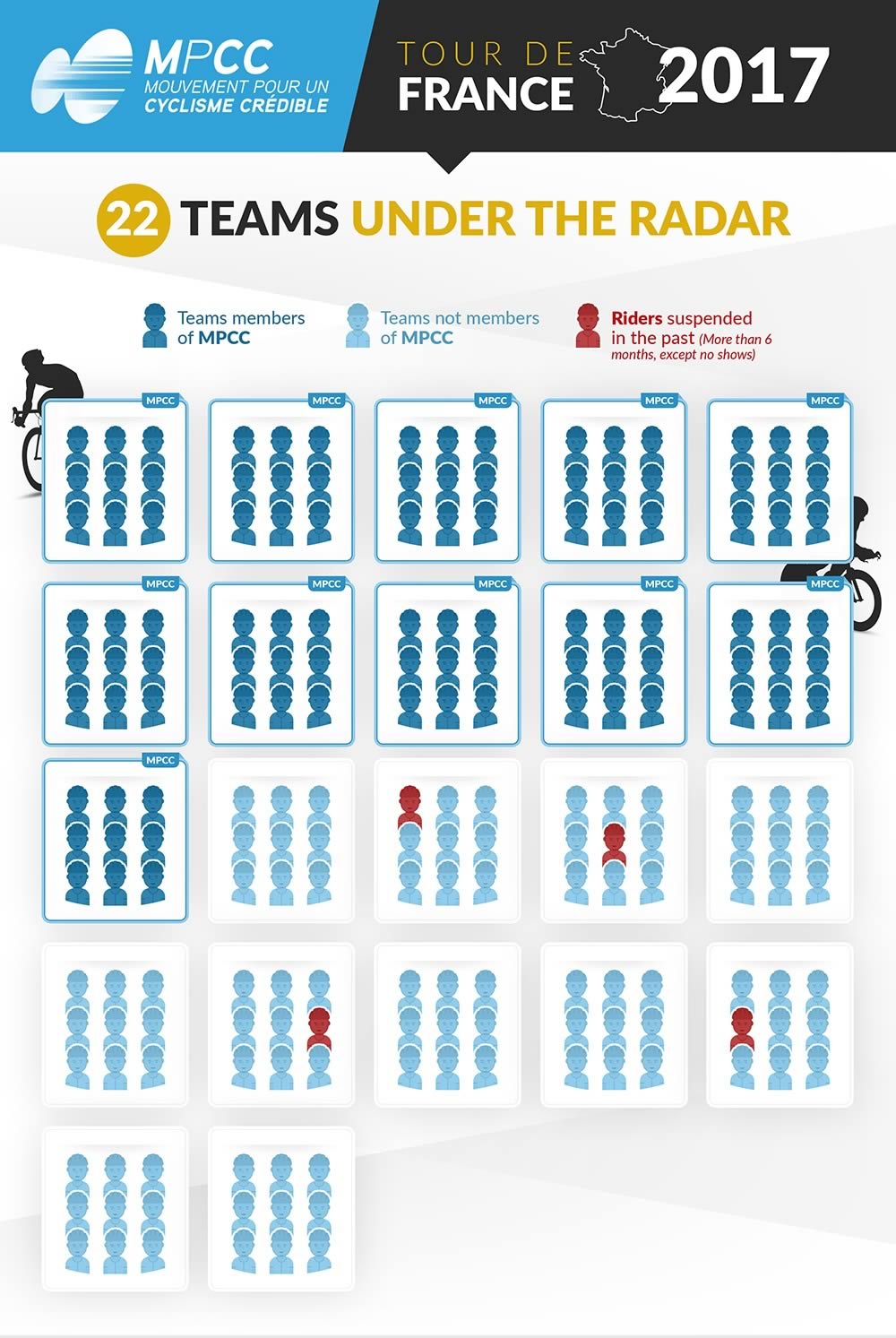
Tour de France : 22 TEAMS UNDER THE RADAR
In an infography, we have represented the 2017 Tour de France peloton, distinguishing member teams and non-member teams of MPCC. Amongst member teams, no riders have ever been suspended. Within non-members, 4 already have!
In the event of every grand tour race or big championships, the Mouvement Pour un Cyclisme Crédible (MPCC) highlights how many riders are part of the movement but also how many riders have been suspended for doping in the past.
The spirit of the MPCC is to regroup teams which on a voluntary basis define stricter rules than international organizations. Amongst those, this one: « Don’t hire riders involved in doping cases and banned for more than 6 months, except no-shows, in the two years following the suspension. »
On the 2017 Tour de France, MPCC members chose not to pick any riders previously suspended for doping. This choice matches the philosophy of the movement, thus fostering cycling's credibility. Like last year, there were 11 MPCC members on this year's Tour de France, representing half of the peloton.
Among the 198 riders who have started the race, four of them were suspended for doping in the past. They all took part in the Tour de France wearing the colors of non-MPCC members. Though, this figure is a sort of an improvement : last year, there were six of them !
2017 Tour de France Infography
> See the Infography : 2016 Tour de France - 2017 Giro d'Italia <
PRESS RELEASE OF 26 JUNE 2017
The MPCC regrets that the organizers of the Giro d'Italia decided to keep inviting teams that aren't part of our movement. The Tour de France and the Vuelta committed to our philosophy and never had any regrets so far.
The UCI has just giver a 30 days suspension to team BARDIANI, thus forbidding it to take part into races until July 14th. This sanction is a consequence of the exclusion of 2 of its riders at the eve of the Giro start, after their positive doping controls. Nevertheless, the Italian team was still given the go to race the Giro d'Italia, despite the discredit they were brought upon.
On the 7th of June, at the last MPCC board, Roger Legeay reminded that in January 2014, he met with the organizers of the Giro and highlighted that it was necessary to give the priority to MPCC members when it came to delivering wild cards.
Even though the organizers of Grand Tours must invite all of the World Tour teams (7 out of 18 are MPCC members), they are free to invite any Pro Continental team (19 out of 22 are MPCC members).
Last october, at the Tour de France 2017 unveiling, Christian Prudhomme (A.S.O) reminded that he was very committed to the MPCC's philosophy and that he only wanted to MPCC Pro Continental teams for wildcards on the races he organizes.
On the other hand, the organizers of the Giro d'Italia - RCS - invited 3 Pro Continental teams that chose not to commit to - or to step out of - the MPCC's most strict rules which main purpose is to strenghten the credibility of our sport.
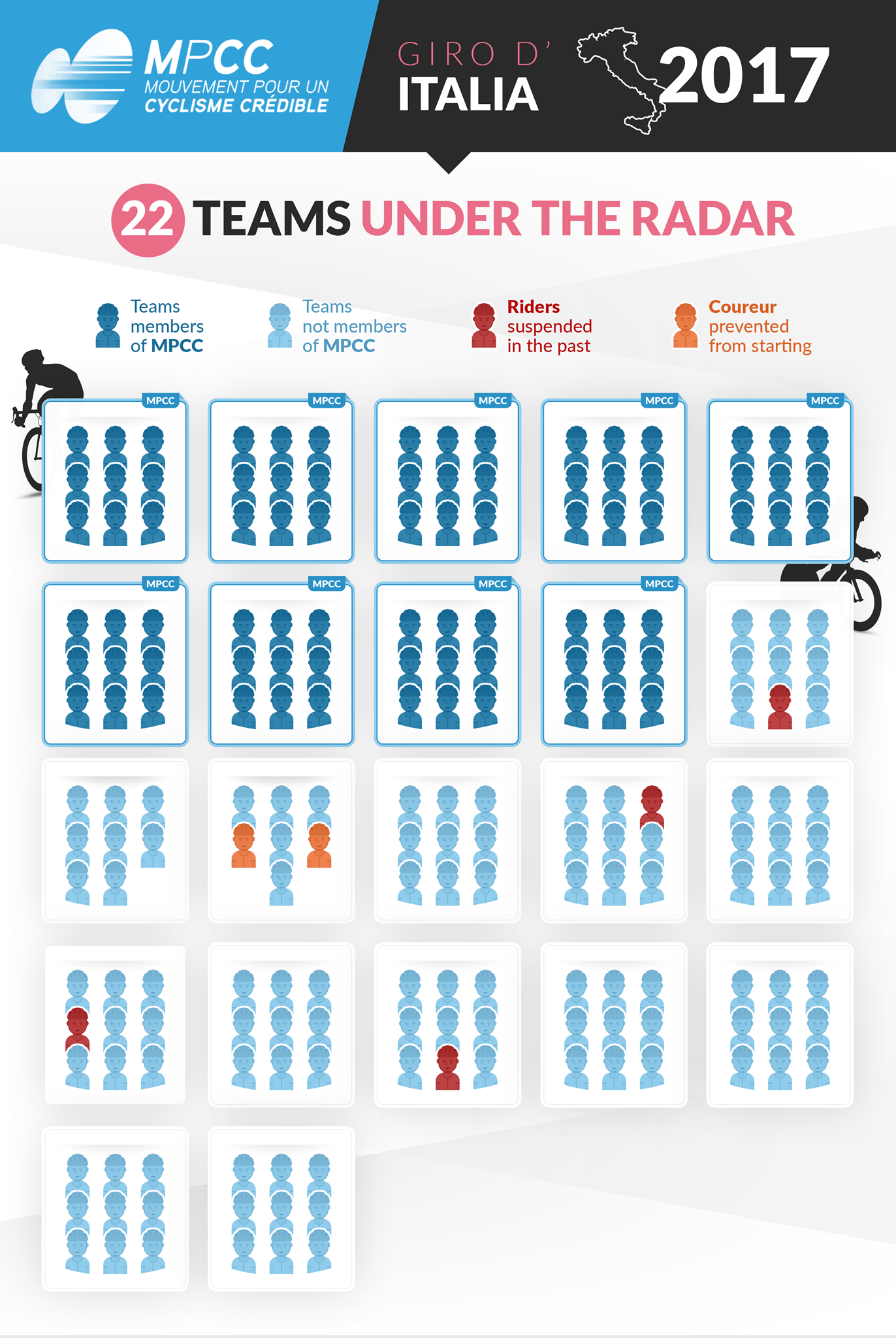
On this infographic, one can notice that riders chosen by the MPCC teams have a significant impact regarding the prestige of a race like the Giro d'Italia. These choices creates a contrast among all the riders at the start of this 100th edition.
In a letter to Mauro VEGNI, Roger Legeay reaffirmed his wish to see RCS join the MPCC in the near future, thus enabling us to work together towards the same goal : the credibility of our sports and its beautiful competitions.
DOCUMENTS :