

Giro: 22 teams under the microscope
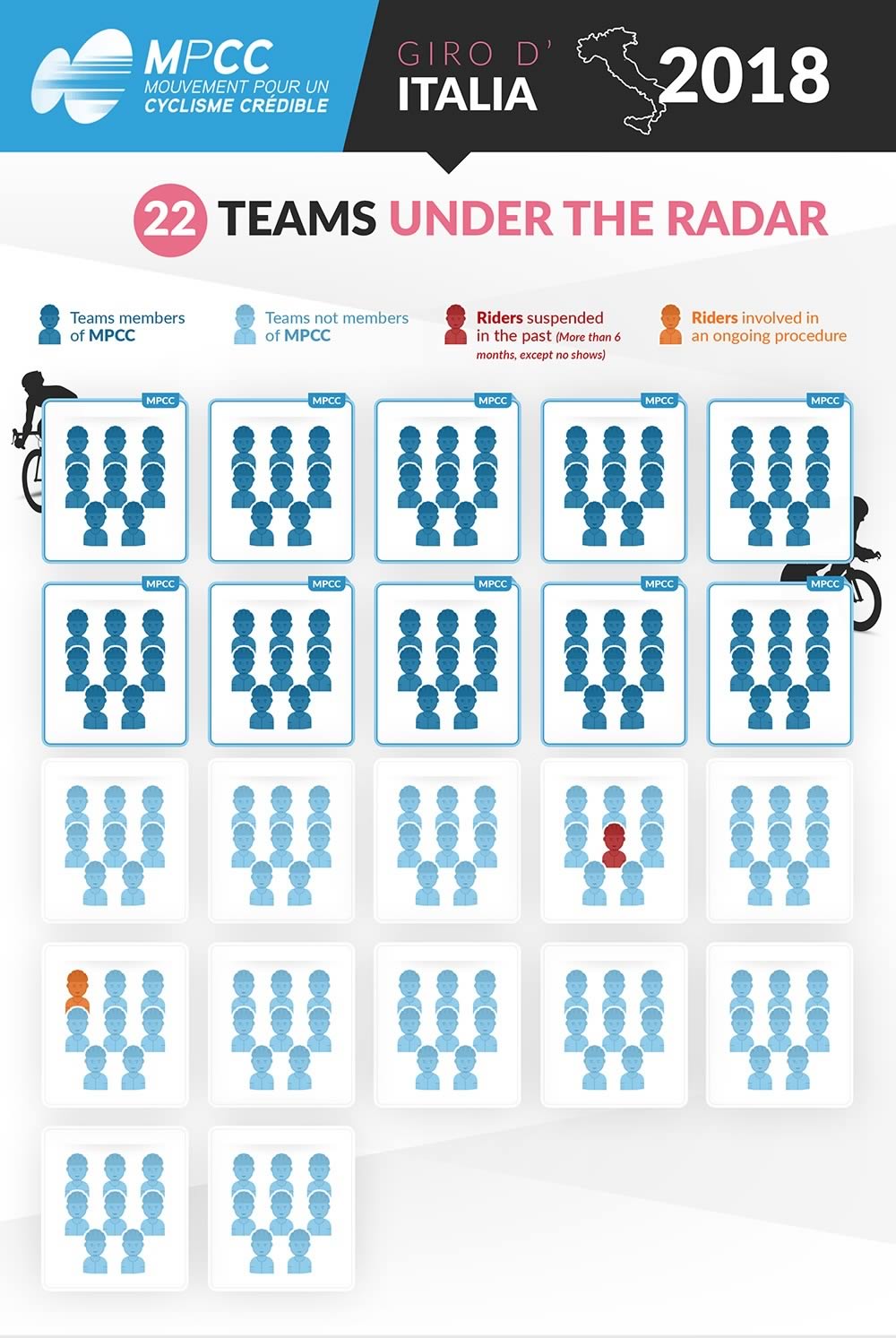
In an infography, we have represented the 2018 Giro d'Italia peloton, distinguishing MPCC member teams and non-member teams. Amongst member teams, no rider have ever been suspended. Within non-members, 1 already have and 1 is involved in an ongoing procedure!
In the event of every grand tour race or big championships, the Mouvement Pour un Cyclisme Crédible (MPCC) highlights how many riders are part of the movement but also how many riders have been suspended for doping in the past.
The spirit of the MPCC is to regroup teams which on a voluntary basis define stricter rules than international organizations. Amongst those, this one: « Don’t hire riders involved in doping cases and banned for more than 6 months, except no-shows, in the two years following the suspension. »
On the 2018 Giro d'Italia, MPCC members chose not to pick any riders previously suspended for doping. This choice matches the philosophy of the movement, thus fostering cycling's credibility. There are 10 MPCC members on this year's Giro d'Italia, representing 45% of the peloton.
Among the 176 riders who have started the race, one of them was suspended for doping in the past. He took part in the Giro d'Italia wearing the colors of a non-MPCC team. An other rider has not been prevented from starting the race in spite of being involved in an ongoing procedure.
2018 Giro d'Italia Infography
> See the Infography : 2016 Tour de France - 2017 Giro d'Italia - 2017 Tour de France - 2017 Vuelta a Espana

Cortisol level tests on the Giro d'Italia
10 team members of the MPCC have submitted80 riders to cortisol level tests on the Giro d'Italia. All the riders have been allowed to start.
On the Giro d'Italia, 10 member teams registered for the race submitted 80 riders to cortisol level tests as part of their commitment to the Movement for a Credible Cycling (MPCC).
These voluntary tests have been performed under the auspices of the Union Cycliste Internationale (UCI) on all participants. The UCI has forwarded to the MPCC the results of all riders of the member teams. All values were above the voluntary MPCC norm. The Board notes with satisfaction that the riders of these MPCC member teams registered for the Giro d'Italia have scrupulously respected the clauses of their standing orders, as was already the case on Paris-Nice, Circuit de la Sarthe and Paris-Roubaix.
Background on cortisol tests by the Mouvement pour un Cyclisme Crédible (MPCC)
The objective of the MPCC and its member teams is to contribute to restoring the credibility of cycling. One of the organisation’s activities are voluntary cortisol tests amongst the riders of the member teams of the MPCC. In case the results of the test present an abnormally low value, the rider concerned will not race for a period of minimum eight days until the cortisol value has recovered again above that minimum value.
For the sake of clarity: it concerns a voluntary norm and the test does not concern an anti-doping control. Under WADA rules, athletes across all sports, with a cortisol level abnormally low, are entitled to perform their sport in competition (unless an anti-doping test has revealed the unauthorized use of the cortisol hormone).
The reason for the MPCC member teams to introduce this voluntary norm (below which the rider concerned will withdraw from competition for that minimum period of eight days), is an effort towards all stakeholders and fans of the sport of cycling and to confirm its commitment to clean sport and to show that cycling and MPCC member teams wish to be a frontrunner in that.
Why cortisol tests ?
Although cortisol hormones are an allowed medicine when pre-scribed by a physician, the use of that medicine has frequently been abused in the history of sports (including in cycling) for the purpose of increasing the performance. Besides, a low level of cortisol can potentially endanger the health of athletes in certain circumstances when he/she is in competition while the athletes perform under high intensity or under stress.
For both reasons and with the objective to contribute to restoring the credibility of cycling, the Mouvement pour un Cyclisme Crédible and its member teams have introduced that voluntary norm below which its riders will temporarily withdraw from competition.
Cortisol level tests on Paris-Roubaix
The team members of the MPCC have submitted 42 riders to a cortisol level test on Paris-Roubaix. All the riders have been allowed to start.
On Paris-Roubaix's eve, 13 member teams registered for the race submitted 42 riders to a cortisol level test as part of their commitment to the Movement for a Credible Cycling (MPCC).
These voluntary tests have been performed in collaboration with French Cycling Association (FFC) and French Cycling League (LNC). All values were above the voluntary MPCC norm. The Board notes with satisfaction that the riders of these MPCC member teams registered for Paris-Roubaix have scrupulously respected the clauses of their standing orders.
Background on cortisol tests by the Mouvement pour un Cyclisme Crédible (MPCC)
The objective of the MPCC and its member teams is to contribute to restoring the credibility of cycling. One of the organisation’s activities are voluntary cortisol tests amongst the riders of the member teams of the MPCC. In case the results of the test present an abnormally low value, the rider concerned will not race for a period of minimum eight days until the cortisol value has recovered again above that minimum value.
For the sake of clarity: it concerns a voluntary norm and the test does not concern an anti-doping control. Under WADA rules, athletes across all sports, with a cortisol level abnormally low, are entitled to perform their sport in competition (unless an anti-doping test has revealed the unauthorized use of the cortisol hormone).
The reason for the MPCC member teams to introduce this voluntary norm (below which the rider concerned will withdraw from competition for that minimum period of eight days), is an effort towards all stakeholders and fans of the sport of cycling and to confirm its commitment to clean sport and to show that cycling and MPCC member teams wish to be a frontrunner in that.
Why cortisol tests ?
Although cortisol hormones are an allowed medicine when pre-scribed by a physician, the use of that medicine has frequently been abused in the history of sports (including in cycling) for the purpose of increasing the performance. Besides, a low level of cortisol can potentially endanger the health of athletes in certain circumstances when he/she is in competition while the athletes perform under high intensity or under stress.
For both reasons and with the objective to contribute to restoring the credibility of cycling, the Mouvement pour un Cyclisme Crédible and its member teams have introduced that voluntary norm below which its riders will temporarily withdraw from competition.
Cortisol level tests on the Circuit de la Sarthe
The team members of the MPCC have submitted 45 riders to a cortisol level test on the Circuit de la Sarthe. All the riders have been allowed to start.
Just before the Circuit de la Sarthe's second stage, 15 member teams registered for the race submitted 45 riders to a cortisol level test as part of their commitment to the Movement for a Credible Cycling (MPCC).
These voluntary tests have been performed in collaboration with French Cycling Association (FFC) and French Cycling League (LNC). All values were above the voluntary MPCC norm. The Board notes with satisfaction that the riders of these MPCC member teams registered for the Circuit de la Sarthe have scrupulously respected the clauses of their standing orders.
Background on cortisol tests by the Mouvement pour un Cyclisme Crédible (MPCC)
The objective of the MPCC and its member teams is to contribute to restoring the credibility of cycling. One of the organisation’s activities are voluntary cortisol tests amongst the riders of the member teams of the MPCC. In case the results of the test present an abnormally low value, the rider concerned will not race for a period of minimum eight days until the cortisol value has recovered again above that minimum value.
For the sake of clarity: it concerns a voluntary norm and the test does not concern an anti-doping control. Under WADA rules, athletes across all sports, with a cortisol level abnormally low, are entitled to perform their sport in competition (unless an anti-doping test has revealed the unauthorized use of the cortisol hormone).
The reason for the MPCC member teams to introduce this voluntary norm (below which the rider concerned will withdraw from competition for that minimum period of eight days), is an effort towards all stakeholders and fans of the sport of cycling and to confirm its commitment to clean sport and to show that cycling and MPCC member teams wish to be a frontrunner in that.
Why cortisol tests ?
Although cortisol hormones are an allowed medicine when pre-scribed by a physician, the use of that medicine has frequently been abused in the history of sports (including in cycling) for the purpose of increasing the performance. Besides, a low level of cortisol can potentially endanger the health of athletes in certain circumstances when he/she is in competition while the athletes perform under high intensity or under stress.
For both reasons and with the objective to contribute to restoring the credibility of cycling, the Mouvement pour un Cyclisme Crédible and its member teams have introduced that voluntary norm below which its riders will temporarily withdraw from competition.
More than 60 riders are now members of the MPCC!
Less than one month after having allowed professional riders to adhere to the MPCC, whether or not they are part of teams that are members of the movement, we can now announced that more than 60 riders - with nearly half are World Tour riders - have sent their membership request.
Thanks to those adhesions - which are free - the MPCC will have the opportunity to go even further:
- Organising an annual MPCC/riders meeting
- Making it possible for the member riders group to have a voting right at general meetings
- Studying their proposals in order to give credibility to cycling’s image
In return, the rider will have to join the MPCC’s philosophy, promote cycling’s image by fighting against any form of doping and cheat, and respect the movement’s internal regulation, especially regarding corticoids and tramadol’s use.

Dear riders, come and join the MPCC on your behalf!
Subscriptions are open to any rider from World Tour teams, Continental Pro Teams, Continental Teams or UCI Women teams, whether their team is part of the MPCC or not. They will be regularly informed of the Movement’s activities and will receive the meeting’s minutes but the main objective is to go even further:
- Organising an annual MPCC/riders meeting
- Making it possible for the member riders group to have a voting right at general meetings
- Studying their proposals in order to give credibility to cycling’s image
In return, the rider will have to join the MPCC’s philosophy, promote cycling’s image by fighting against any form of doping and cheat, and respect the movement’s internal regulation, especially regarding corticoids and tramadol’s use.
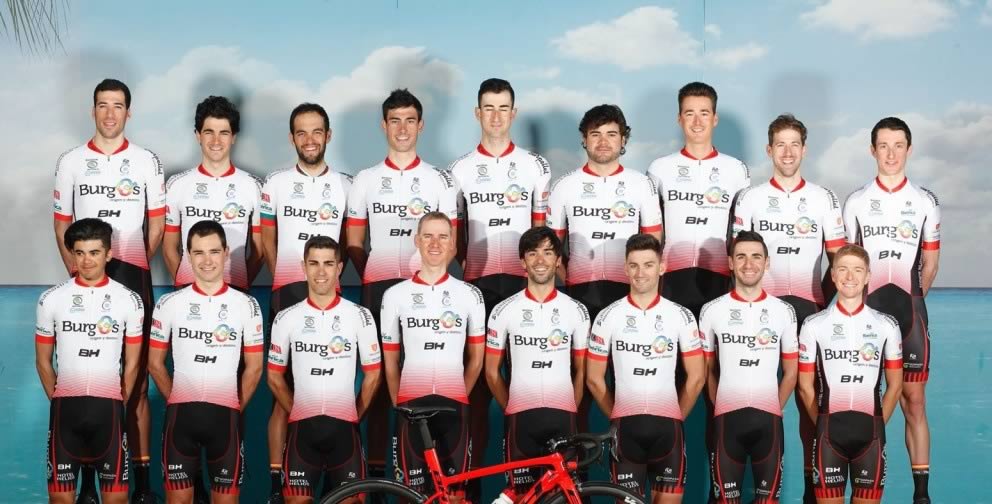
Pro Continental team Burgos-BH joins the MPCC!
The Spanish team Burgos-BH joins the MPCC! There are now 23 Pro Continental teams committed to the movement.
This season, Burgos-BH has been promoted to the UCI Pro Continental ranks, while celebrating more than 35 years of existence. The adhesion of the team, on a provisional basis, allows the MPCC to reach a total of 30 member teams that are part of the first and second divisions!
Julio Andrés's team roster includes some riders who have raced at the World Tour level, such as Matvey Mamykin, Silvio Herklotz or José Mendes. The referring physician is Dr Gonzalo Barrantes Delgado.
The team manager comments:
"We started a new project in 2018 but the philosophy is to think in long term. We wish to develop a new professional continental team working with young talents. We are working in order to be more professional. The change in the category means the change in a lot of our structures. If we are honest, we worked as professional but as amateur team in the past. Now, it is not possible to continue with this system and we are growing in the different areas. In this way, we wish to be absolutely strict about the antidoping fight:
- We have signed one doctor with an excellent reputation. He was never linked with doping problems and he has an absolutely clean mentality.
- We didn't sign riders with doping cases in the past.
- We are not going to accept any antidoping rules violation. All the riders know that there are no pressure on the performances or the results. But there is a big pressure on the antidoping mentality: we need clean riders every day in the year.
- We wish to be a member of the MPCC. Cycling has to offer the best image. And this is a global responsibility. We don't have any problem to do controls of cortisol, for example. If one rider is sick, he can take medicines. But it has no sense to run. If one rider is tested positive, maybe he can run in legal point of view. But it has no sense to destroy the cycling image. It is our responsibility and we accept and we understand that ALL the professional teams have to go in the same direction."
Cortisol level tests on Paris-Nice
The team members of the MPCC have submitted 33 riders to a cortisol level test on Paris-Nice. All the riders have been allowed to start.
On the start of Paris-Nice's 7th stage, 11 member teams registered for the race submitted 33 riders to a cortisol level test as part of their commitment to the Movement for a Credible Cycling (MPCC).
These voluntary tests have been performed in collaboration with French Cycling Association (FFC) and French Cycling League (LNC). All values were above the voluntary MPCC norm. The Board notes with satisfaction that the riders of these MPCC member teams registered for Paris-Nice have scrupulously respected the clauses of their standing orders.
Background on cortisol tests by the Mouvement pour un Cyclisme Crédible (MPCC)
The objective of the MPCC and its member teams is to contribute to restoring the credibility of cycling. One of the organisation’s activities are voluntary cortisol tests amongst the riders of the member teams of the MPCC. In case the results of the test present an abnormally low value, the rider concerned will not race for a period of minimum eight days until the cortisol value has recovered again above that minimum value.
For the sake of clarity: it concerns a voluntary norm and the test does not concern an anti-doping control. Under WADA rules, athletes across all sports, with a cortisol level abnormally low, are entitled to perform their sport in competition (unless an anti-doping test has revealed the unauthorized use of the cortisol hormone).
The reason for the MPCC member teams to introduce this voluntary norm (below which the rider concerned will withdraw from competition for that minimum period of eight days), is an effort towards all stakeholders and fans of the sport of cycling and to confirm its commitment to clean sport and to show that cycling and MPCC member teams wish to be a frontrunner in that.
Why cortisol tests ?
Although cortisol hormones are an allowed medicine when pre-scribed by a physician, the use of that medicine has frequently been abused in the history of sports (including in cycling) for the purpose of increasing the performance. Besides, a low level of cortisol can potentially endanger the health of athletes in certain circumstances when he/she is in competition while the athletes perform under high intensity or under stress.
For both reasons and with the objective to contribute to restoring the credibility of cycling, the Mouvement pour un Cyclisme Crédible and its member teams have introduced that voluntary norm below which its riders will temporarily withdraw from competition.
2018/03/06 Press Release
29 out of the 45 first and second division’s teams are members of the Mouvement Pour un Cyclisme Crédible (MPCC). This is a big part of the international peloton. Many of them are first class riders, including world champion Peter Sagan, Giro d’Italia winner Tom Dumoulin, and 2nd and 3rd of the last Tour de France: Rigoberto Uran and Romain Bardet.
All the MPCC team members commit on a voluntary basis to “take responsibility for withdrawing immediately from a race a rider that would receive the first advise of a positive or abnormal control”.
On the 18th of December 2017, following the announcement of 4 times Tour de France winner Chris Froome’s abnormal control, the MPCC and its board asked Team Sky to “immediately suspend the rider until the end of the procedure, without waiting for the final decision. That would help both the rider and the team to implement a defence strategy with serenity, avoiding any irritation coming from other staffs and riders.”
Team Sky chose not to suspend its rider until the end of the procedure as Christopher Froome took part in the Ruta del Sol’s first stage on the 14th of February.
The MPCC takes full notice of this decision from team Sky.
The MPCC also takes full notice of the Ruta del Sol’s organizers’ decision to welcome Chris Froome warmly.
The board formally asks UCI and WADA for a standardization of the procedures and that a rider facing a pending antidoping enquiry should have to stop racing systematically. The MPCC also recalls its requests for a ban of the corticosteroids and tramadol use in competition.
In order to maintain cycling’s image and credibility, it is of great importance that when facing the situation of a positive or abnormal antidoping control result, the procedure remains the same whether the rider is part of a MPCC team or not.
Waiting for a change in the official rules, the board presently asks the UCI to change its World Tour rules: organizers should be able to exclude from their races a rider that would be facing a pending enquiry following a positive or abnormal control.
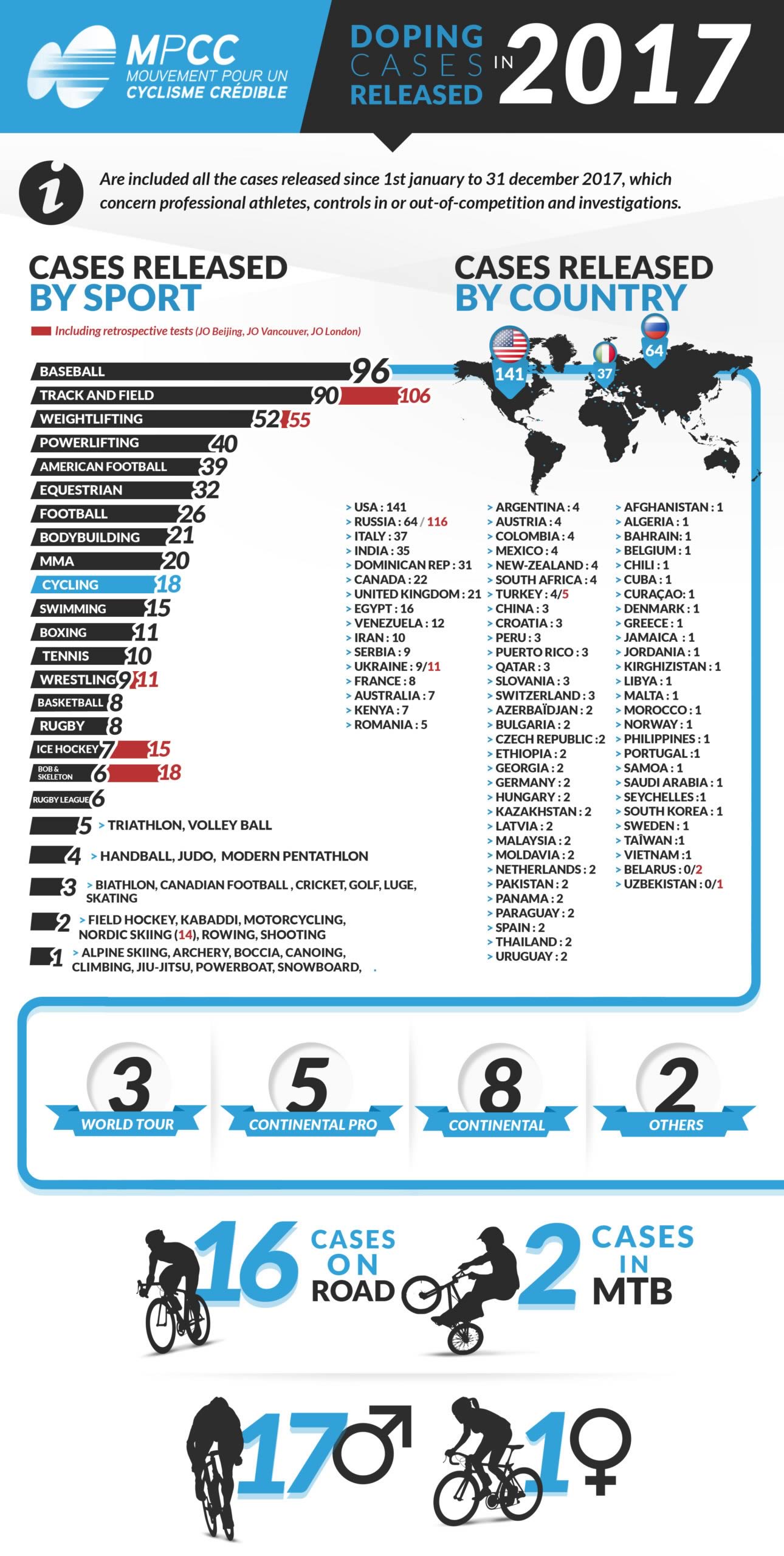
ROAD CYCLING: INCREASE IN THE NUMBER OF DOPING CASES IN YEAR 2017
In 2017, 3 more doping cases than in 2016 were revealed. Even if this is a small increase, it particularly involves the world’s best cyclists. </strong></span><strong>Compared to 2016, 1st and 2nd division’s teams are far more concerned: 8 cases in 2017 vs only 3 in 2016.
This evolution sheds light on a strange paradox: cycling had never been so badly ranked in this “worst classification” (10th position) while in the same time, the number of pro riders-related revealed cases is back to rising.
From a general point of view, the number of revealed doping cases in sport has been constantly increasing during the last years. The most affected sports (baseball, track and field…) kept the same trend in 2017. This is the case of weightlifting that almost doubled its 2016 score (52 cases vs 26 in 2016), without even including the athletes that were recently sanctioned after the reanalysis of their samples of the Beijing and London Olympics (half of the identified positive samples concerned weightlifters).
Some federations that previously had been quite discrete regarding antidoping fight decided to step up efforts and communication around that problem. Therefore, some sports that faced just a few doping cases in the past emerge in this classification, some of them are surprisingly well ranked. This is the case of MMA (Free Fight), equestrian and Tennis (10 cases in 2017 vs only 1 in 2016!).
Within this context, cycling has managed to keep quite stable figures just like other sports such as swimming and boxing, thanks to experienced and well-known antidoping measures and transparency. However, as many cases coming from the amateur world were revealed in those sports in 2017, we should still analyse those figures with caution.
The most affected sports countries would like to be part of the “best students” too. Currently waiting for an IOC rehabilitation, Russia revealed more than 60 cases in 2017 (3 times more than the year before). Nevertheless, USA still sanctioned more than twice as many cheaters - even if most of them competed in non-Olympic sports.