
Credibility figures as at 31 August
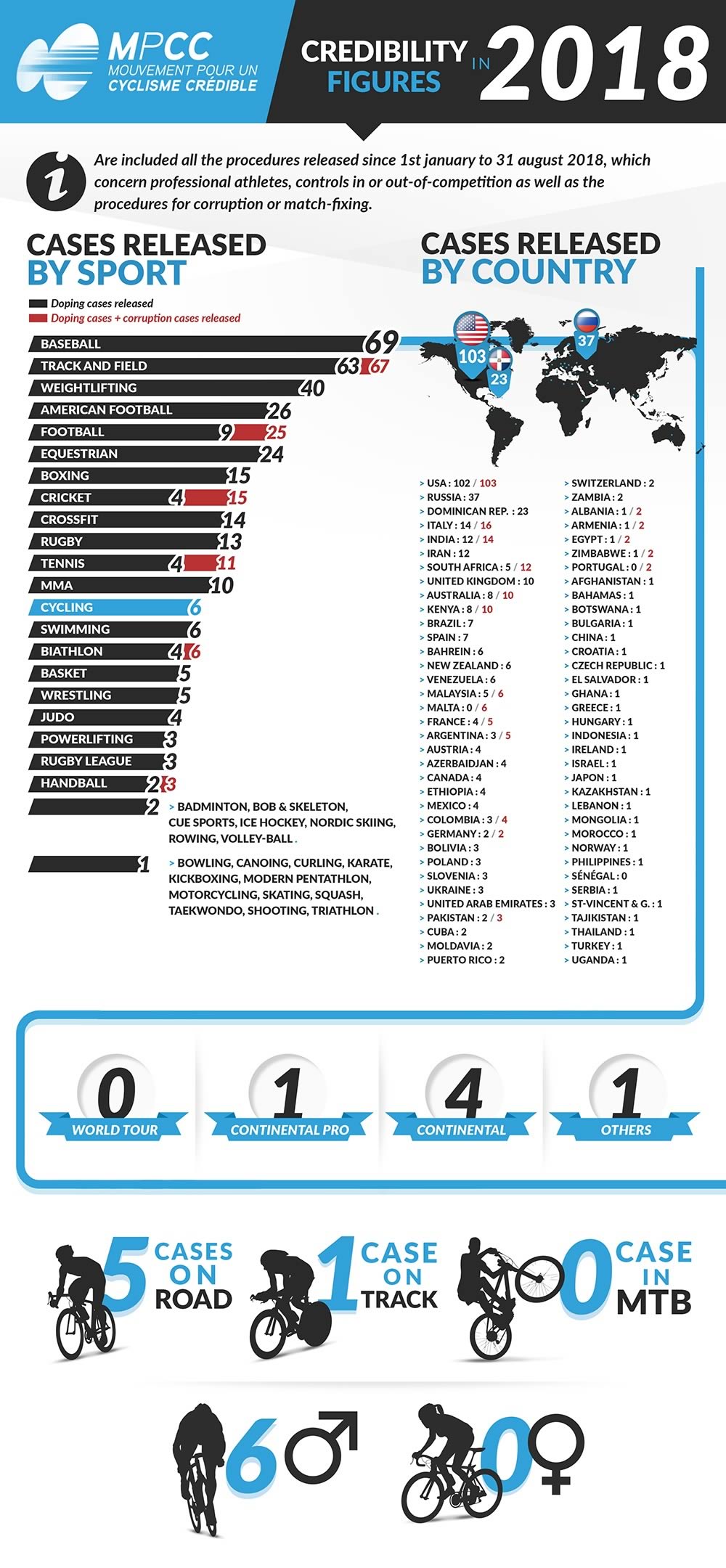
380 cases of doping, fraud or corruption have already been revealed this year in the world of sport on the highest level. Among them, only 6 concerned cycling.
With cycling ranking 13th "Credibility Ranking", riders can be genuinely surprised to still be the targets of so many negative comments regarding their image. These comments are not really due to the number of doping cases revealed this year, but probably more to the sole case concerning Chris Froome. This case has been subject to a lot of media attention until the UCI dismissed it 5 days prior to Le Tour de France.
As of today, 6 professional cyclists are linked to ongoing procedures concerning suspected doping : 3 in Europe, 3 in Latin America. None of them involves a World Tour rider, a women, or a mountain bike rider. This number is smaller than last year (10 less cases on the same date) but we still need to be careful on drawing any conclusion. In 2017, there were 7 cases at the end of August and 15 at the end of the year (14 eventually, given that Froome was not convicted). Cautiousness is required too when it comes to the nature of the detected substances : in two cases out of six, EPO usage has been detected.
Out of cycling, the nations and sports involved in doping revelations have been the same for a few years. Dominican Republic leads the way with 23 doping cases, all of them involving baseball players. Crossfit makes a sensational entrance into our classification. This new sport is now well aware that a big clean-up among his practitioners is an urgent issue. The 14 cases registered in only a few weeks prove that their testing methods are efficient!
Corruption, fraud and match-fixing also have their favorite sports, and they are not always the same as in doping : football, cricket and tennis account for more than 80% of the revelations in 2018.


Press Release - 17th September 2018
The Board of the MPCC met in Roissy on September 13th to analyze the events that occured prior to Le Tour de France. The main focus was on Chris Froome's abnormal control, a procedure that came to an end only a few days before the start of the race.
The Movement highlight the urgent nature of its previous suggestions to WADA regarding the principle of automatic non-active status in case of an ongoing procedure concerning a positive or abnormal control to a specified substance or a non-specified substance.
It has been 12 years now that the Movement has been commited to these rules on a voluntary basis, with the same purpose as before : promoting transparency, and thus the image and health of the riders, but also the image of the teams and, as a whole, the image of cycling.
The MPCC reminds all the teams involved in such cases and who are not part of the movement that nothing prevents them from making the choice of not to line a rider up on a race, no matter what the antidoping rules currently are.
The MPCC also hopes that the Union Cycliste Internationale (UCI) will endorse in 2019 its project regarding new regulations for corticoids and tramadol. The Movement renews its request on this topic and wish to see these substance on the prohibited list.
The vigilance of the Movement and its members remains the same regarding the fight against mechanical doping. The success of this fight is essential for the credibility of our sport.
The MPCC commits itself to a process that aims at making cycling the most credible it can be on a global scale, meaning that it goes even further than the sole fight against doping, which was the core of the Movement when it was created in 2007.
The draft reforms of the Professional Cycling Council (PCC), planned for 2020, needs to be focused on the ethics and the credibility of cycling. The Movement has high hopes in the coming month and acknowledge the difficulty of the decision that needs to be taken, and will support any measures promoting credibility.
Finally, the Board is glad to see that, as of today, 261 riders have commited to the MPCC. Soon enough, the staff of all the teams (managers, directors, coaches, medical staff, etc) will be able to be part of the MPCC and embrace its philosophy.
More than 250 riders are now members of the MPCC!
Seven month after having allowed professional riders to adhere to the MPCC, whether or not they are part of teams that are members of the movement, we can now announced that more than 250 riders have sent their membership request.
Thanks to those adhesions - which are free - the MPCC has the opportunity to go even further:
- Organising an annual MPCC/riders meeting
- Making it possible for the member riders group to have a voting right at general meetings
- Studying their proposals in order to give credibility to cycling’s image
In return, the rider will have to join the MPCC’s philosophy, promote cycling’s image by fighting against any form of doping and cheat, and respect the movement’s internal regulation, especially regarding corticoids and tramadol’s use.
Cortisol level tests on the Vuelta a España
11 team members of the MPCC have submitted 87 riders to cortisol level tests on the Vuelta a España. All the riders have been allowed to start.
On the Vuelta a España, 11 member teams registered for the race submitted 87 riders to cortisol level tests as part of their commitment to the Movement for a Credible Cycling (MPCC) :
- AG2R La Mondiale
- Bora-Hansgrohe
- Groupama-FDJ
- Lotto-Soudal
- Dimension Data
- EF Education First-Drapac
- Sunweb
- Burgos-BH
- Caja Rural
- Cofidis
- Euskadi Murias
These voluntary tests have been performed under the auspices of the Union Cycliste Internationale (UCI) on all participants. The UCI has forwarded to the MPCC the results of all riders of the member teams. All values were above the voluntary MPCC norm. The Board notes with satisfaction that the riders of these MPCC member teams registered for the Vuelta a España have scrupulously respected the clauses of their standing orders, as was already the case on Paris-Nice, Circuit de la Sarthe, Paris-Roubaix, Giro d'Italia, 4 jours de Dunkerque and Tour de France.
Background on cortisol tests by the Mouvement pour un Cyclisme Crédible (MPCC)
The objective of the MPCC and its member teams is to contribute to restoring the credibility of cycling. One of the organisation’s activities are voluntary cortisol tests amongst the riders of the member teams of the MPCC. In case the results of the test present an abnormally low value, the rider concerned will not race for a period of minimum eight days until the cortisol value has recovered again above that minimum value.
For the sake of clarity: it concerns a voluntary norm and the test does not concern an anti-doping control. Under WADA rules, athletes across all sports, with a cortisol level abnormally low, are entitled to perform their sport in competition (unless an anti-doping test has revealed the unauthorized use of the cortisol hormone).
The reason for the MPCC member teams to introduce this voluntary norm (below which the rider concerned will withdraw from competition for that minimum period of eight days), is an effort towards all stakeholders and fans of the sport of cycling and to confirm its commitment to clean sport and to show that cycling and MPCC member teams wish to be a frontrunner in that.
Why cortisol tests ?
Although cortisol hormones are an allowed medicine when pre-scribed by a physician, the use of that medicine has frequently been abused in the history of sports (including in cycling) for the purpose of increasing the performance. Besides, a low level of cortisol can potentially endanger the health of athletes in certain circumstances when he/she is in competition while the athletes perform under high intensity or under stress.
For both reasons and with the objective to contribute to restoring the credibility of cycling, the Mouvement pour un Cyclisme Crédible and its member teams have introduced that voluntary norm below which its riders will temporarily withdraw from competition.
Cortisol level tests on the Tour de France (2)
11 team members of the MPCC have submitted 33 riders to cortisol level tests on the Tour de France. All the riders have been allowed to enter in the 9th stage.
On the Tour de France, 11 member teams registered for the race submitted 33 riders to cortisol level tests as part of their commitment to the Movement for a Credible Cycling (MPCC), before the start of the 9th stage.
These voluntary tests have been performed under the auspices of the Union Cycliste Internationale (UCI) on all participants. The UCI has forwarded to the MPCC the results of all riders of the member teams. All values were above the voluntary MPCC norm. The Board notes with satisfaction that the riders of these MPCC member teams registered for the Tour de France have scrupulously respected the clauses of their standing orders, as was already the case on Paris-Nice, Circuit de la Sarthe, Paris-Roubaix, the Giro d'Italia, the French National Championships and the start of the Tour de France in Vendée.
Background on cortisol tests by the Mouvement pour un Cyclisme Crédible (MPCC)
The objective of the MPCC and its member teams is to contribute to restoring the credibility of cycling. One of the organisation’s activities are voluntary cortisol tests amongst the riders of the member teams of the MPCC. In case the results of the test present an abnormally low value, the rider concerned will not race for a period of minimum eight days until the cortisol value has recovered again above that minimum value.
For the sake of clarity: it concerns a voluntary norm and the test does not concern an anti-doping control. Under WADA rules, athletes across all sports, with a cortisol level abnormally low, are entitled to perform their sport in competition (unless an anti-doping test has revealed the unauthorized use of the cortisol hormone).
The reason for the MPCC member teams to introduce this voluntary norm (below which the rider concerned will withdraw from competition for that minimum period of eight days), is an effort towards all stakeholders and fans of the sport of cycling and to confirm its commitment to clean sport and to show that cycling and MPCC member teams wish to be a frontrunner in that.
Why cortisol tests ?
Although cortisol hormones are an allowed medicine when pre-scribed by a physician, the use of that medicine has frequently been abused in the history of sports (including in cycling) for the purpose of increasing the performance. Besides, a low level of cortisol can potentially endanger the health of athletes in certain circumstances when he/she is in competition while the athletes perform under high intensity or under stress.
For both reasons and with the objective to contribute to restoring the credibility of cycling, the Mouvement pour un Cyclisme Crédible and its member teams have introduced that voluntary norm below which its riders will temporarily withdraw from competition.

June 22nd Press Release
One day after the announcement of an agenda that includes new anti-doping measures, the MPCC praises the UCI and its president Mr. David Lappartient for the strong decisions taken towards the credibility of cycling.
The Management Committee of the UCI has included in the medical field of its Agenda 2022 measures that will be implemented starting January 1st 2019:
- Cortisol controls leading to a minimum of eight days off work and competition in case of an anomaly
- Obligation to declare local infiltrations of glucocorticoids, leading to a minimum of eight days off work and competition.
- Tramadol ban
After 10 years of inertia on these topics on the World Anti-Doping Agency side, the MPCC congratulate the UCI and its president Mr. David Lappartient for the strong decision taken towards the credibility of cycling. The MPCC would also like to thank the managers, the riders and the doctors of the teams belonging to the movement, as they committed to these rules as soon as they joined. Together, they showed that a strict approach of the corticoids and the tramadol problem, on a voluntary basis, was possible, and they convinced the authorities to modify the rules of our sport.
Since MPCC was created, 3207 cortisol tests have been carried out by the movement. These tests will continue for the rest of the 2018 season. The movement reserves the right to keep carrying out these test in 2019 if its members consider that it is necessary to complement the UCI’s scheme to come. There are currently 7 teams out of 18 in the World Tour that are part of the MPCC, along with 24 Continental Pro, 8 Continental and 6 Women teams. Besides, 207 riders (male and females) are now members of the MPCC as individuals, less than 4 months after the individual membership has been made possible at the beginning of March.
Nevertheless, the MPCC asks again to the WADA, as an international independent organisation:
- To add Tramadol on the Prohibited List
- To confirm the principle of an automatic provisional suspension in the event of a positive or abnormal control
- To confirm the competition stoppage in case of glucocorticoids intake
In the meantime, the MPCC and its members will keep on committing to stricter rules than WADA’s ones, on a voluntary basis:
- Provisional suspension in case of abnormal or positive control
- Termination of contract when a rider is suspended for more than 6 months
- No signing of a rider that has been suspended for more than 6 months
- Introspection period (No competition for 8 days) for a team with two positive controls in the last 12 months, except if the UCI has already applied the same sanction.
All the teams, riders, organizers, national federations, sponsors who share the values of the MPCC are of course welcome to become members of the movement. The rules of the MPCC, applied on a voluntary basis, are a vital complement to the fight against doping and remain an essential tool for the credibility of cycling.

200 riders are now members of the MPCC
In only three months, MPCC has registered more than 200 subscriptions coming from pro riders, males and females.
On June 5th, during the last Critérium du Dauphiné, the Board held a meeting to validate these 200 first riders to join the movement: a list that we enjoy seeing get bigger and bigger every day. MPCC is also getting more and more international, with these new members coming from 27 countries, and employed by 35 different teams (male and female).
Our movement would like to thank all these riders for their commitment. They decided, on their own behalf, to assert their support for the ethical values of a credible cycling. Those who have not done it yet can join MPCC at any time, whatever their team - or their federation - position towards the movement. They just need to subscribe on our website. On this same link is the list, regularly updated, of all the riders who have already joined.
On the very beginning (in 2007), the movement was created by sport groups that now represent more than 60% of World Tour and Conti Pro Teams. Since then, national federations, sponsors, organizers, doctors, agents, sympathizers and riders have joined the MPCC. The riders will have te opportunity to elect their own representatives on the the next General Assembly in next october.
The Board is also very pleased to see that all of its rules have been strictly followed by all the members during the first half of the season. 254 cortisol test have been carried out in the member teams. No anomaly was detected among the riders who underwent these unannounced checks on a voluntary basis.
View the list of the 200 riders that are members of the MPCC

Interview with the UCI President David Lappartient
As a guest member, part of the Professional Cycling Council, the MPCC reached out to the UCI's president to do an interview regarding the stance of the UCI on various topics on which the MPCC has been engaged for a long time.
With David Lappartient, we have been able to talk about the ethics problems, his support towards the MPCC and several rules of the MPCC that the UCI would either like to include in its own regulations, or to promote them to the WADA to incorporate them in the World Anti-Doping Code.
More precisely, we focused on our common will to forbid the use of corticoids and tramadol during a competition, and our wish to see the provisional ban automatic when it comes to a positive or abnormal control of a rider.
We warmly thank David Lappartient for his time and his answers to our questions.
You may watch the whole interview here :

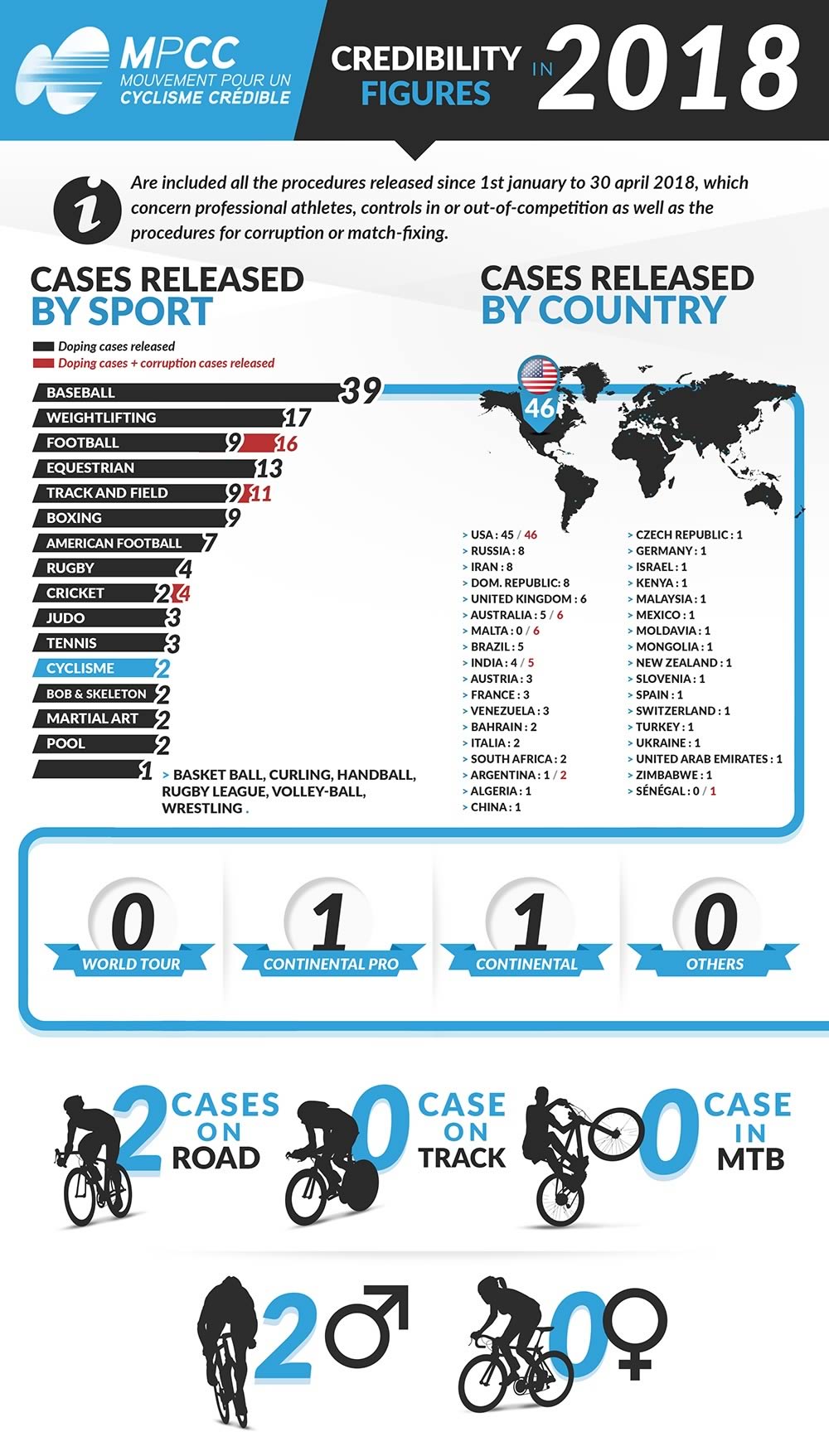
Credibility figures as at 30 April
MPCC has decided to add match-fixing and corruption-related cases to in his global counting of the doping related cases in sport.
In 2014, when we started this global counting, we wanted to compare the amount of doping cases in cycling to the other cases in the world of sport. The rules of confidentiality established by some federations to protect their image limited the relevance of this comparative table.
During 4 years though, we observed more and more transparency in the procedures : in 2014, we identified less that 300 cases related to doping on the public place. In 2017, this figure has doubled.
At the same time, we identified more and more cases of match-fixing and corruption. We decided to expand the spectrum of our study so that it will give a better and wider report on the acts of cheating that harms the credibility of the concerned sports.
We will release this “barometer” several times during the year, as credibility is the heart of our mission more than ever.
Cortisol level tests on the Quatre jours de Dunkerque
The team members of the MPCC have submitted 54 riders to a cortisol level test on the Quatre jours de Dunkerque. All the riders have been allowed to start.
Just before the Quatre jours de Dunkerque's 4th stage, 18 member teams registered for the race submitted 54 riders to a cortisol level test as part of their commitment to the Movement for a Credible Cycling (MPCC).
These voluntary tests have been performed in collaboration with French Cycling Association (FFC) and French Cycling League (LNC). All values were above the voluntary MPCC norm. The Board notes with satisfaction that the riders of these MPCC member teams registered for the Quatre jours de Dunkerque have scrupulously respected the clauses of their standing orders.
Background on cortisol tests by the Mouvement pour un Cyclisme Crédible (MPCC)
The objective of the MPCC and its member teams is to contribute to restoring the credibility of cycling. One of the organisation’s activities are voluntary cortisol tests amongst the riders of the member teams of the MPCC. In case the results of the test present an abnormally low value, the rider concerned will not race for a period of minimum eight days until the cortisol value has recovered again above that minimum value.
For the sake of clarity: it concerns a voluntary norm and the test does not concern an anti-doping control. Under WADA rules, athletes across all sports, with a cortisol level abnormally low, are entitled to perform their sport in competition (unless an anti-doping test has revealed the unauthorized use of the cortisol hormone).
The reason for the MPCC member teams to introduce this voluntary norm (below which the rider concerned will withdraw from competition for that minimum period of eight days), is an effort towards all stakeholders and fans of the sport of cycling and to confirm its commitment to clean sport and to show that cycling and MPCC member teams wish to be a frontrunner in that.
Why cortisol tests ?
Although cortisol hormones are an allowed medicine when pre-scribed by a physician, the use of that medicine has frequently been abused in the history of sports (including in cycling) for the purpose of increasing the performance. Besides, a low level of cortisol can potentially endanger the health of athletes in certain circumstances when he/she is in competition while the athletes perform under high intensity or under stress.
For both reasons and with the objective to contribute to restoring the credibility of cycling, the Mouvement pour un Cyclisme Crédible and its member teams have introduced that voluntary norm below which its riders will temporarily withdraw from competition.