
Figures of credibility as at 1st July
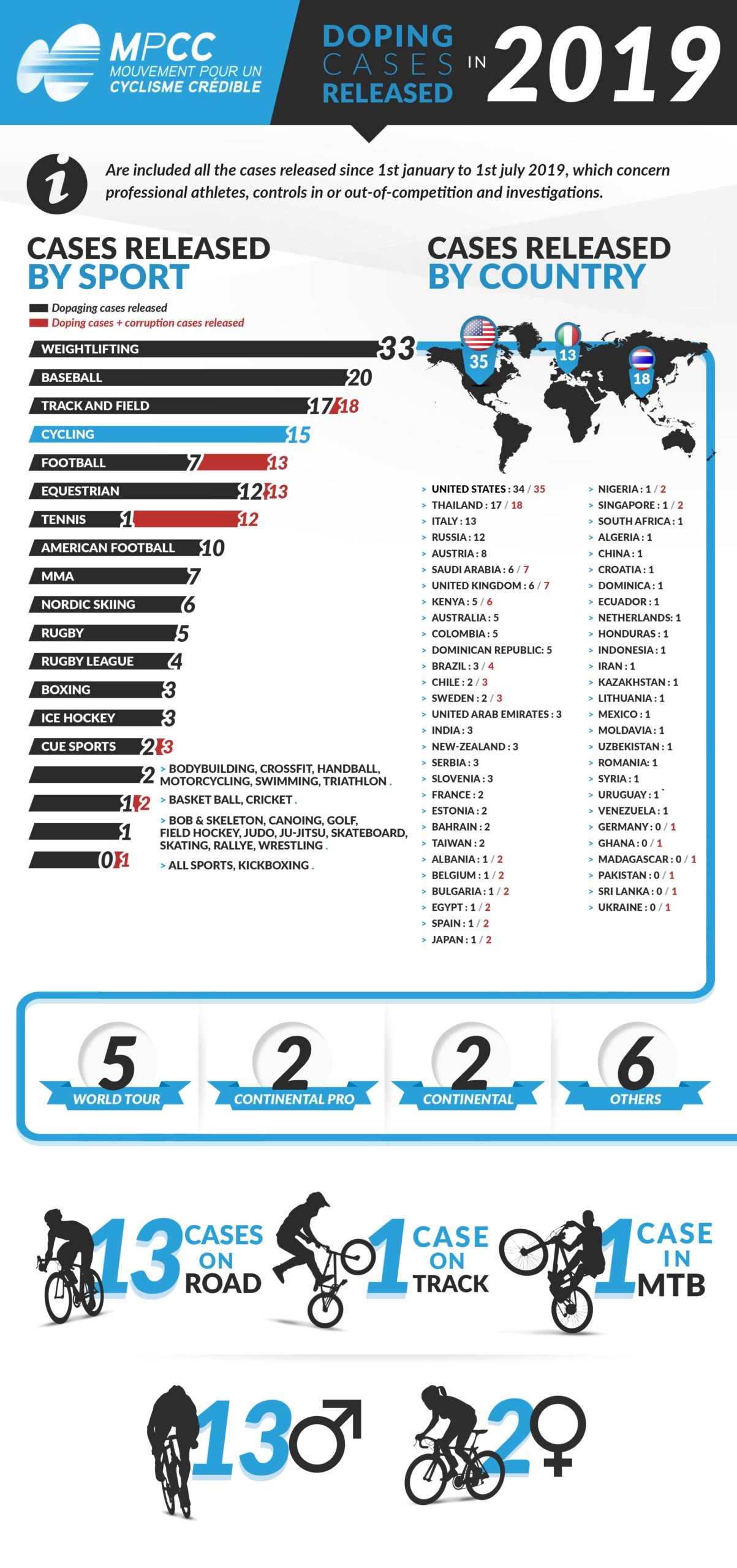
The cases revealed in cycling during the first semester of the year are not good. In total, 15 cases were revealed including 7 from the ‘Operation Aderlass’ police investigation.
“Always leave a light on”. MPCC President Roger Legeay’s famous punchline illustrates that it is necessary to stay vigilant at any time regarding the attacks to the credibility of cycling. The beginning of 2019 shows how accurate this phrase is.
15 cases were revealed since the beginning of the year, with 7 of them involving pro riders, in only 6 months. These are the worst results since 2014 – since we started accounting doping and corruption cases.
These results partly are the consequence of a German police investigation led in Austria: The Operation Aderlass. This operation involves 7 cases that were all revealed during the first semester. It shed a light on very modern techniques of – sometimes hard – doping (blood transfusions), which casts a shadow on the efficiency of antidoping fight and tarnishes the image of cycling.
Although, it is possible to relativize the reach of some of these cases as 4 of them are procedures regarding facts that happened years ago (2011-2013).
These 15 cases mainly concern 3 countries: Colombia (4), Slovenia (3) and Austria (3).
Hence, at the end of June, cycling was placing 4th in the “most affected by attacks to the sport’s ethics” ranking, coming after weightlifting, baseball and track and field. At the end of 2018, cycling was only coming in 13th position.

Cortisol level tests on the Tour de France
11 member teams subjected 88 riders to cortisol level tests on the Tour de France. All the riders have been allowed to start.
On the Tour de France, 11 member teams registered for the race submitted 88 riders to cortisol level tests as part of their commitment to the Movement for a Credible Cycling (MPCC):
- AG2R La Mondiale
- Arkea-Samsic
- Bora-Hansgrohe
- Cofidis Solutions Crédit
- Dimension Data
- EF Education First
- Groupama-FDJ
- Lotto-Soudal
- Sunweb
- Total Direct Energie
- Wanty - Groupe Gobert
These voluntary tests have been performed under the auspices of the Union Cycliste Internationale (UCI) on all participants. The UCI has forwarded to the MPCC the results of all riders of the member teams. All results were in compliance with the standard established by MPCC members. The Board notes with satisfaction that the riders of these MPCC member teams registered for the Giro d'Italia have scrupulously respected the clauses of their standing orders.
Background on cortisol tests by the Mouvement pour un Cyclisme Crédible (MPCC)
The objective of the MPCC and its member teams is to contribute to restoring the credibility of cycling. One of the organisation’s activities are voluntary cortisol tests amongst the riders of the member teams of the MPCC. In case the results of the test present an abnormally low value, the rider concerned will not race for a period of minimum eight days until the cortisol value has recovered again above that minimum value.
For the sake of clarity, the test is based on a voluntary norm. This is not an anti-doping control. Under WADA rules applied in all sports, athletes with an abnormally low cortisol level are entitled to perform their sport in competition (unless an anti-doping test has revealed the unauthorized use of the cortisol hormone).
The reason why MPCC member teams have decided to implement this voluntary norm - below which the rider is prevented from competition for a minimum 8-day period - is confirm its commitment to a clean sport as cycling and MPCC member teams wish to be frontrunners in this fight.
Why cortisol tests ?
Although cortisol hormones are an allowed medicine when pre-scribed by a physician, the use of that medicine has frequently been abused in the history of sports (including in cycling) for the purpose of increasing the performance. Besides, a low level of cortisol can potentially endanger the health of athletes in certain circumstances when he/she is in competition while the athletes perform under high intensity or under stress.
For both reasons and with the objective to contribute to restoring the credibility of cycling, the Mouvement pour un Cyclisme Crédible and its member teams have introduced that voluntary norm below which its riders will temporarily withdraw from competition.
Gazprom-Rusvelo joins the MPCC!
The Russian team Gazprom-Rusvelo adheres to the MPCC, becoming the 21st Continental Pro team to join the movement.
General manager of the structure, Renat Khamidulin declares :
"The team has completely changed in last few years. Now we have a lot of young riders and these riders are growing with the team from the youth categories. Our goal now is to educate the new generation of Russian cycling riders and to make them real professionals. We feel it's important to give them a right mentality from the youngest age. We think it's will be valuable for their future."
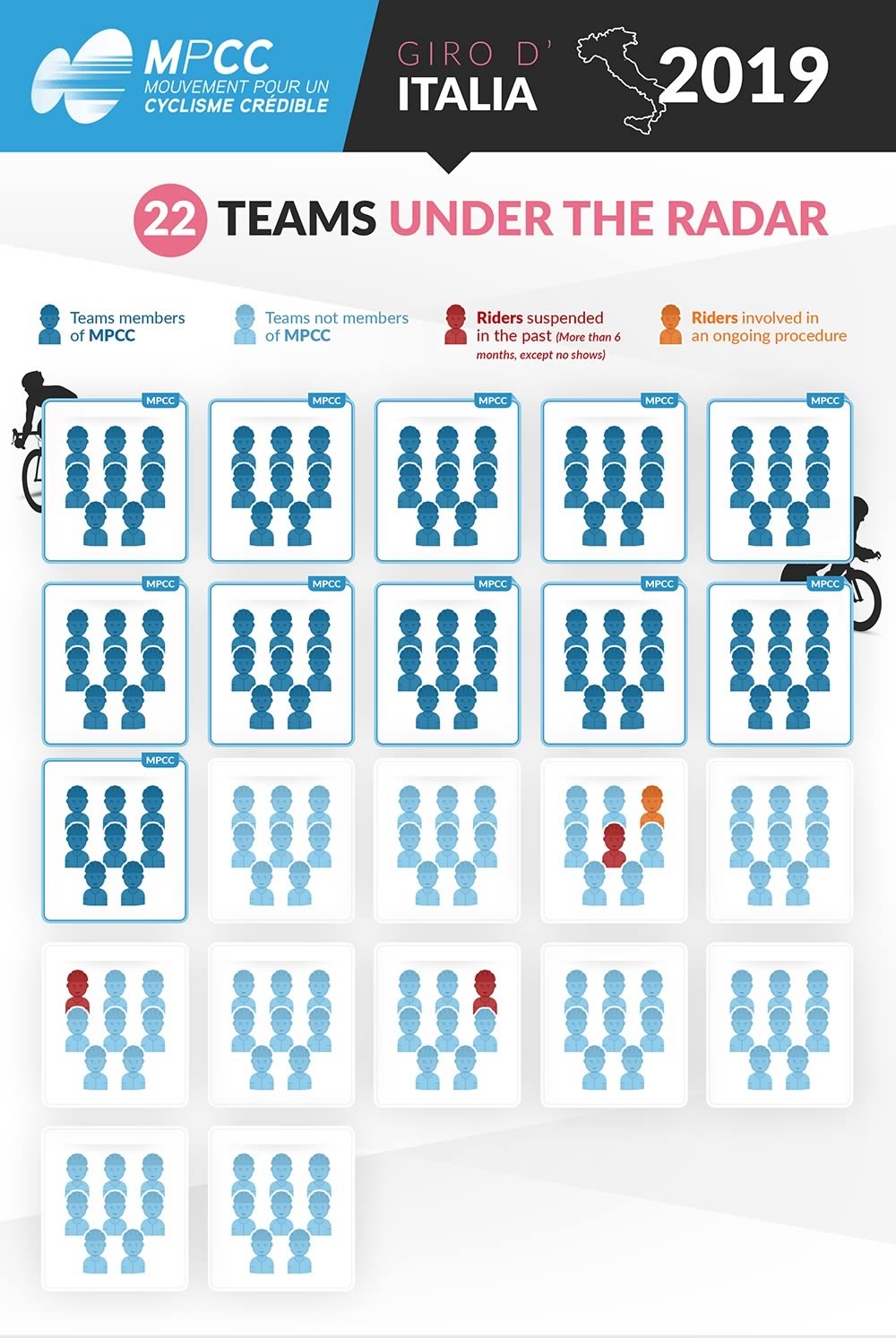
Giro 2019: 22 teams under the microscope
In an infography, we have represented the 2018 Giro d'Italia peloton, distinguishing MPCC member teams and non-member teams. Amongst member teams, no rider have ever been suspended. Within non-members, 3 already have and 1 is involved in an ongoing procedure!
In the event of every grand tour race or big championships, the MPCC highlights how many riders are part of the movement but also how many riders have been suspended for doping in the past.
The spirit of the MPCC is to regroup teams which on a voluntary basis define stricter rules than international organizations. Amongst those, this one: « Don’t hire riders involved in doping cases and banned for more than 6 months, except no-shows, in the two years following the suspension. »
On the 2019 Giro d'Italia, MPCC members chose not to pick any riders previously suspended for doping. This choice matches the philosophy of the movement, thus fostering cycling's credibility. There are 11 MPCC members on this year's Giro d'Italia, representing 50% of the peloton.
Three riders have been suspended in the past and are, despite this, competing in the Giro d'Italia. Last year, only one rider was in this situation. In addition, a fourth rider - also part of a non-MPCC team - has been excluded from the race because of an ongoing procedure.
Cortisol level tests on the Giro d'Italia
11 team members of the MPCC have submitted 88 riders to cortisol level tests on the Giro d'Italia. All the riders have been allowed to start.
On the Giro d'Italia, 11 member teams registered for the race submitted 88 riders to cortisol level tests as part of their commitment to the Movement for a Credible Cycling (MPCC):
- AG2R La Mondiale
- Androni Giocattoli - Sidermec
- Bardiani - CSF
- Bora-Hansgrohe
- Dimension Data
- EF Education First
- Groupama-FDJ
- Israel Cycling Academy
- Lotto-Soudal
- Nippo Vini Fantini Faizane
- Sunweb
These voluntary tests have been performed under the auspices of the Union Cycliste Internationale (UCI) on all participants. The UCI has forwarded to the MPCC the results of all riders of the member teams. All values were above the voluntary MPCC norm. The Board notes with satisfaction that the riders of these MPCC member teams registered for the Giro d'Italia have scrupulously respected the clauses of their standing orders.
Background on cortisol tests by the Mouvement pour un Cyclisme Crédible (MPCC)
The objective of the MPCC and its member teams is to contribute to restoring the credibility of cycling. One of the organisation’s activities are voluntary cortisol tests amongst the riders of the member teams of the MPCC. In case the results of the test present an abnormally low value, the rider concerned will not race for a period of minimum eight days until the cortisol value has recovered again above that minimum value.
For the sake of clarity: it concerns a voluntary norm and the test does not concern an anti-doping control. Under WADA rules, athletes across all sports, with a cortisol level abnormally low, are entitled to perform their sport in competition (unless an anti-doping test has revealed the unauthorized use of the cortisol hormone).
The reason for the MPCC member teams to introduce this voluntary norm (below which the rider concerned will withdraw from competition for that minimum period of eight days), is an effort towards all stakeholders and fans of the sport of cycling and to confirm its commitment to clean sport and to show that cycling and MPCC member teams wish to be a frontrunner in that.
Why cortisol tests ?
Although cortisol hormones are an allowed medicine when pre-scribed by a physician, the use of that medicine has frequently been abused in the history of sports (including in cycling) for the purpose of increasing the performance. Besides, a low level of cortisol can potentially endanger the health of athletes in certain circumstances when he/she is in competition while the athletes perform under high intensity or under stress.
For both reasons and with the objective to contribute to restoring the credibility of cycling, the Mouvement pour un Cyclisme Crédible and its member teams have introduced that voluntary norm below which its riders will temporarily withdraw from competition.
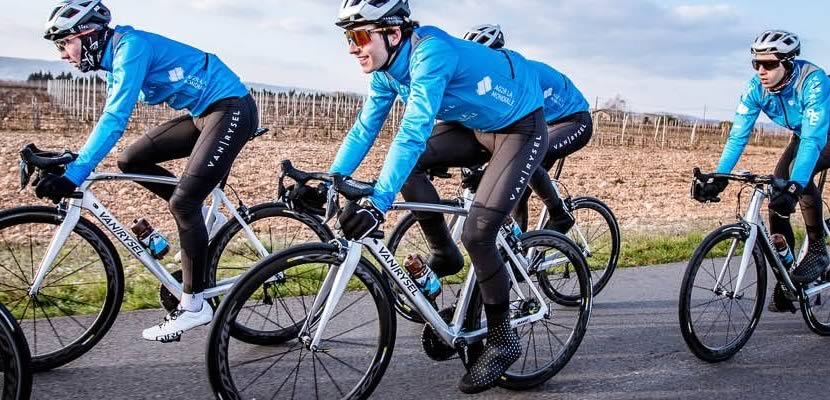
U19 team Van Rysel - AG2R La Mondiale joins the MPCC!
Part of AG2R La Mondiale Pro Team's development program, the U19 team Van Rysel - AG2R La Mondiale is now a member of the MPCC.
The team manager Alexandre Chenivesse explains why he requested MPCC membership: ""We are very aware of all of the efforts made to help the fight against doping and bad practices. With the support of our physician Dr. Gwenaelle Madouas, each year we educate and inform our 15 U19 riders. We wish to turn out commitment into a powerful and genuine act, so does The AG2R La Mondiale pro team which we are part of the development program, as well as the company AG2R La Mondiale. As of today, 15% of the riders we welcomed in our team managed to sign a professional contract. As a development team, we have a key role to play in the guidance of these young athletes and in helping them to deal with performance."
Press release - 29th March 2019
Further to an invitation from the World Anti-Doping Agency (WADA), a meeting took place in Lausanne on March 12th between WADA, The UCI, the CADF and a MPCC’s delegation.
MPCC made a presentation of its philosophy, insisting on the voluntary approach of its members (more than 650 members, including 350 riders and 41 teams, accounting for 60% of the global peloton). MPCC is undoubtedly an asset to the credibility of our sport as managers can act with more flexibility than regulatory bodies: they may fire riders and refrain from hiring the ones that have tested positive, or even pronounce a provisional suspension. During this constructive dialogue, all of the topics raised by MPCC were addressed.
Puerto Case
The criminal and disciplinary proceedings are now over. Nevertheless, WADA is still in the process of identifying the owners of the blood bags. Once this process is over, WADA will decide how it will release the names of the athletes in question to their respective International Federations. This data will only be released on a confidential basis and the names of the athletes will not be released to the public by WADA, given that any prosecution is impossible.
Tramadol
WADA is supportive of the UCI’s approach to researching this substance, which focuses on the health and safety of riders. Besides the monitoring of this substance, WADA has also started a process with multiple experts to determine the actual impact of tramadol on an athlete’s performance. MPCC reiterated its wish to put tramadol on the List of Prohibited Substances and Methods.
GLUCOCORTICOIDS
With the help of its experts, WADA is continuing to work on a modification of the rules regarding the use of glucocorticoids, as the current regulation is not viewed as satisfactory. MPCC renewed its request for the prohibition of glucocorticoid use by injection in competition.
Salbutamol
WADA confirmed its regulations in regards to salbutamol for 2019. Following the evolution of the knowledge base in this area, consideration is being given to possibly change the regulations on the basis of recent results and expert conclusions.
Provisional suspension: specified substance
WADA will not change its regulations. This is an individual decision that should be taken by Anti-Doping Organizations. MPCC renewed its request for a provisional suspension as soon as a disciplinary process is ongoing, whether the substance is specified or not.
Thyroid supplements
MPCC also raised the issue of the misuse of thyroid supplements in cycling (Thyrax in Europe, Synthroid in the US). MPCC will submit its proposals during the year 2019.
It was agreed that MPCC will keep providing UCI, CADF and WADA with all information that may help the fight against doping in cycling. This first meeting shall also be followed by regular exchanges to keep track of the evolution of every issue. It is obviously essential that every stakeholder be fully committed, especially the teams, riders and organizers that belong to the MPCC on a voluntary basis.
Attending this meeting:
WADA:
- Olivier NIGGLI, Director General
- Sébastien GILLOT, Director, European Regional Office and International Federations Relations
- Olivier RABIN, Senior Executive Director, Sciences and International Partnerships
UCI:
- Simon GEINOZ, Head of Legal Anti-Doping Services
CADF:
- Francesca ROSSI, Director of the Cycling Anti-Doping Foundation
MPCC:
- Roger LEGEAY, President of the MPCC Guest member of the PCC (Professional Cycling Council)
- Iwan SPEKENBRICK, Vice-president of the MPCC General Manager of World Tour team SUNWEB President of the AIGCP (Association internationale des groupes cyclistes professionnels) Member of the PCC (Professional Cycling Council)
- Philippe SENMARTIN, General Secretary of the MPCC Member of the pro-continental team DIRECT ENERGIE Lawyer
- Dr Prentice STEFFEN, Doctor of the pro-continental team RALLY UHC CYCLING
- Christophe LAVERGNE, French Federation, member of the MPCC FFC Chief Legal Counsel

Press release - 21st February 2019
New members, cortisol level controls, upcoming meeting with WADA, Tour and Giro wildcards... All of these topics have been discussed during our last Board meeting.
Gathered in Roissy on Wednesday the 20th of February, the MPCC board stated on its new members. Two pro teams joined the MPCC: Riwal-Readynez (Pro Continental, Denmark) and Groupama FDJ (Continental, France). During the ‘off-season’, 77 pro athletes – men and women – as well as more than 200 teams’ staff members joined the MPCC.
The MPCC can now rely on 643 members, more than half of them (338) being active riders. As a reminder, any team’s staff members can join the MPCC, whether their team is part of the MPCC or not. To do so, they only need to fill up the appropriate form:
Riders registration - Staff registration
The MPCC acknowledged that, starting on the 1st of March 2019, Tramadol use during races will now be forbidden by UCI rules, and blood tests will be conducted to detect this substance. As we are still waiting for similar rules regarding corticoids, the MPCC will keep doing cortisol level tests amongst member teams in 2019. On a voluntary basis, these teams commit not to line up - on any race - any rider going through corticoids treatment.
The board also selected the representants that will head to Lausanne on the 12th of March to meet WADA’s officials, as we positively answered to WADA President Craig Reedie’s invit
The President of the MPCC Roger Legeay will be accompanied by 4 members of the movement: the vice-President of the MPCC Iwan Spekenbrink, the Secretary Philippe Senmartin, the Rally-UHC Cycling team's physician Prentice Steffen and the French federation's Legal director Philippe Lavergne.
To conclude, as we are still waiting for the attribution of the last Tour de France wild cards, the MPCC is very satisfied with the organizers’ decision to assign the first two wild cards to MPCC members: Cofidis (France) and Wanty Groupe Gobert (Belgium). The MPCC is also delighted that the Giro d’Italia granted all of the 4 available wild cards to MPCC members: Androni - Giocatolli - Sidermec (Italy), Bardiani - CSF (Italy), Israel Cycling Academy (Israel) et Nippo - Fini Fantini - Faizane (Italy)..
WADA willing to meet MPCC
World Anti-Doping Agency (WADA)’s President Sir Craig Reedie invited the pPresident of the Movement for a Credible Cycling (MPCC), Roger Legeay, to meet in order to continue discussions between the institution and our movement.
The Movement for a Credible Cycling (MPCC) received on November 5th 2018 a response from World Anti-Doping Agency’s President Sir Craig Reedie to its last letter.
World Anti-Doping Agency (WADA)’s President states in his letter that there is “obviously a difference of opinion” between the two bodies. He concludes with a formal invitation to meet the president of the Movement for a Credible Cycling in order to “discuss these matters further.”. MPCC accepts this invitation from WADA’s governing body and thus agrees to confront these two visions.
MPCC and all its members hope that this meeting will be the perfect opportunity to obtain an explanation to its unanswered question, especially when it comes to important topics such as corticoids, tramadol and salbutamol.
Thanks to all of its members, making the movement representative of the world of cycling, MPCC succeeded in being considered by WADA as a legitimate interlocutor. The movement has now more than 500 members, including 289 riders, with most of them being contracted to first and second division teams.
Time has come for this representativity to become even stronger : riders, teams, staff members, Federations, organizers, sponsors: you are all welcome to join forces with MPCC by sending a membership request. Our common purpose is to make the voice of all of our members even louder. WADA’s invitation is proof that this voice has a genuine influence.
Read the discussions between MPCC and WADA
MPCC’s initial open letter
Sir Craig Reedie’s response (1)
MPCC’s response
Sir Craig Reedie’s response (2)

Dear staff members, come and join the MPCC!
Six months after having opened the membership to the riders, the MPCC has decided to open the membership to any staff people.
The MPCC opens its membership to all the staff members from World Tour teams, Continental Pro Teams, Continental Teams or UCI Women teams, whether their team is part of the MPCC or not. They will be regularly informed of the Movement’s activities, will receive the meeting’s reports, will be invited to the General Assembly and will be free to send the movement any suggestion.
In return, the member will have to join the MPCC’s philosophy, promote cycling’s image by fighting against any form of doping and cheat and respect the movement’s internal regulation.