
2019 sees sharp rise in cycling doping cases
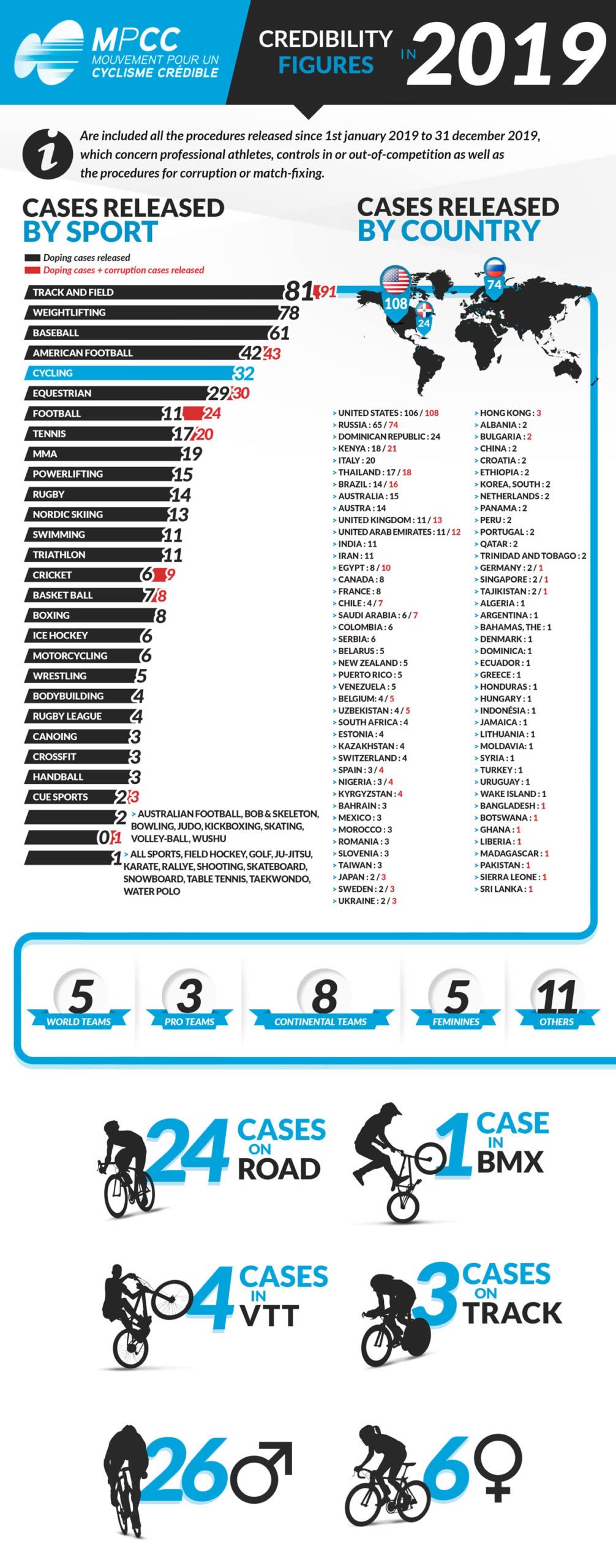
The number of doping cases revealed in 2019 amongst cycling’s professional elites has nearly doubled in the span of one year. The MPCC takes it as a serious warning.
Since the creation of our credibility barometer six years ago, cycling figures had never been this alarming.
A year ago, we were writing that data for cycling doping, from one year to the next, was not suggesting any real trend in the medium term, unlike other sports where an ever-increasing number of cases were revealed. This year, we’re noting a clear break with the recent past. This sudden increase was equally observed in men’s and women’s cycling, whether it was track cycling or road cycling (all things considered). While cycling had kept plummeting in the list of sports most affected by doping, it rose again from 13th to 5th in the span of just one year.
2019 was marked by Operation Aderlass, which revealed the existence of an international blood doping network involving several sports and most particularly cycling. It is not out of the question that further names are revealed soon in addition to the 7 known cases in our sport (6 men and 1 woman). This police operation — carried out in close conjunction with the investigators from WADA (World Anti-Doping Agency) — alone does not explain the skyrocketing in the number of infractions. Furthermore, it served as a reminder that doping can spiral into all teams, including those committed to MPCC.
Two hypotheses are being used as explanation for those many doping cases in 2019: first, a renewed interest in doping; second, better targeted doping tests.
2019 was also marked by the decision to ban Russia from all major sporting events (Olympics and World Championships, notably) for four years over doping violations. Although this ban imposed by WADA — and contested by Russia — still needs to be confirmed by the Court of Arbitration for Sport, there is no country talked about so often on account of doping scandals in two different sports: athletics (21 doping cases and 9 cases of fraud from executives) and weightlifting (16 doping cases). Those two sports alone represent 60% of the procedures that were made public this year in Russia.
In the United States, American football (39 cases) and baseball (27 cases) combine to account for more than half of the damage done to the credibility of sport. The United States still ranks first in our standings for the 4th consecutive year while Italy, the most affected nation in Europe and overall 5th in our standings, has seen their number of procedures gone public cut by half in 2019, compared to the previous two years.

Team Alpecin-Fenix joins MPCC!
The Belgian team joins MPCC and becomes the 26th first or second division team to become part of the movement.
Alpecin-Fenix is the new name of 2019 team Corendon-Circus. Led by Belgian road champion Tim Merlier and double CX World Champion Mathieu Van der Poel, Corendon-Circus grabbed 21 wins last season, including 2 on World Tour races.
Philip Roodhooft, general manager of the team, has a few words to say about the MPCC membership process:
"We wish to be part of the movement based on simple reasons: we want our team management to be correct, ethical and transparent. Joining MPCC is one of the steps towards this type of management"
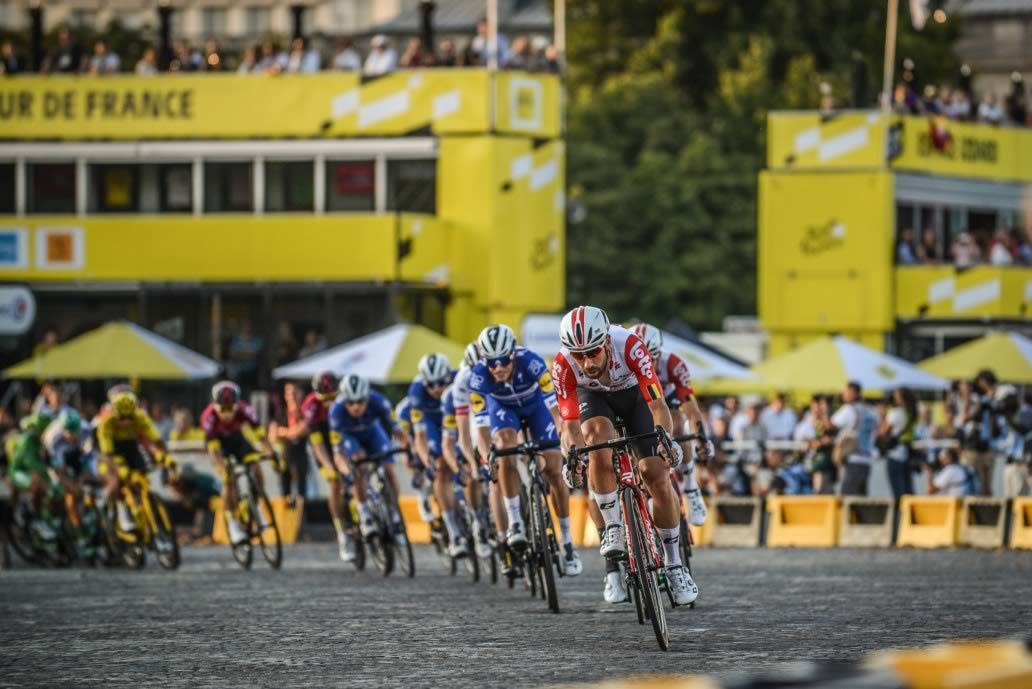
Wilds Cards: still not 100% of wild cards granted to MPCC teams
In 2018, 89% of the Wild Cards awarded by organizers were granted to MPCC teams. In 2019, the percentage rose to 91%. 100% remains the objective.
At the end of each season, MPCC delivers an infographic to sum up the choices made by the World Tour races regarding wild cards. This infographic aims at showing whether the wild cards were granted to MPCC teams or not.
In 2018, 89% of the World Tour wild cards were granted to MPCC teams. There are usually 3 or 4 wild cards on stage races, and up to 11 on one-day races. This percentage is already a success, but the movement is still aiming at 100% for all of these organizers. 100% of wild cards to MPCC teams would be a great reward for our strong commitment, on a voluntary basis, to stricter ethical rules. In 2019, this figure is increasing, rising from 89% to 91%. We are glad to see that World Tour organizers kept putting their trust in Conti Pro teams which belong to the movement.
The movement is also very satisfied to see that all of the three Grand Tours (Giro, Tour, Vuelta) gave 100% of their precious wild cards to MPCC teams. In 2018, RCS Sport, organizer of the Giro, put one of its 4 wild cards aside for a non-MPCC team. The movement reacted strongly to this decision and is glad to see that, a year later, all of the Grand Tours organizers have put their trust in the teams which rely on MPCC to be on their side so we can fight together for the credibility of cycling.
Unfortunately, we cannot say the same for some of the “monuments” of the cycling season: Milan – San Remo and the Tour of Lombardy are not part of the “100%” category. Same goes for the Ronde Van Vlaanderen, even though they were in the 100% team last year. MPCC urges these organizers to value the message sent by the teams joining MPCC when it comes to the credibility of cycling, and invites the non-MPCC teams that were given wild cards last year to join the movement.
Within the 2020 peloton, 19 teams are registered in the “Continental Pro” division, 16 of them being committed to MPCC. The three non-members teams are Alpecin-Fenix, Uno-X Norwegian Development Team and Vini Zabu KTM. On Wednesday January 8th, ASO made an announcement regarding the wild cards awarded for the Tour de France, Paris-Nice and the Critérium du Dauphiné. All of these wild cards were given to MPCC teams.
MPCC wants to highlight the strong and remarkable commitment of some organizers. This engagement is crucial in order to strengthen the credibility of our sport. It is also important to keep underlining the choices of the few organizers not going that way. Thus, MPCC asks for the wild cards of the 2020 races to be all granted to teams which belong to our movement, and urges the teams yet to join our movement to commit to stricter rules.

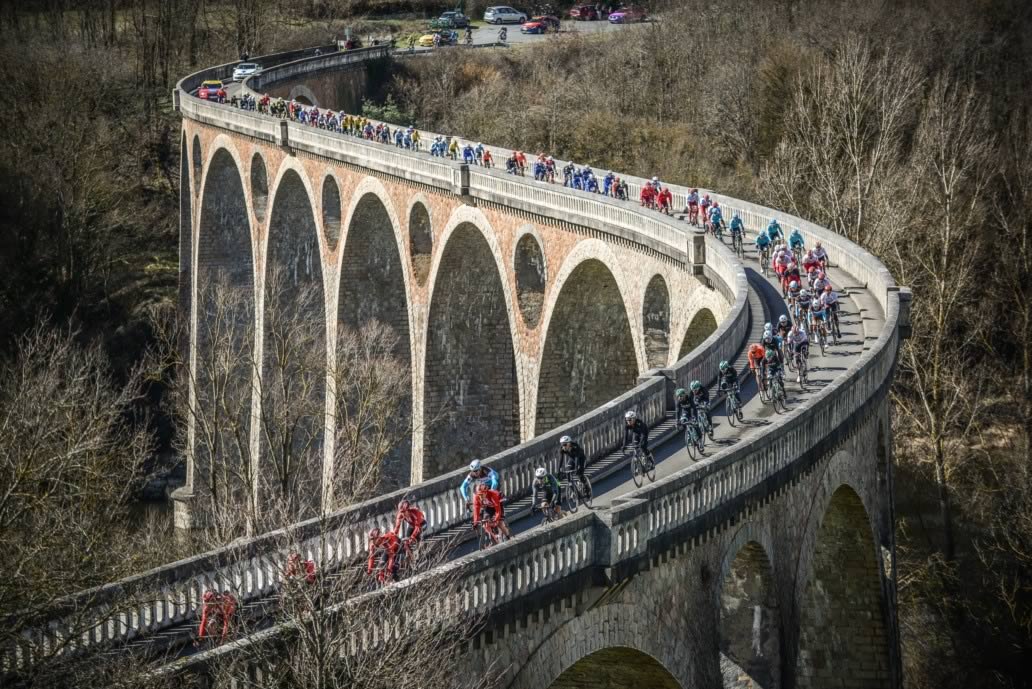
Team Arkea’s women team joins MPCC !
The new French women team ‘‘Team Arkéa’’, which will be part of the « UCI Women’s Continental Team », requested to join MPCC on 23rd December 2020. This is the 6th women’s team to join the movement.
Team Arkéa is Arkéa-Samsic’s new women’s team, run by Emmanuel Hubert. The men’s team became a member of MPCC on 5th July 2007. The line-up will include 10 riders, 9 of them aged between 18 and 25 years old.
Here is what team manager Gabrielle Rimasson wants to say about the team becoming a member of the movement :
« This team is the little sister of Arkéa-Samsic Continental Pro team. It seemed logical and ethical to follow its steps and join MPCC in order to protect the health of the riders, as well as the image of cycling and of our partners. The philosophy of the MPCC will be adressed during our next reunion in January, and we will offer the riders and the staff to become members of the movement as individuals »
Team Kern Pharma joins MPCC !
The new Spanish team Kern Pharma joined MPCC on 20th December 2019. It becomes the 10st Continental Pro Team to join the movement.
Team Kern Pharma is the evolution of amateur team Lizarte, which grabbed 25 wins on Spanish races this year. Its line-up for 2020 will include twelve riders aged 23 or less, including Jon Agirre, 7th on the Col de la Loze stage and winner of the KOM Classification on the Tour de l’Avenir 2019.
Here is what Juan José Oroz, team manager, has to say on the process of joining MPCC :
« At the first meeting of our team, we considered the philosophy of the movement and invited the riders and the staff to browse the MPCC’s website. It seems logical and ethical to join the movement in order to protect the health of the riders, as well as the image of cycling and our partners. "
MPCC alerts UCI to the urgency of going even further with the fight against blood doping
During the General Assembly that took place on last October 16th, Groupama-FDJ manager Marc Madiot and Sunweb manager Iwan Spekenbrink informed the Movement of an interview they had earlier this fall with Georg Preidler, former member of both teams. On March 4th 2019, the Austrian rider, who was a member of MPCC as an individual, confessed his involvement in the operation Aderlass (Cross-country skiing and cycling) and offered his resignation to the Groupama-FDJ team. A few months later, the information he provided to his former employers were transmitted to MPCC. The Movement then sent a letter to the UCI.
Several measures suggested to the UCI
MPCC wanted to draw UCI’s attention on the necessity to increase the number of blood tests, especially outside of competition. This proposition relies on the information we gathered, which hints on the existence of mafia doping protocols outside of the teams’ structures.
Furthermore, in MPCC’s opinion, the way these tests are carried out must be redefined. A formal request has been issued, aiming at running these tests closer to the start of the race and as soon as possible after the finish. Georg Preidler’s testimony is a clear warning sign on this issue.
MPCC also advises UCI to be even more vigilant during the holiday periods of the riders, or during the long breaks they may take in the middle of the year.
In its response to MPCC, issued on November 5th and signed by its president David Lappartient, UCI reminds that it is “known as the anti-doping organisation which draws the bigger number of blood samples, following the biological passport guidelines” and that CADF (Cycling Anti-Doping Foundation), a UCI-appointed entity, “draws as many samples they can, within the limits of its budget, while favouring targeted tests”.
Regarding the timing of the tests, UCI says that in 2019, several tests were carried “on the departures’ sites, with all the trouble it implies”. MPCC obviously supports this process and hopes to see it develop further more. MPCC teams will always support such tests despite the logistical constraints they require.
MPCC hopes that WADA is following the issue closely and welcomes its new President Witold Banka to ask MPCC for any information.
In its response, UCI also reminds that “UCI’s anti-doping regulation states that any athlete can be tested at any time and any place” and that “it is obvious that CDAF makes use of this opportunity and carries out tests during the periods” highlighted by MPCC.
While maintaining its full confidence in the UCI on the fight against blood doping, MPCC wants to remind that none of the riders who were part of the Aderlass operation were ever tested positive. These unfortunate revelations came from the police’s hard work only.
MPCC asks for more impact in the way controls are carried out.
Georg Preidler’s testimony, transmitted by his former employers Marc Madiot and Iwan Spekenbrink, caused a great worry among the members of MPCC, a concern that translated into the formal request for these tests to be carried out more aggressively by UCI and CADF. Teams, riders, technical staff, agents, federations, organizers and sponsors: more than 700 of them are members of the MPCC and support this increased aggressiveness.
On the basis of the testimonies it gathered, MPCC asks for a formal enquiry to open regarding the alleged use of a “powder” (Aicar-based?) that could be used by some teams or riders on the final parts of races. UCI responds that CADF not only investigates the use of Aicar but also any substance that could be broadly used within the peloton.
MPCC members are troubled by the question of sporting fairness on the biggest cycling races of the world that they take part in. They want the cheaters to be troubled in turn by what the fight against doping has in store for them. This fight will only be more effective if it feeds on any fact or intel that are provided to the bodies that lead it.
President Lappartient hails our actions, as MPCC is thankful to the UCI to be attentive to its recommendations and suggestions.
-------------------------------------------------------------------------------
MPCC reminds every rider or staff member that they can support the MPCC’s philosophy by becoming a member of the movement as individuals. Click here to make your request to become a member.
-------------------------------------------------------------------------------
MPCC also reminds that the movement is still waiting for some answers: - From WADA regarding tramadol being added to the list of the forbidden substances - From WADA regarding thyroid hormone being added to the list of forbidden substances - From WADA regarding new regulations on corticosteroids - From UCI regarding the set-up of cortisol test. MPCC also gives serious thought to the ketones issue, a very important topic in the 2019.
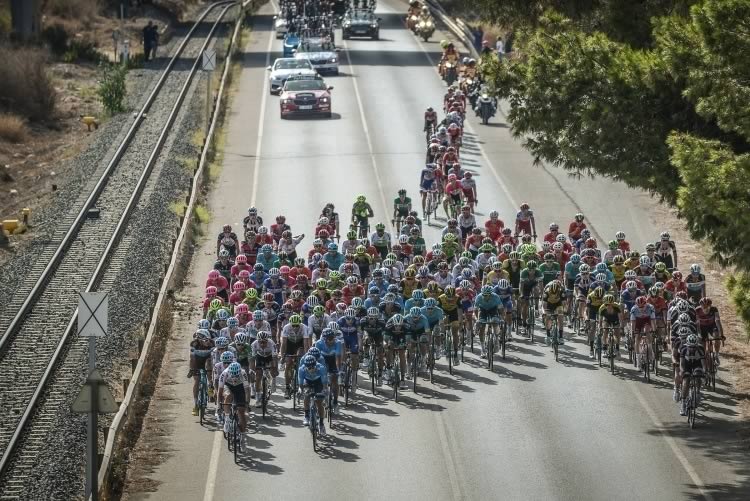
Press Release - 16th October 2019
The MPCC held its annual General Assembly on the 14th October 2019 in Paris. This meeting was representative of the more than 700 members of the movement - nearly half being active professional riders.
The President of the MPCC Roger Legeay first paid tribute with deep emotion to Dr Armand Mégret, who recently passed away. Armand has greatly contributed in advancing the fight against doping and participating in the development of the internal regulation of our movement, having been in charge of its cortisol level tests for 13 years.
The composition of the Board of Directors changes: after 2 years as the MPCC's treasurer, Yvon Sanquer is replaced by Sébastien Hinault after the unanimous approbation of the General Assembly.
The members of the MPCC have reviewed the discussion that was initiated with the WADA earlier this year. Following an open letter the MPCC addressed to WADA one year ago, a meeting was held on the 12th March 2019.
A few days ago in Paris, the MPCC met with a rider linked with the Aderlass case - a doping affair that have occurred during winter, mainly involving skiers and cyclists. Convinced in its ability to make concrete proposals to improve the fight against doping, the MPCC will continue to fit with its philosophy by pursueing the dialogue with the UCI.
264 cortisol level tests have been carried out in 2019, in collaboration with the UCI. In 2020, the MPCC has the desire to increase the total number of tests. Dr Pierre Lebreton has been named as referring doctor of the movement in charge of the implementation of the tests. He will allow the MPCC to continue the excellent work of Dr Armand Mégret.
On the request of the physicians of the MPCC teams, tests on Thyroid Stimulating Hormone (TSH) will be added to cortisol level ones our movement will perform. The goal is to collect anonymous and accurate data so the working group the MPCC is setting up can provide a framework for a new regulation on thyroid hormones. In case any anomaly is found, the team physician responsible for the involved athlete will have to line things up in the proper way.

MPCC continues to strengthen the credibility of the 3 Grands Tours
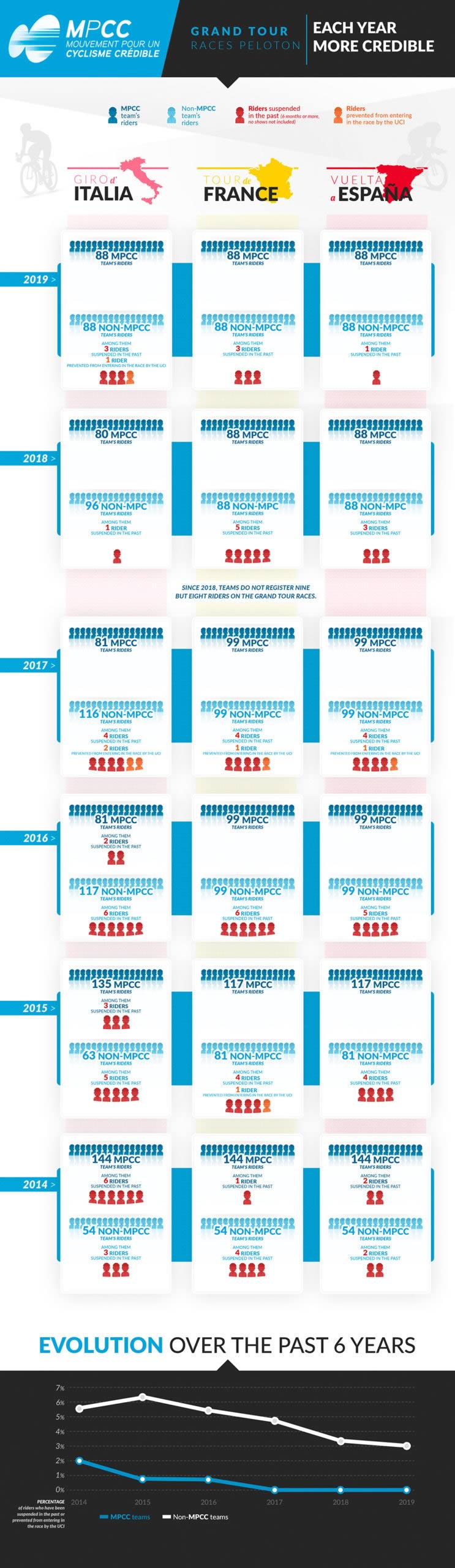
Since 2014, MPCC has been tracking the records of the starting riders of the 3 Grand Tours. In 2019, 7 of them, contracted to non-MPCC member teams, had previously been suspended for more than 6 months in their careers ; 1 has been prevented from competition by the UCI.
When looking at this datavisualisation, two figures catch the eye: first, the amount of riders suspended in in the past, and then the fact a rider has not been allowed to start one of the Grand Tour races by the UCI.
On a voluntary basis, our movement require our members to commit to Article 4, one of the most important of MPCC’s rules and regulations:
<em« MPCC teams agree not to enter riders, even in the case of a contract extension, who are convicted of (or deemed involved in) any anti-doping violation under Articles 2.1 to 2.8 of the World Anti-Doping Code, who were given a sanction of more than 6 months by the international court or national body (excluding penalties for three breaches of the ADAMS geolocation anti-doping administration and management system), within 2 years after the suspension or subject to a sanction for:
1. Abnormalities noted on the biological passport (or a violation of the biological passport regulations).
2. Damage to the image and credibility of cycling as previously defined. (…).
MPCC is glad to see that its members, attached to the philosophy of the movement, keep committing to this rule and refrain from choosing previously suspended riders to start a Grand Tour or any other race.
The 7 riders who have previously been suspended in the past are indeed all contracted to teams not belonging the MPCC (11 MPCC teams have started the Giro, the Tour and the Vuelta, for a total of 18 different teams).
As a whole, the percentage of riders previously suspended or not allowed to start is gradually dropping year after year on the Grand Tour. It was a little less than 5% in 201. For the year 2018, the number was a little bit over 3%. In 2019, it's 1,5%. MPCC teams are leading by example. The 0% objective remains an absolute priority.
> Revoir les Infographies : Giro d’Italia 2019 - Tour de France 2019 - Vuelta a Espana 2019
L'INFOGRAPHIE DES 3 GRANDS TOURS 2019 :
Armand Mégret passed away
The Mouvement Pour un Cyclisme Crédible (MPCC) is saddened by the passing of Armand Mégret at the age of 76 after a lengthy illness. In addition to his commitment to the Fédération Française de Cyclisme (FFC) and to the Union Cycliste Internationale (UCI), Armand played a key role in the development of the MPCC in his capacity as lead doctor monitoring the organisation of cortisol level tests — a role he was holding since 2008. His active involvement in the movement’s various work meetings have contributed to significant progress on topics of interest to us, whether it is the health of the riders or the fight against doping. In particular, he was engaged in identifying and cracking down on new doping practices, which led to the tramadol ban earlier this year. He helped the MPCC gain credibility with its members and the public by bringing his rigor and expertise to the movement.
Armand will be missed and we extend our deepest sympathy to his family and close ones.
Cortisol level tests on the Vuelta
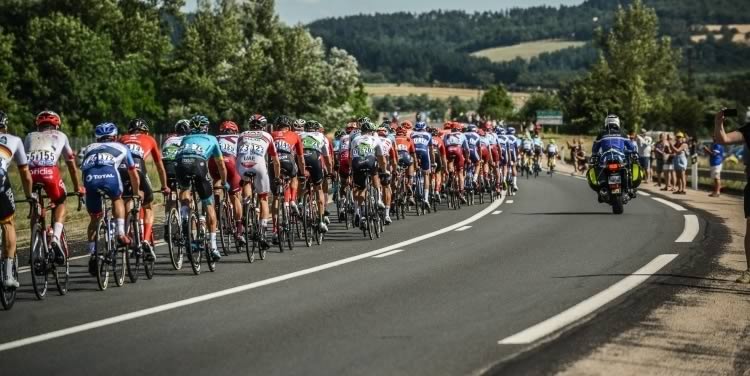
11 member teams subjected 88 riders to cortisol level tests on the Vuelta. All the riders have been allowed to start.
On the Vuelta, 11 member teams registered for the race submitted 88 riders to cortisol level tests as part of their commitment to the Movement for a Credible Cycling (MPCC):
- AG2R La Mondiale
- Bora-Hansgrohe
- Burgos-BH
- Caja Rural - Seguros RGA
- Cofidis Solutions Crédit
- Dimension Data
- EF Education First
- Euskadi Basque Country
- Groupama-FDJ
- Lotto-Soudal
- Sunweb
These voluntary tests have been performed under the auspices of the Union Cycliste Internationale (UCI) on all participants. The UCI has forwarded to the MPCC the results of all riders of the member teams. All results were in compliance with the standard established by MPCC members. The Board notes with satisfaction that the riders of these MPCC member teams registered for the Vuelta have scrupulously respected the clauses of their standing orders.
Background on cortisol tests by the Mouvement pour un Cyclisme Crédible (MPCC)
The objective of the MPCC and its member teams is to contribute to restoring the credibility of cycling. One of the organisation’s activities are voluntary cortisol tests amongst the riders of the member teams of the MPCC. In case the results of the test present an abnormally low value, the rider concerned will not race for a period of minimum eight days until the cortisol value has recovered again above that minimum value.
For the sake of clarity, the test is based on a voluntary norm. This is not an anti-doping control. Under WADA rules applied in all sports, athletes with an abnormally low cortisol level are entitled to perform their sport in competition (unless an anti-doping test has revealed the unauthorized use of the cortisol hormone).
The reason why MPCC member teams have decided to implement this voluntary norm - below which the rider is prevented from competition for a minimum 8-day period - is confirm its commitment to a clean sport as cycling and MPCC member teams wish to be frontrunners in this fight.
Why cortisol tests ?
Although cortisol hormones are an allowed medicine when pre-scribed by a physician, the use of that medicine has frequently been abused in the history of sports (including in cycling) for the purpose of increasing the performance. Besides, a low level of cortisol can potentially endanger the health of athletes in certain circumstances when he/she is in competition while the athletes perform under high intensity or under stress.
For both reasons and with the objective to contribute to restoring the credibility of cycling, the Mouvement pour un Cyclisme Crédible and its member teams have introduced that voluntary norm below which its riders will temporarily withdraw from competition.