

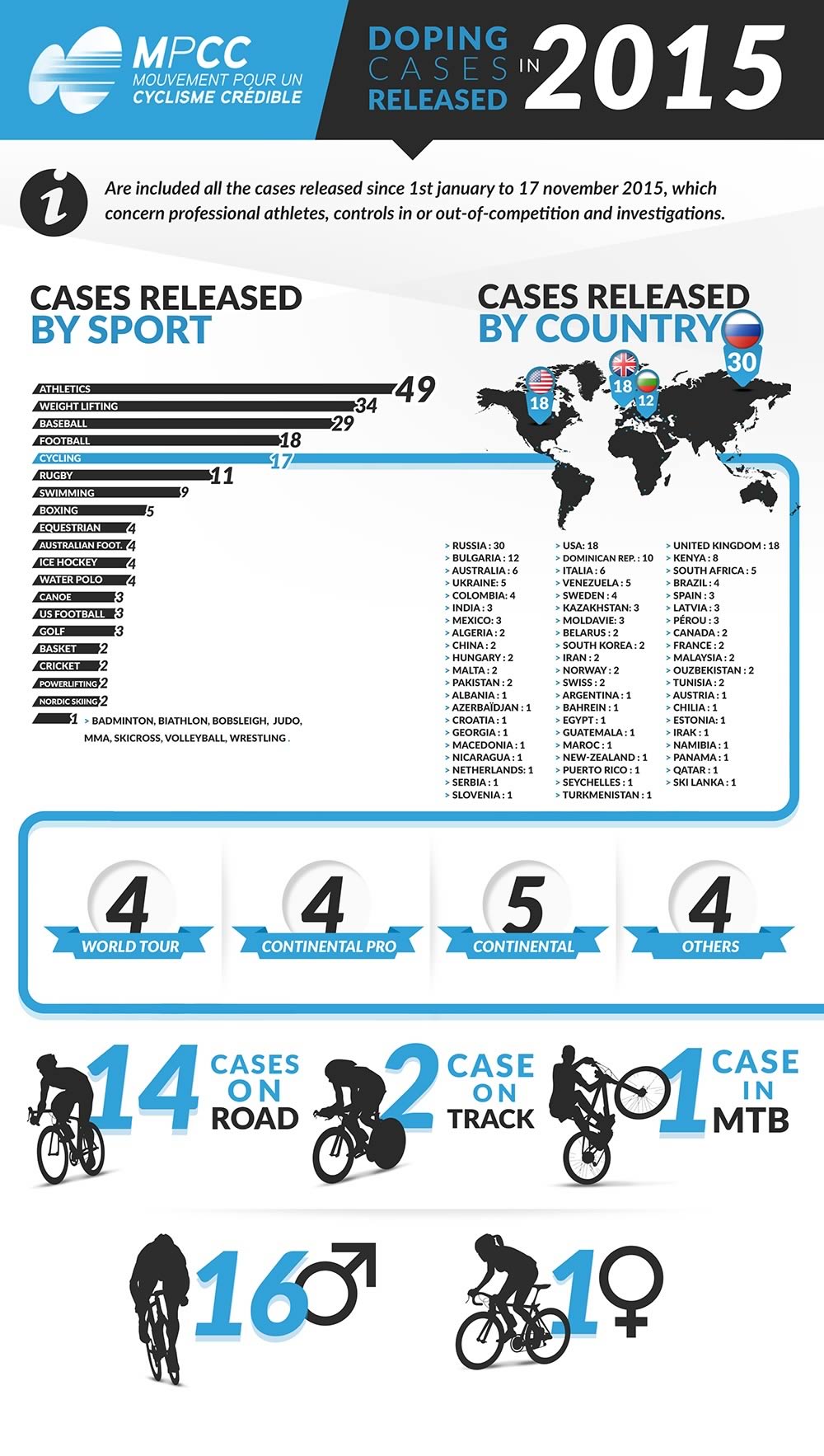
Doping figures as at November 17
Amid a backdrop of doping scandal MPCC releases the last update of its doping case count by sport and country. The Russian Athletics Federation (ARAF) has been temporarily suspended by the International Association of Athletics Federations (IAAF), which has even been threatened of suspension by the World Anti Doping Agency (WADA) less than nine months ahead of Rio 2016 Summer Olympics. Last year, athletics was the sport with the highest number of positive tests showing a total of 95 cases – 33 more than baseball.
As of 17 November 2015, athletics is the sport the most affected by doping and the gap is big again: from 29 positive tests on 26 August, just before the World Championships, athletics reached the figure of 49, being 15 more than weightlifting, the second most affected sport. As for Russia, it holds the number one position in country ranking with a total of 30 cases from the same date of 17 November 2015 – compared to 18 in both USA and United Kingdom.
Identifying doping cases is not an easy task and is subject to discretion if required by their respective international federations. Some do not advertise doping cases in their discipline. This has actually been highlighted by the recent scandals. Cycling, in contrast, reveals each positive test. Our numbers are therefore based on 2015 proven cases, according to official communications from federations and anti-doping agencies, etc.
Former President of IAAF, Lamine Diack, who has recently been put under investigation, said at the end of August: « We are not cycling ». With 17 cases, cycling is ranked 5th in that classification, behind baseball (3rd), football (4th) and... far from athletics. Only 4 of these cases involved members of World Tour teams. In half of the cases, the rider involved was part of a minor team (continental or non-UCI structures).
As a reminder, in 2014 cycling was the sport with the highest number of carried out tests targeting EPO or testosteron worldwide. All substances or methods taken together, cycling is ranked 3rd, with 30 tests less than athletics. By comparison, 1,800 athletes took part in Beijing 2015 World Championships, 198 riders competed in the 2015 Tour de France.

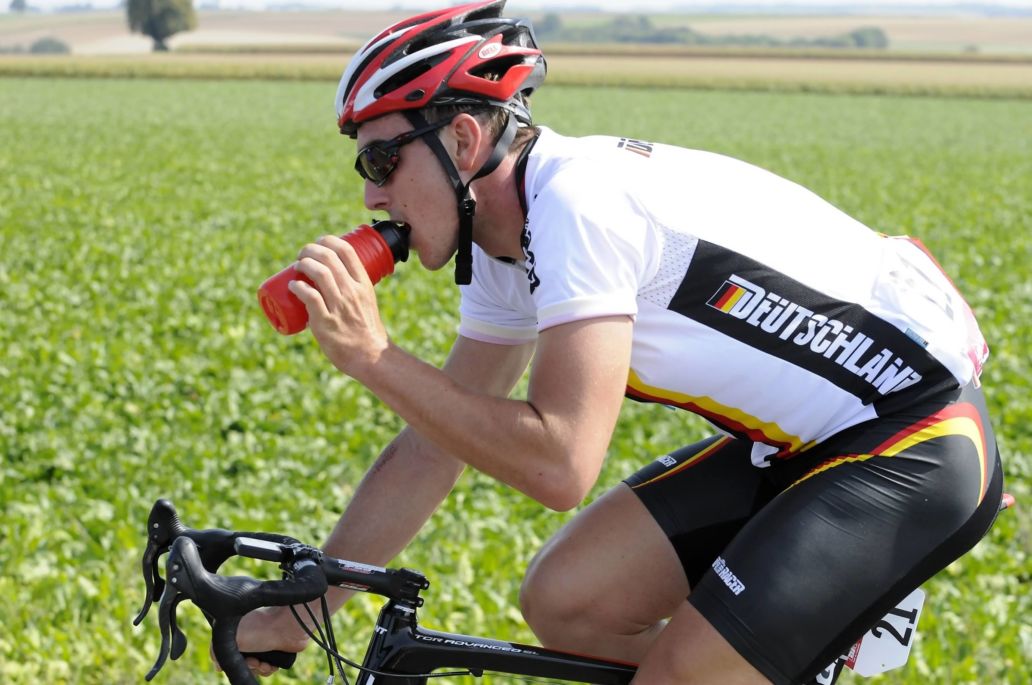
German Cycling Association joins MPCC!
There are more and more leading cycling countries to see their association joining MPCC. Five out of the 10 first nations in the 2015 World Tour ranking are now part of MPCC after the announcement made on November 3 of BDR's membership (Bund Deutscher Radfahrer).
The BDR’s decision falls within a particular context as the Secretary General Martin Wolf points out: « A large number of German high-level riders such as Marcel Kittel, John Degenkolb or Tony Martin have openly committed to support the fight against doping. Some renowned German teams such as Giant-Alpecin, Bora-Argon 18 and Stötling (which merges with Cult Energy in 2016) are already members of MPCC. »
Martin Wolf : « To apply the principles of MPCC into the national team »
« German medias, especially the first channel ARD, have started again to report on the Tour de France this year, with particular consideration for the fight against doping, he continues. Our national association wishes to be exemplary in antidoping matters by joining MPCC and apply its principles into the national team. Thanks to this membership, BDR wants to increase its influence in this process in a credible and lasting manner, but also to encourage all the German teams to commit to MPCC. »
The BDR adds it « has been demanding for a long time the development and implementation of an anti-doping law in Germany. »
Roger Legeay : « An other big step for MPCC »
With this membership, there are now 9 national associations part of MPCC: France, Belgium, The Netherlands, Switzerland, Norway, Ireland, Israël, Morocco and Germany.
President of MPCC, Roger Legeay considers German Cycling Association’s arrival as great news : « The BDR is a very big association and its membership represents an other big step for MPCC. We can’t wait to work alongside them and are asking all the national associations to join us. »
John Degenkolb interview on anti-doping matters:
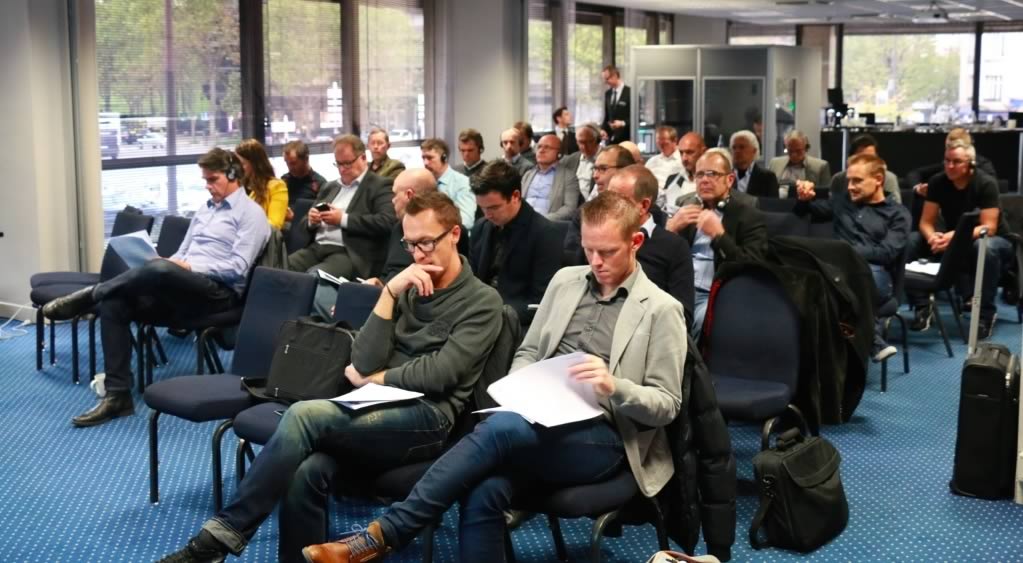
10/20 Press Release
MPCC is delighted to be able to count now on the opinion of 7 endocrinologist experts (from USA, Belgium, Italy, Sweden and France) who unanimously validate two key MPCC principles in the field of health:
- Corticosteroids use enhances the performance
- An abnormally low cortisol level endangers rider health during periods of high stress.
Every MPCC member team representative attending the doctors meeting confirmed the wish to continue performing cortisol level tests. They even want to increase the number of controls carried out (615 this year). Last August, tests were made for the first time in the Eneco Tour. MPCC wants to extend the cortisol monitoring to new countries in 2016 as well as to women's teams which are members of the movement.
Regarding the issue of the use of corticosteroids, WADA has established a working group – chaired by Valérie Fourneyron – which MPCC and its experts will be invited to cooperate with.
Moreover tramadol will be added to the list of substances prohibited in competition from January1, 2016. This was a long standing request by MPCC to WADA.
The new representative doctors of MPCC member teams are:
- Dr. Guillaume Sarre (AG2R La Mondiale)
- Dr. Servaas Bingé (Lotto-Soudal)
The General Assembly lamented five teams’ failure to comply with the commitment they expressed to MPCC on their own volition: Astana, Lotto-Jumbo, Lampre-Merida, Southeast and Bardiani-CSF.
MPCC also welcomed the fact that the UCI considers the movement as reflective of the majority of professionnal teams by adopting in its rules the principle of self-suspension which is applied by MPCC members since its very inception.
As requested by MPCC, the Professional Cycling Council (CCP) decided to allow a team to replace a rider in the case of force majeure, including that of an abnormally low cortisol level at the start on a grand tour.
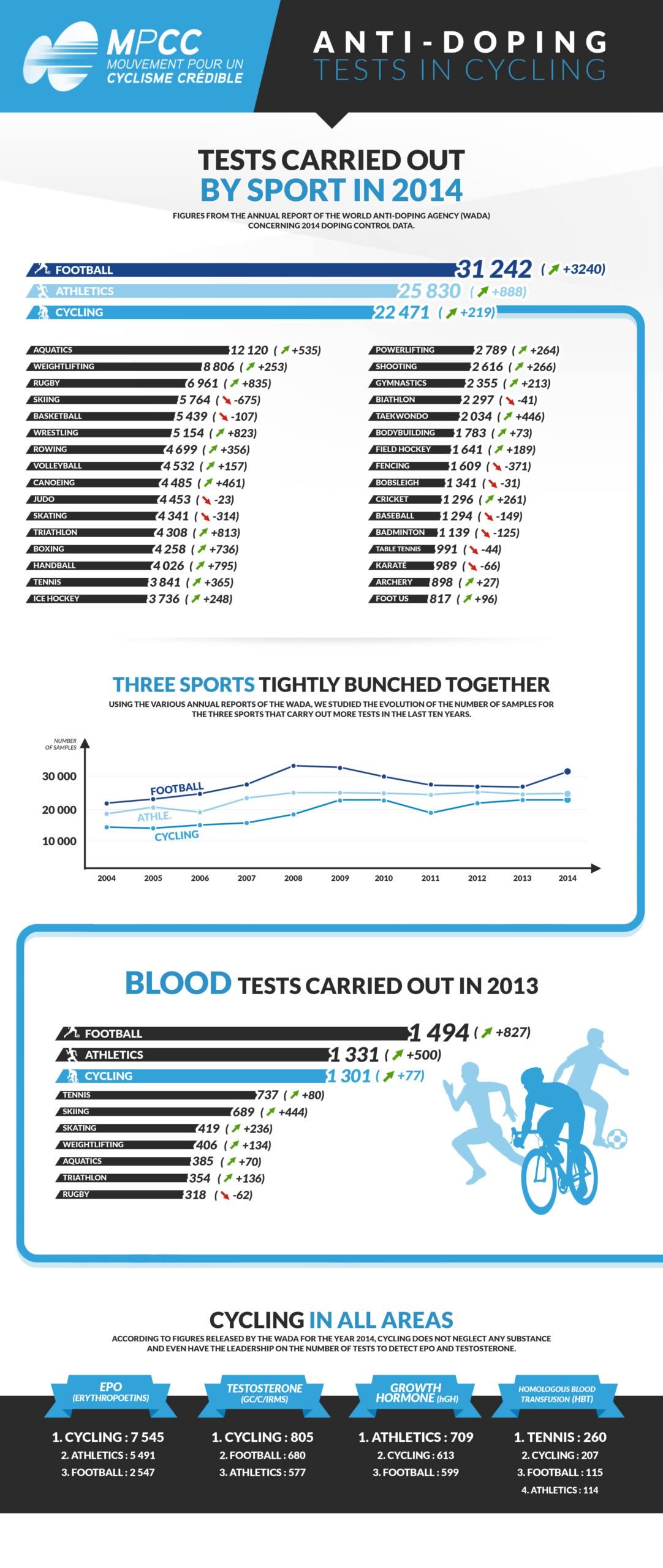
Cycling still a driving force of the antidoping fight
Cycling still among the top three of an improving peloton
Football, athletics and cycling are the three sports doing the most meaningful work against doping in terms of quantity of tests performed each year. This trio has been the same for many years now – the fact that cycling is part of that leading bunch is remarkable if we compare the global number of athletes practicing these sports to a high level. According to a 2006 census conducted by the FIFA, there are 113,000 professional football players in the world. In contrast, only 1,200 cycling riders are pro all disciplines taken together. Contacted by MPCC, the IAAF was unable to provide a figure which would be used as a comparative element.
Having been the most growing sport in the number of tests performed in 2013, cycling reached its peak with 22,252 controls carried out over the entire year. That figure went even higher in 2014 (22,471 tests) but football emerged as the sport showing the largest increase with 3,240 additional tests compared to 2013.
Cycling was the only sport among the 2013 top five to have increased the number of tests, whereas football, athletics, swimming and weightlifting made fewer. In 2014 all those sports have resumed upward movement, as well as rugby - the 6th sport on the list. Though the number of tests performed was lower for 24 sports in 2013, they were only 11 remaining in 2014.
Cycling keeps the lead on EPO testing and now also on testosteron
In 2013 cycling was the only sport performing more than 1,000 blood tests, making it the leader in this specific fight. This figure continued to increase in 2014 (from 1,224 to 1,301) while other big sports achieved to catch up. Football carried out 827 more blood tests than in 2013, athletics 500, occupying now the top two positions ahead of cycling.
However cycling remains the sport which favours the most the qualitative side. As in 2013, cycling still is the leading sport on the screening of EPO. Cycling also achieved to pass ahead of athletics to become the sport which performs the largest number of testosteron tests.
A very clear increase of the number of growth hormone tests has been observed in all sports put together. Cycling is the second sport, behind athletics, with the largest number of growth hormone controls.
In 2013 athletics was the sport with the largest number of approved transfusion tests carried out. This sport now comes in fourth position. In this area tennis took a spectacular step and moved from the eighth rank to the first one. Cycling confirms its determination to leave nothing to chance by remaining in the second position. So cycling is the only sport to be among the top two in terms of tests performed for each of the four doping substances the most tested in sport : EPO, testosteron, growth hormone, homologous transfusion.
The antidoping struggle of cycling is intended to be both quantative and qualitative – not forgetting its pioneering role played in the implementation of ADAMS geolocalisation system (endorsed from its inception in 2005) and biological passport (endorsed from its inception too in 2008).
09/03/15 Press Release
After hearing Team Astana representative Dmitriy Fofonov’s arguments, the Board of directors of MPCC has decided to exclude Team Astana for non-compliance with the 9th article of the internal regulation. The team let one of its riders take the start of the Tour de France with a cortisol level under the MPCC volontary norm.
Although cortisol hormones are an allowed medicine when prescribed by a physician, the use of that medicine has frequently been abused in the history of sports (including in cycling) for the purpose of increasing the performance. Besides, a low level of cortisol can potentially endanger the health of athletes in certain circumstances when he/she is in competition while the athletes perform under high intensity or under stress.
For both reasons and with the objective to contribute to restoring the credibility of cycling, MPCC and its member teams have introduced that voluntary norm below which its riders will temporarily withdraw from competition.
In another case, the movement also heard Team Androni Giocattoli manager Gianni Savio’s arguments about the three doping cases found in his team during the last 24 months, including two this year. One of these riders has been dismissed while the other one is suspended pending counter-analysis results. The team abided to the 10th article of the internal regulation and self-suspended for a month with knowledge of the third case. MPCC notes Androni Giocattoli’s compliance with the voluntary rules governing the movement and supports the team members’ choice to sue those riders.
Regarding image and credibily of cycling, MPCC approves the firm attitude of the UCI which has been strict in the application of its rules by excluding Vincenzo Nibali and his sporting director from the Vuelta. It is important that the jury has all the necessary information in the event of a comeback into the peloton after a crash or a flat tyre. To his end continuous-time video arbitration is seen by the movement as a necessity.
The Board of directors also mentioned the coming general meeting which will be held on 19 October in the presence of the 106 members of the movement.
Doping figures as at August 26
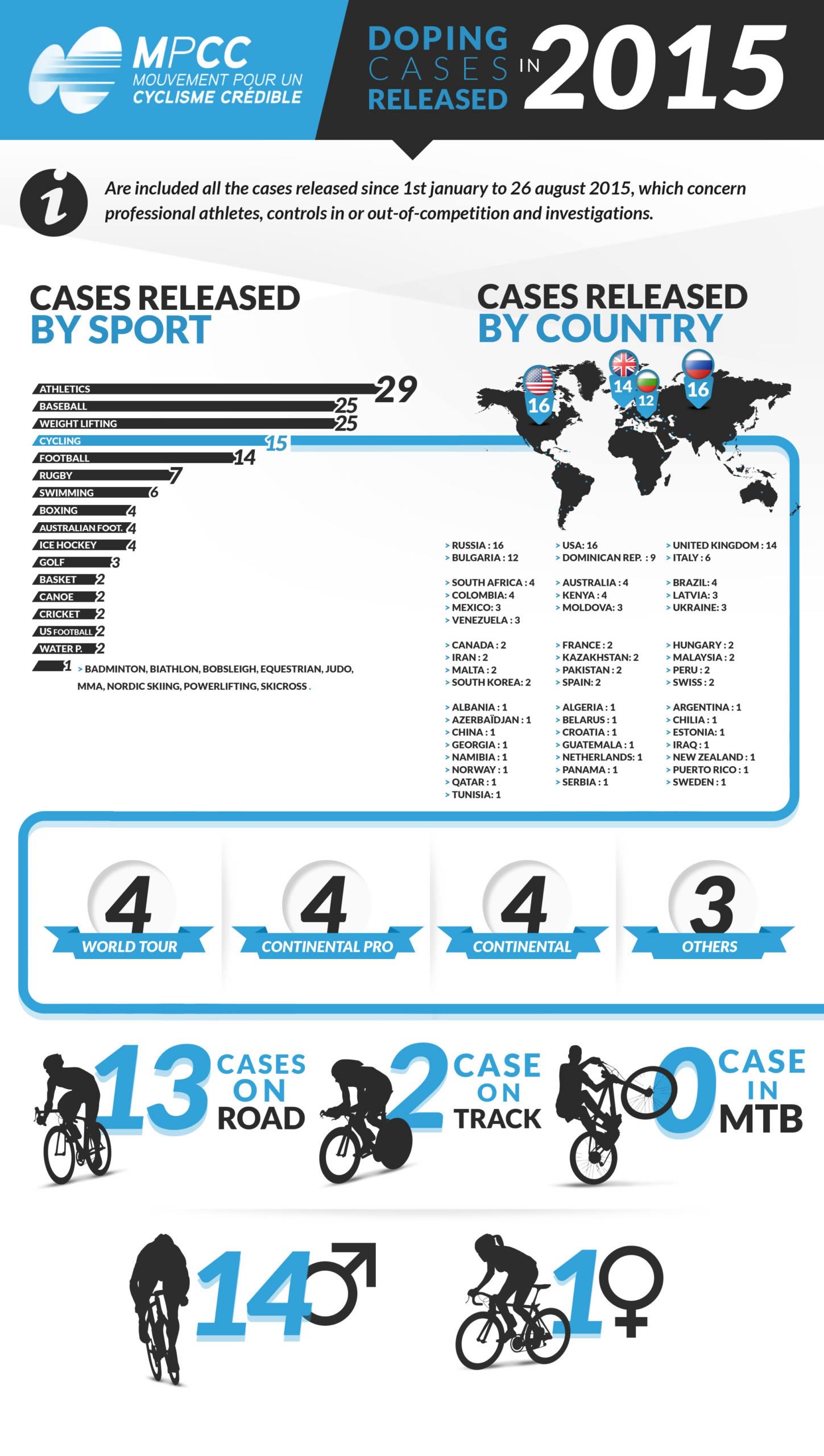
« We are not cycling. (...) We have no lesson to be taught by any other sport. » Two days before the kick off of World Championships in Athletics, former IAAF president Lamine Diack has protected his sport by attacking ours. MPCC would remind the recorded figures in 2014: our sport-by-sport doping case statistics highlighted Athletics as the sport with the biggest figure (95 cases for professional athletes). Cycling’s was six times lower (16 released cases).
Once again this year Athletics remains the most affected sport with 29 cases as at 26 August – 4 more than baseball or weightlifting, 14 more than cycling which totals 15 cases with only 4 in the World Tour.
Identifying cases of doping is not an easy task and is subject to discretion if required by their respective international federations, some do not advertise doping cases in their discipline. Cycling, in contrast, reveals each positive test. Our numbers are therefore based on proven cases in 2014, according to official communications federations and anti-doping agencies, etc...
As a reminder, in 2013 cycling was the sport with the highest number of blood tests conducted. All tests taken into account, athletics figure reached 24 942, cycling 22 252. By comparison, 1 800 athletes are taking part into Beijing 2015 World Championships, 198 riders competed in the Tour de France.
All sports have to face the antidoping challenge – that is highlighted by these infographics. International sport association presidents have to admit that the fight must be universal.
Vuelta: cortisol level tests revealed no abnormally low values
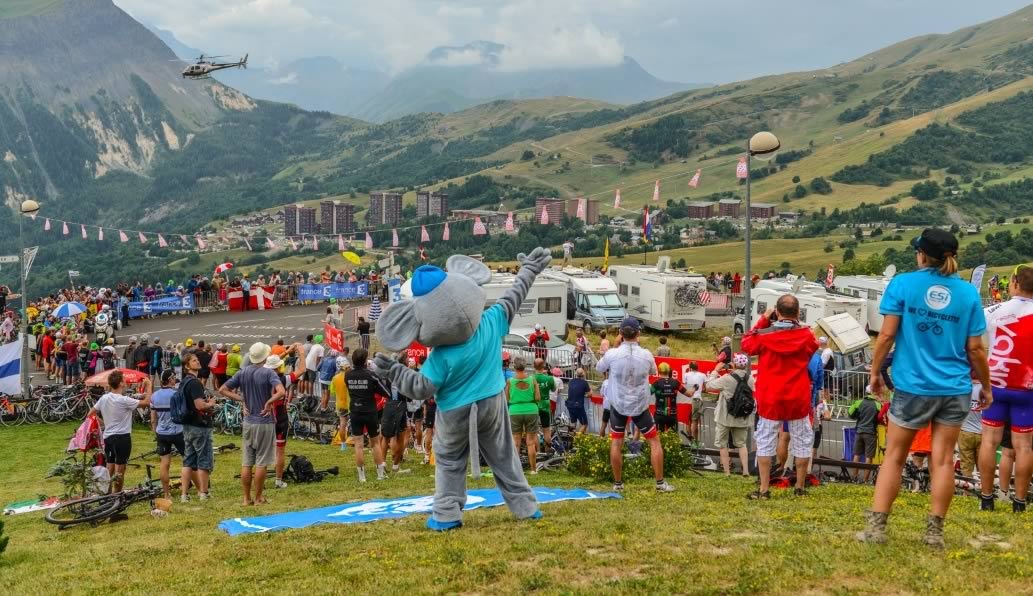
This Thursday, 20 August 2015, in Marbella, start of the race, 13 team members registered for the Vuelta a España submitted their riders to a cortisol level test as part of their commitment to the Movement for a Credible Cycling (MPCC):
- AG2R La Mondiale
- Caja Rural - Seguros RGA
- Cannondale-Garmin
- Cofidis
- Team Colombia
- Team Europcar
- FDJ
- Giant-Alpecin
- IAM
- Team Katusha
- Lotto-Soudal
- MTN-Qhubeka
- Orica-Greenedge
These voluntary tests have been performed under the auspices of the Union Cycliste Internationale (UCI) on all participants. The UCI has forwarded to the Movement pour un Cyclisme Crédible the results of all riders of the MPCC member teams. All values were above the voluntary MPCC norm. The Board notes with satisfaction that the riders of these MPCC member teams registered for the Tour de France have scrupulously respected the clauses of their standing orders.
Background on cortisol tests by the Mouvement pour un Cyclisme Crédible (MPCC)
The objective of the MPCC and its member teams is to contribute to restoring the credibility of cycling. One of the organisation’s activities are voluntary cortisol tests amongst the riders of the member teams of the MPCC. In case the results of the test present an abnormally low value, the rider concerned will not race for a period of minimum eight days until the cortisol value has recovered again above that minimum value.
For the sake of clarity: it concerns a voluntary norm and the test does not concern an anti-doping control. Under WADA rules, athletes across all sports, with a cortisol level abnormally low, are entitled to perform their sport in competition (unless an anti-doping test has revealed the unauthorized use of the cortisol hormone).
The reason for the MPCC member teams to introduce this voluntary norm (below which the rider concerned will withdraw from competition for that minimum period of eight days), is an effort towards all stakeholders and fans of the sport of cycling and to confirm its commitment to clean sport and to show that cycling and MPCC member teams wish to be a frontrunner in that.
Why cortisol tests ?
Although cortisol hormones are an allowed medicine when pre-scribed by a physician, the use of that medicine has frequently been abused in the history of sports (including in cycling) for the purpose of increasing the performance. Besides, a low level of cortisol can potentially endanger the health of athletes in certain circumstances when he/she is in competition while the athletes perform under high intensity or under stress.
For both reasons and with the objecitve to contribute to restoring the credibility of cycling, the Mouvement pour un Cyclisme Crédible and its member teams have introduced that voluntary norm below which its riders will temporarily withdraw from competition.
Eneco Tour: cortisol level tests revealed no abnormally low values
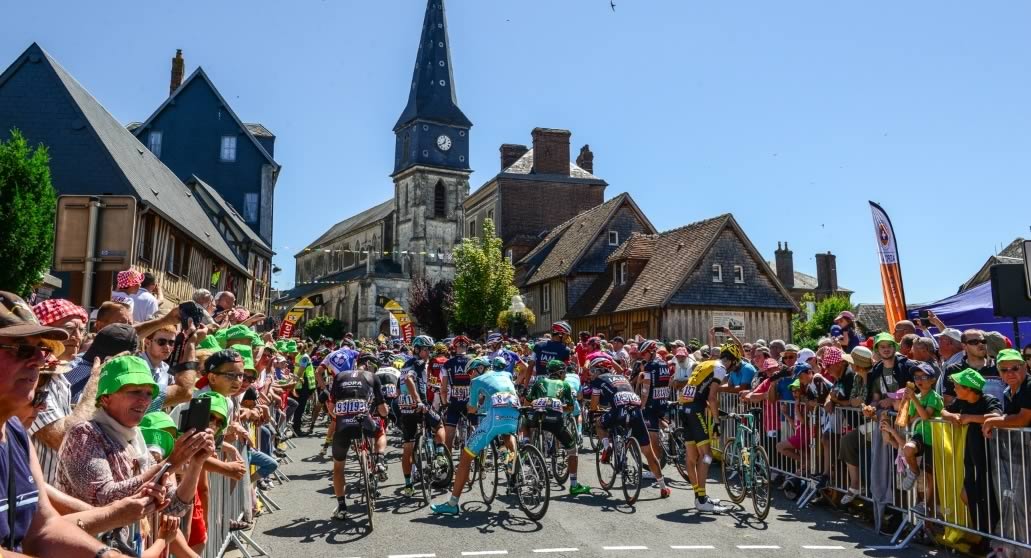
For the very first time, random cortisol level tests have been performed by MPCC on a race outside of France, on Tuesday morning at the start of Eneco Tour's fourth stage. 11 MPCC member teams submitted 33 riders to these cortisol level tests. All values were above the voluntary MPCC norm.
TDF: others cortisol level tests revealed no abnormally low values
This Saturday, 25 July 2015, in Modane, start of stage 20, 4 team members registered for the Tour de France submitted their riders to a cortisol level test as part of their commitment to the Movement for a Credible Cycling (MPCC):
- Bretagne-Séché Environnement
- Team Katusha
- Cannondale-Garmin
- Lotto-Soudal
These voluntary tests have been performed in collaboration with French Cycling Association (FFC) and French Cycling League (LNC). All values were above the voluntary MPCC norm. The Board notes with satisfaction that the riders of these MPCC member teams registered for the Tour de France have scrupulously respected the clauses of their standing orders.
Background on cortisol tests by the Mouvement pour un Cyclisme Crédible (MPCC)
The objective of the MPCC and its member teams is to contribute to restoring the credibility of cycling. One of the organisation’s activities are voluntary cortisol tests amongst the riders of the member teams of the MPCC. In case the results of the test present an abnormally low value, the rider concerned will not race for a period of minimum eight days until the cortisol value has recovered again above that minimum value.
For the sake of clarity: it concerns a voluntary norm and the test does not concern an anti-doping control. Under WADA rules, athletes across all sports, with a cortisol level abnormally low, are entitled to perform their sport in competition (unless an anti-doping test has revealed the unauthorized use of the cortisol hormone).
The reason for the MPCC member teams to introduce this voluntary norm (below which the rider concerned will withdraw from competition for that minimum period of eight days), is an effort towards all stakeholders and fans of the sport of cycling and to confirm its commitment to clean sport and to show that cycling and MPCC member teams wish to be a frontrunner in that.
Why cortisol tests ?
Although cortisol hormones are an allowed medicine when pre-scribed by a physician, the use of that medicine has frequently been abused in the history of sports (including in cycling) for the purpose of increasing the performance. Besides, a low level of cortisol can potentially endanger the health of athletes in certain circumstances when he/she is in competition while the athletes perform under high intensity or under stress.
For both reasons and with the objecitve to contribute to restoring the credibility of cycling, the Mouvement pour un Cyclisme Crédible and its member teams have introduced that voluntary norm below which its riders will temporarily withdraw from competition.
Tour de France: cortisol level tests revealed no abnormally low values
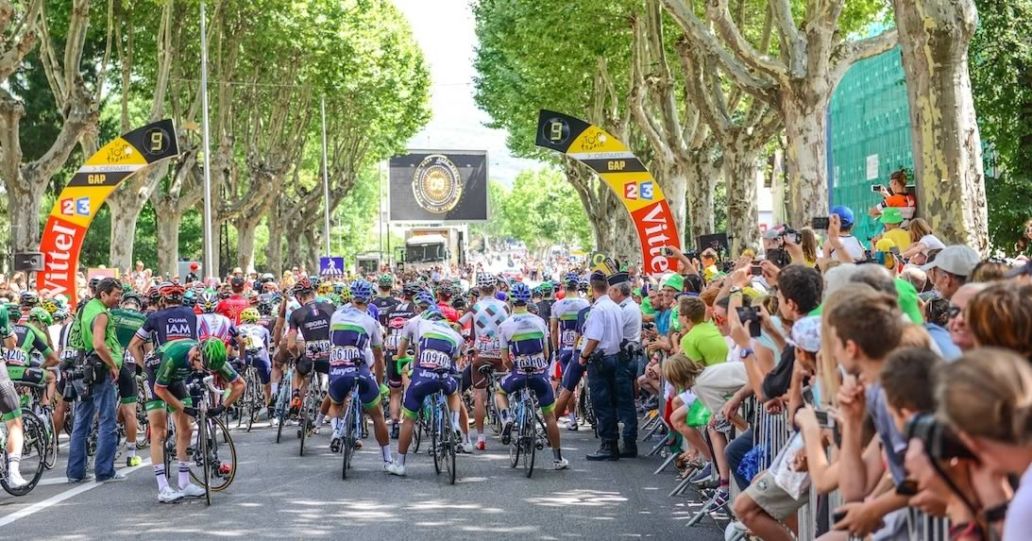
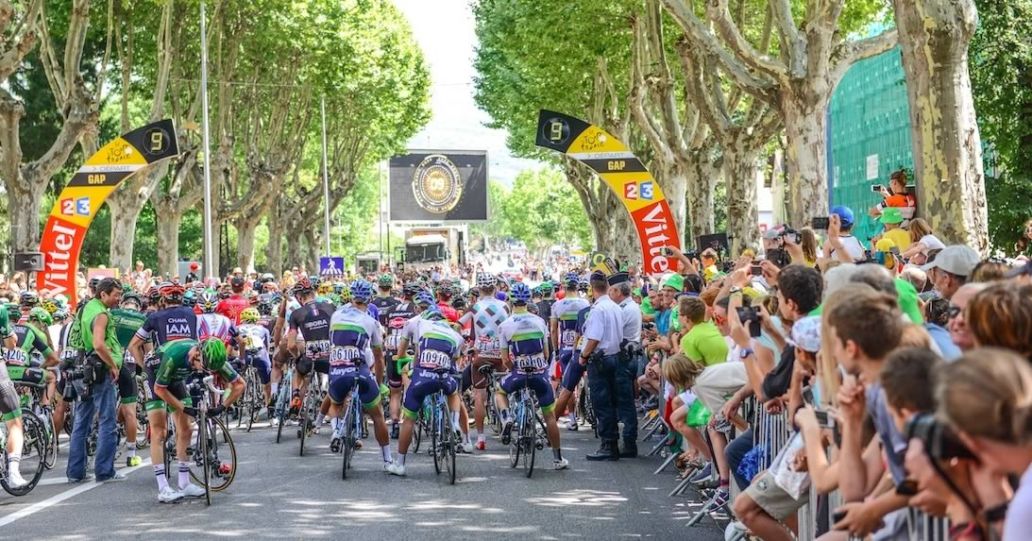
This Friday, 24 July 2015, in Saint-Jean-de-Maurienne, start of stage 19, 9 team members registered for the Tour de France submitted their riders to a cortisol level test as part of their commitment to the Movement for a Credible Cycling (MPCC):
- AG2R La Mondiale
- FDJ
- Giant-Alpecin
- Orica-Greenedge
- Team Europcar
- Cofidis Solutions Credits
- IAM Cycling
- Bora - Argon 18
- MTN - Qhubeka
These voluntary tests have been performed in collaboration with French Cycling Association (FFC) and French Cycling League (LNC). All values were above the voluntary MPCC norm. The Board notes with satisfaction that the riders of these MPCC member teams registered for the Tour de France have scrupulously respected the clauses of their standing orders.
Background on cortisol tests by the Mouvement pour un Cyclisme Crédible (MPCC)
The objective of the MPCC and its member teams is to contribute to restoring the credibility of cycling. One of the organisation’s activities are voluntary cortisol tests amongst the riders of the member teams of the MPCC. In case the results of the test present an abnormally low value, the rider concerned will not race for a period of minimum eight days until the cortisol value has recovered again above that minimum value.
For the sake of clarity: it concerns a voluntary norm and the test does not concern an anti-doping control. Under WADA rules, athletes across all sports, with a cortisol level abnormally low, are entitled to perform their sport in competition (unless an anti-doping test has revealed the unauthorized use of the cortisol hormone).
The reason for the MPCC member teams to introduce this voluntary norm (below which the rider concerned will withdraw from competition for that minimum period of eight days), is an effort towards all stakeholders and fans of the sport of cycling and to confirm its commitment to clean sport and to show that cycling and MPCC member teams wish to be a frontrunner in that.
Why cortisol tests ?
Although cortisol hormones are an allowed medicine when pre-scribed by a physician, the use of that medicine has frequently been abused in the history of sports (including in cycling) for the purpose of increasing the performance. Besides, a low level of cortisol can potentially endanger the health of athletes in certain circumstances when he/she is in competition while the athletes perform under high intensity or under stress.
For both reasons and with the objecitve to contribute to restoring the credibility of cycling, the Mouvement pour un Cyclisme Crédible and its member teams have introduced that voluntary norm below which its riders will temporarily withdraw from competition.