07/03 Press Release
Following the cortisol level tests carried out by the UCI on all the riders competing in the 2015 Tour de France, MPCC has received notice of the anonymous results of its 14 team members starting the race, on Friday afternoon.
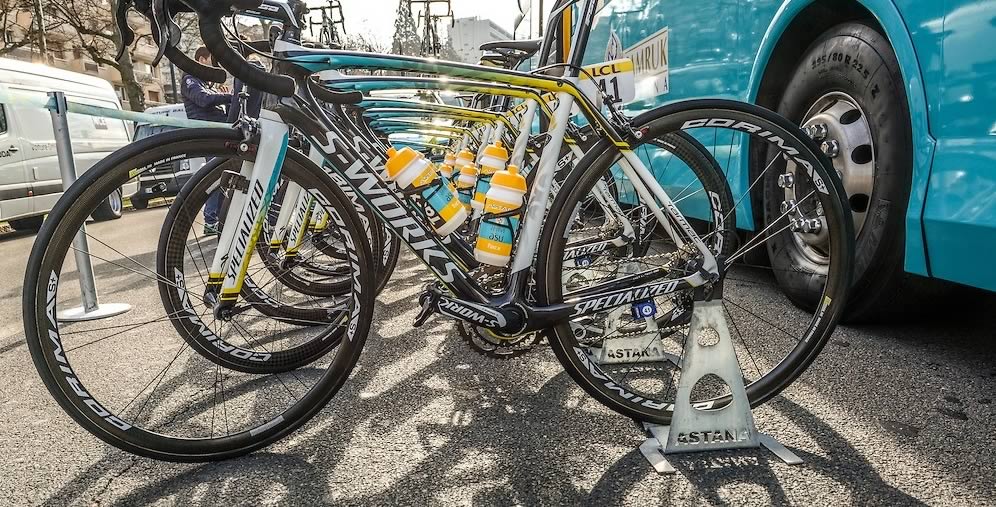
Its results having shown an abnormally low cortisol level, Team Astana has immediately reported Roger Legeay, President of MPCC, the identity of the rider concerned (Lars Boom).
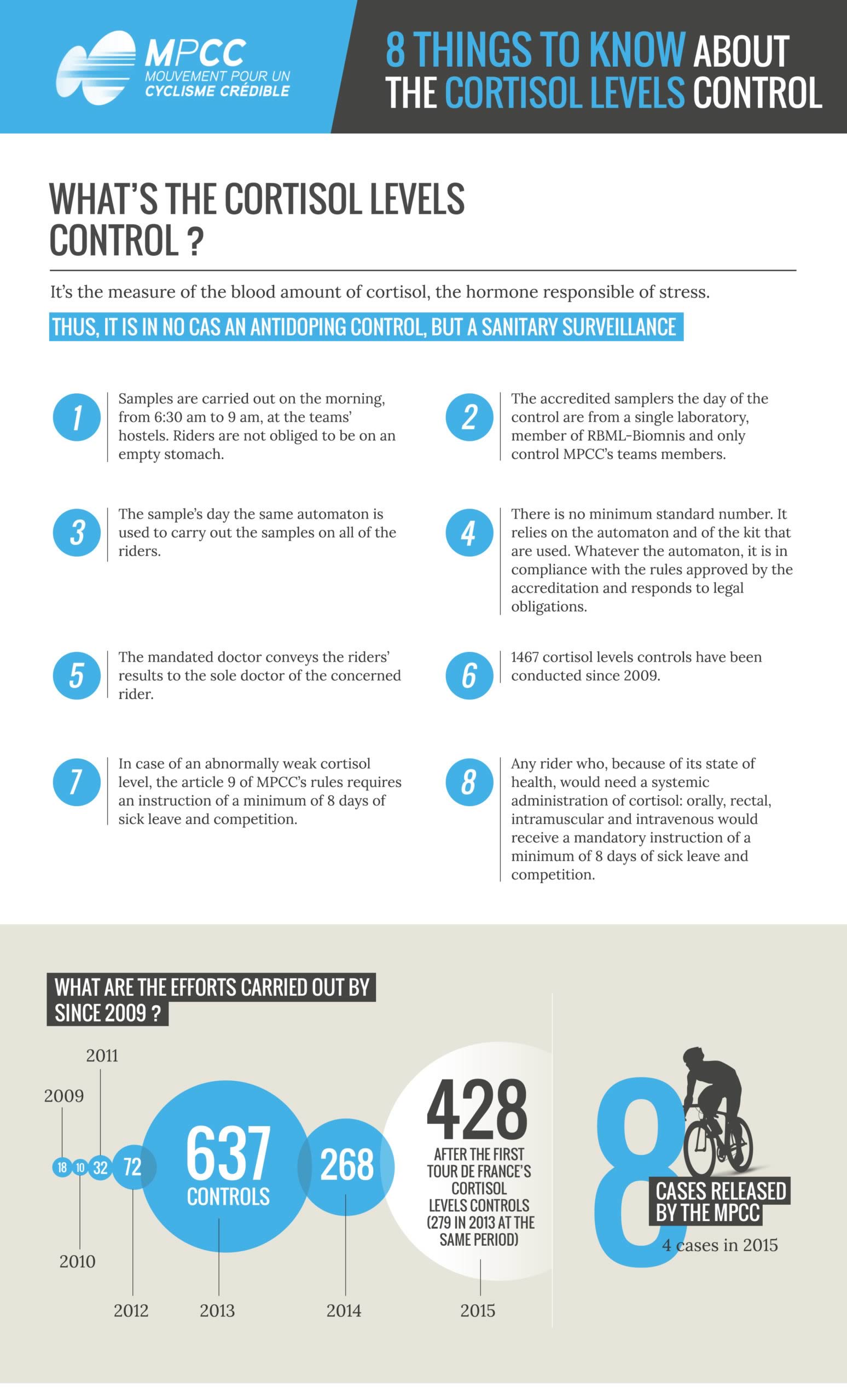
According to article 9 of MPCC regulation, in case of abnormally low cortisol levels, competition will resume after an additional 8-day rest minimum, and back-to-normal cortisol levels.
MPCC would like to remind that cortisol level tests are carried out within the framework of health, not antidoping.
Press release about Team Southeast
In August 2014, UCI revealed that Matteo Rabottini, from MPCC member Neri Sottoli, had been tested positive. The movement “deplored that they were not informed by the team spontaneously, following the positive control of its rider, and were provided no acceptable explanation at the general meeting, during which the team [did] not show up.”
On 3 December 2014, the board of MPCC met Serge Parsani, sporting director of the team, and who was representing its manager Angelo Citracca. The membership of the team for the coming season depended on these new explanations. At the end of the board meeting it was decided to suspend team Neri Sottoli’s MPCC membership with immediate effect, until the October 2015 general meeting. The team, since renamed Southeast, continued to be considered a member of MPCC until that decision was made in this general meeting.
On 9 June 2015, UCI revealed that Ramon Carretero had been tested positive for EPO. The Panamanian rider is also part of Team Southeast which followed Neri Sottoli. Those two positive tests occurred over a less than twelve month period, so MPCC signalled Team Southeast that, under the rules of the movement, it had to suspend itself between June 13 and 20 of this year.
In response to MPCC’s self-suspension request, Team Southeast stated that it has no longer considered itself as a member of the movement since January 2015 and hasn’t felt concerned by the self-suspension. Contacted several times since the beginning of the year, Team Southeast’s executives never indicated to MPCC their wish to remain member of the movement or not.
Given the facts outlined and in accordance with the rules governing the organization, MPCC therefore opens exclusion process against this team.
Dauphiné: Cortisol level tests revealed no irregularity
This Saturday June 13th in Montmélian, start of stage 7, the 13 team members registered for Critérium du Dauphiné submitted their riders to a cortisol level test as part of their commitment to the Movement for a Credible Cycling (MPCC):
- AG2R La Mondiale
- Astana
- Bora-Argon 18
- Cannondale-Garmin
- Cofidis
- Europcar
- FDJ
- Giant-Alpecin
- IAM
- Katusha
- Lotto-Soudal
- MTN-Qhubeka
- Orica-Greenedge
These tests have been performed within the framework of riders’ health, in collaboration with French Cycling Association (FFC) and French Cycling League (LNC). No irregularity has been revealed. The Board notes with satisfaction that all the team members of MPCC registered for Critérium du Dauphiné have scrupulously respected the clauses of their standing orders.
Cortisol levels: MPCC’s answer to LottoNL-Jumbo
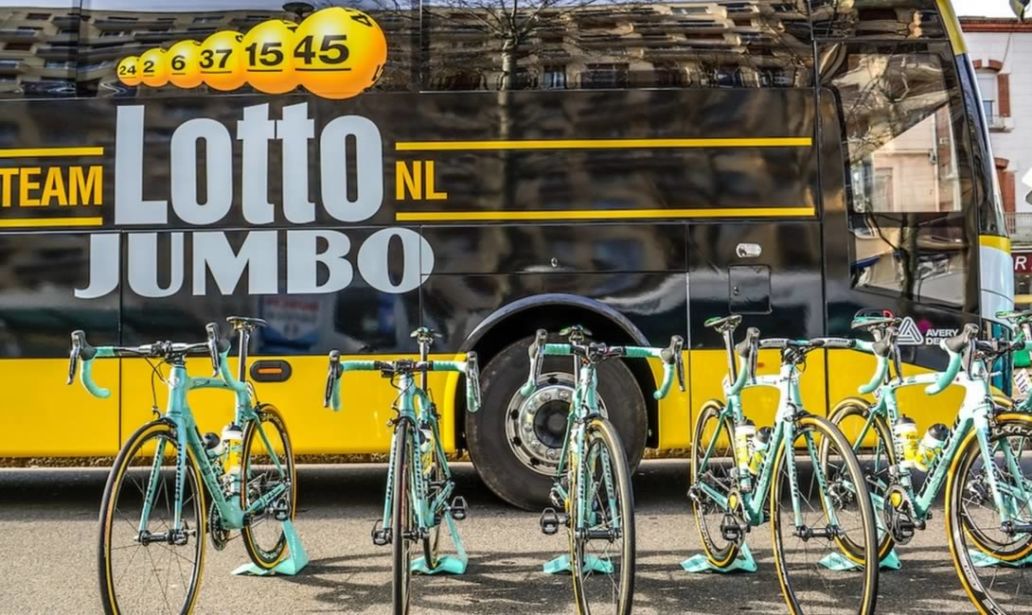
In a press release dated on 10th of June 2015, LottoNL-Jumbo announced its decision to quit MPCC by reconsidering the Article 9 of the internal regulation. This stipulates that « in case of unusually low cortisol levels, competition will resume after an additional 8-day rest minimum and back-to-normal cortisol levels. » This article has been existing since the establishment of the movement in 2007. Any team which wants to be part of MPCC fully acknowledges the full internal regulation, which is yearly approved by the General Assembly in the presence of movement’s members.
Thus, on 21st of October 2014, MPCC’s General Assembly unanimously approved its internal regulation for the year 2015. Outside the general meeting, team physicians even asked for « the number of cortisol tests, procuded several times a year on a voluntary basis, to be increased. »
These same physicians also asked international expert opinions to support the recommendation of French experts Yves Le Bouc, Martine Duclos and Michel Guinot (doctors appointed by the French Cycling Association) in order to reach a shared position on corticosteroids use. In beginning of April 2015, U.S. endocrinologist expert Jonathan Ownby reinforced the position adopted by MPCC members. Other opinons are expected soon by the MPCC. Like any other team member, LottoNL-Jumbo recommended the opinion of an international expert of their choice, who never replied to MPCC’s requests.
In addition to that and after team member physicians request, MPCC reminds that a number of requests, related to the implementation of the regulation of corticosteroids use, has been sent to Union Cycliste Internationale (UCI) and World Anti Doping Agency (WADA).
According to MPCC Board members meeting in Lyon on 8th of June 2015, there is no reason to grant LottoNL-Jumbo’s request, to avoid proceeding to cortisol level tests on the coming races. No change in the internal regulation can be adopted before the next General Assembly planned in October 2015.
More than 1,300 cortisol level tests have been performed on riders of MPCC team members since 2009. Only 7 samples revealed unusually low cortisol levels in that period. The Board is surprised to observe that the cortisol level of a rider on inhaled corticosteroids treatment has not been better monitored by LottoNL-Jumbo medical staff in the days prior to 2015 Giro, especially in the light of a first case of unusually low cortisol level faced by the team at the start of 2013 Vuelta.
In conclusion, the MPCC Board reminds that the health of the riders and full respect of the rules abided voluntarly by the members remain the fundamental principles of the movement.
“Everybody into MPCC would like to see the MPCC rules enforced by WADA or UCI”
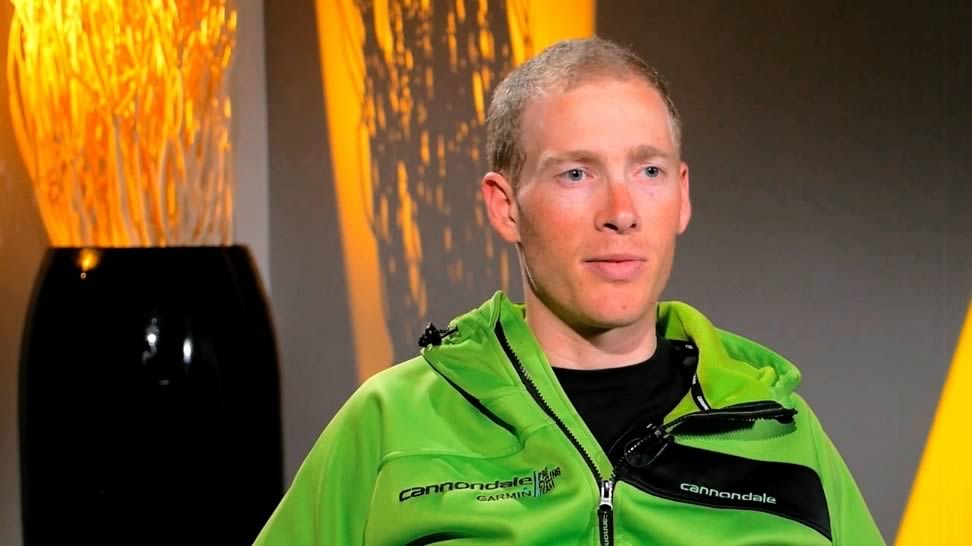
Andrew Talansky was the first Americain rider to win Critérium du Dauphiné since Lance Armstrong, then stripped of his results achieved between August 1998 and the end of his career. Has the US people renewed their confidence in the country’s riders since the fall of the former seven time winner of the Tour de France ? The question remains, he says, even though he insists he was on the same side as those fans who felt cheated by all this story: he believed it before discovering the truth and had to disown his idol. « We have the same experience as the American fans », he states on behalf of a whole generation of riders who have not experienced the US Postal or Discovery Channel period and are now part of new teams such as Cannondale-Garmin.
Today, Andrew Talansky’s main concern about fight against doping is to know if fans are aware of the efforts made: « I think they can see that and they can understand ». He explains that Cannondale-Garmin’s commitment to MPCC - which is very faithful because lasting for almost 8 years - was part of an overall process established by the general manager Jonathan Vaughters from the very beginning of the team. He hopes that « maybe down the roads, in a few years » UCI may « model their own rules a little closer » to MPCC's.
Rollin : "There was a global awareness"
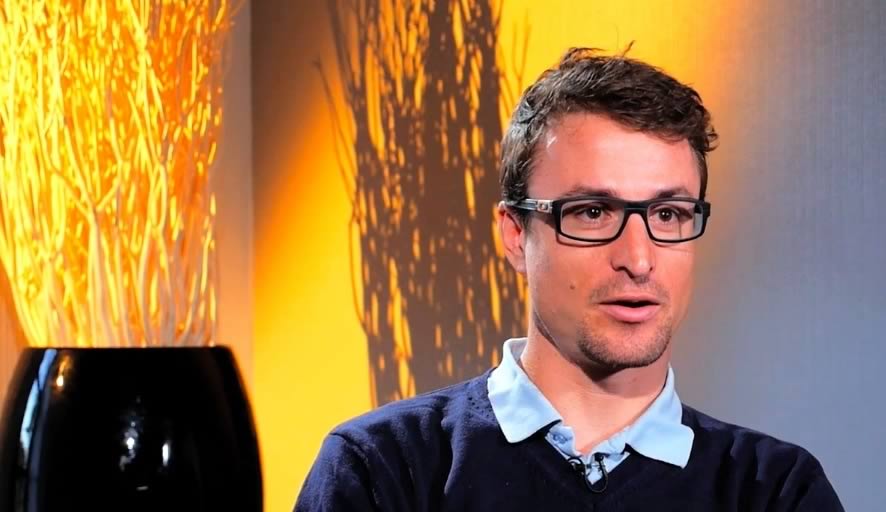
Dominique Rollin is an unconventional rider: now back in pro ranks with MPCC member Team Cofidis after a year without competition, the Canadian is beginning a second career. The first one came at the relatively late age of 26 in 2009 with Cervélo, after two years at the Continental level in the United States. But in his early years, he spent time in Europe as part of VC Roubaix, a French amateur team which since became Roubaix-Lille Métropole.
In an interview with MPCC, Dominique Rollin considers that, in order to promote cycling, the main area of focus must not be the fight against doping: he estimates that this matter must be resolved internally and that this sport has to bring forward all that it does to make itself more attractive and understandable. He says he doesn’t feel concerned by such issues as corticosteroids because he doesn’t « have this culture to use pills ». He is rooted in the principle that he has never needed medicine, preferring instead to leave the task to alleviate health problems to his body – so he sees pain as something normal to deal with. In that sense he says he was surprised by the European culture upon his arrival in this continent.
Press release about Bardiani-CSF case
Following reports in today's press regarding team BARDIANI-CSF currently racing in the Giro d'Italia, MPCC expressly points out that on Friday, May 9, the movement was informed by team BARDIANI-CSF that one of its riders showed an abnormally low cortisol level.
As of this Friday prior to the start of the Giro d'Italia, MPCC has formally requested to the team BARDIANI-CSF - through its president - not to enter this rider into the race and to prescribe eight days off-race as from the date the sample was taken by the UCI, in accordance with article 9 of MPCC regulations and its annex.
MPCC considered that the explanations provided by the team BARDIANI-CSF were not sufficient to keep the rider in the race and immediately invited the team manager to attend the board of directors scheduled on June 8th in Lyon, in order to provide further explanation and allow the board to review this case.
MPCC would like to remind that on October 20, 2014, all the team doctors reaffirmed the strict enforcement of the existing rules for health reasons.
At this annual meeting, MPCC team doctors expressed unanimously their wish to increase the number of cortisol level tests.
Since the beginning of the year a total of 263 cortisol level tests have been run on the professional peloton, either on the initiative of MPCC (128) or UCI (135 in the Giro).
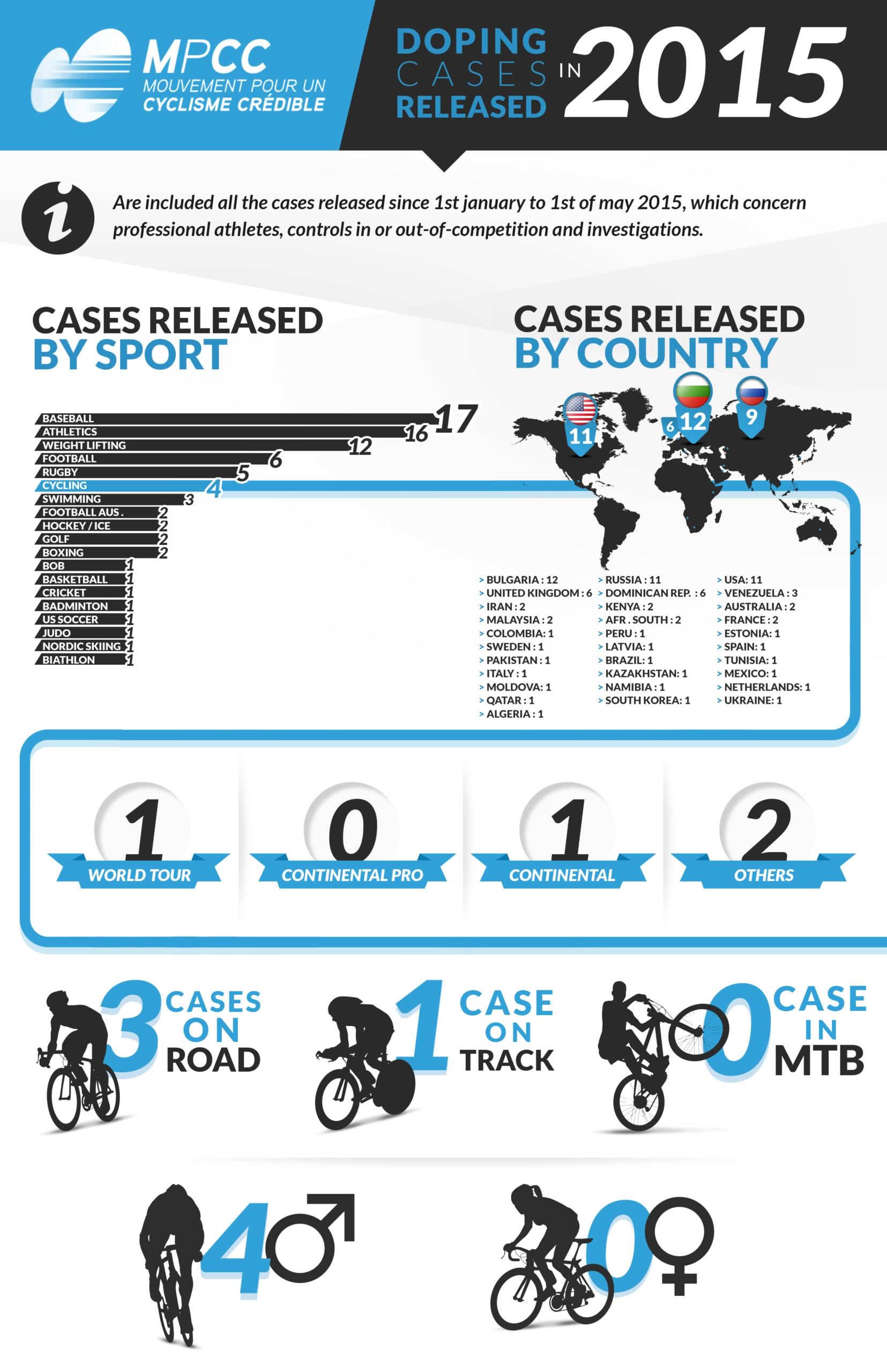
Doping figures as at May 1
Identifying cases of doping is not an easy task and is subject to discretion if required by their respective international federations, some do not advertise doping cases in their discipline. Cycling, in contrast, reveals each positive test. Our numbers are therefore based on proven cases in 2014, according to official communications federations and anti-doping agencies, etc..
In 2014, athletics was the sport most affected by positive tests (95), ahead of baseball (62). As at 1 May 2015, these two sports are at the front again with 17 positive tests for baseball and 16 for athletics. After four months, cycling, 4th most affected sport in 2014, is behind baseball, athletics, weightlifting, football and rugby.
The nation with the highest number of cases since the beginning of the year is Bulgaria: 11 weightlifters from this country have been tested positive.
MPCC counting includes:
- Road cycling: three cases identified for this most publicised discipline.
- Track cycling: one case
- Mountain bike: no case
Each time a team member of MPCC has been concerned by a case, the MPCC regulations were followed to the letter : suspension, dismissal.
"We are the only ones who can prevent a team from riding"
Confronted to a doping case, Team Lampre left MPCC at the beginning of the year. Why is that?
Our rules have not changed since 2007. Among MPCC affiliated teams, no rider who has been suspended more than six months may be retained by his team. These rules were established by all the managers, and to this day they have always applied them. In order to avoid having to comply with this rule, the Lampre team chose to leave our organization. They alleged some labor law issues in Italy. And I want to make it clear that if they had not, we would have considered excluding them.
Lampre did not seem to show any surprise when riders were excluded from some others MPCC teams after a doping case. It does not happen everywhere, but with MPCC, that's how things are. This is all very unfortunate. We need clear signals, similar to what they did for Horner by excluding him from the Vuelta due to a treatment with corticosteroids. This is the founding principle of volunteerism. You volunteer to respect the rules, or you are not a volunteer. Lampre was a volunteer. Faced with a doping problem, they are not volunteers any more.
Isn't MPCC striving to remain faithful to rules which, as time goes by, become immutable?
For founding members, our regulations came into force eight years ago. When a member choses to join, he doesn’t come to us saying, “there’s a line missing." While all suggestions are good to take into consideration, no one has ever told us: "It would be great if you could do this or that." Conversely, no one has ever said to us: "There is a line you could do without." The stability of our rules is paramount. In the heat of the moment, after cases such as Armstrong or Puerto, everyone obviously agreed with these rules. Well, once things calm down a bit, they remain the same!
What is the position of MPCC regarding one of its members, Astana, the license of which UCI has tried in vain to revoke?
MPCC is not concerned with granting or not granting licenses. We acknowledge it, that's all. There are known limitations to the arsenal of legal repression available to the international associations. The pitfall encountered by UCI regarding the Astana case is probably the same as the one who had forced UCI to step back in the Katusha case two years ago. These recent events show that MPCC rules are an inescapable, vital complement to those of UCI, even though they may in no event replace them. Today, after several doping cases observed in the same team, MPCC is the only body who can prevent this team from riding. In 2013, we had the self-suspensions from the AG2R La Mondiale and Rusvelo teams. At the end of the 2004 season, Astana had to self-suspend. Let’s keep in mind that the voluntary action of our members was instrumental in the team having to suspend itself during the Beijing tour, the last race of the World Tour. And all this was only made possible because of their voluntary commitment to strict rules. You have to admit it takes certain courage for teams to accept this level of responsibility, with all the constraints that it entails... Astana was thus exposed to UCI financial penalties for not taking part in an event that was part of the international schedule, and to which they were supposed to participate. What we now wish to obtain is for the UCI to consider a non-participation in a World Tour event following an MPCC induced self-suspension as acceptable grounds.
In your opinion, is there a significant portion of MPCC members who join for self-serving motives?
Everyone understands that on a voluntary basis, there is more that we can do. World Tour teams are here, with very strict rules to respect: take Astana for instance, they are now facing a potential one month-long self-suspension if the team faces a new doping cases by August 1st, 2016! Opportunism? After the Armstrong case, in the heat of the moment, teams came to join. But even today, new teams such as Roompot spontaneously join MPCC. 100% of Continental Pro teams are members. Yet the MPCC regulation has a real financial impact. A rider affected by the opening of a judicial or disciplinary procedure does not ride, so he is paid not to ride. MPCC membership also implies the manager, the doctors, the sponsor, the coaching team. It goes much further than just an opportunistic posture. It is easy to see when you take Astana, AG2R La Mondiale: they self- suspended, with the financial implications that it entails!
Is the new UCI management going in the right direction in terms of regaining a lost credibility in that sport?
Of course it’s going in the right direction. There is a clear willingness to leave nothing to chance and to legislate. In this context, MPCC is truly a purveyor of ideas: we did it for xenon, for tramadol, for the "no needle policy", for self- suspension in case of abnormally low cortisol levels, for the electric bike. But we also know that there are MPCC rules that will not become UCI rules because they are obligated to respect World Anti-Doping Agency rules and stay within the framework of its Global Code, whereas our actions are based on the concepts of volunteerism and commitment.
Do you wish for the UCI and the CCP (4) to go even further?
Can they? Since January 2015, the UCI has incorporated the principle of self-suspension of a team, but it only applies if the team is proven to be at fault. So we are still in a principle of suspension, not self-suspension. Our regulations stipulate that, whatever happens, two positive cases in less than a year means one week with no competition for the whole team; three positive cases in less than two years also mean one month of suspension for the whole team. It makes sense, within a legal context such as that which binds the UCI, to allow the team to explain, to show that it did not errors, but all this shows that MPCC remains a true, efficient addition to UCI rules. Because with the MPCC, things happen right away. A second positive case on Thursday, the rider states he will not seek a counter-analysis, and on Monday the team self-suspends. We got a decision in four days!
I also want to point out that since 2007, a rider who belongs to an MPCC affiliated team and receives notification of a positive B sample result cannot take part in any competition until the disciplinary procedure has closed. It is very important for the credibility of our sport.
The new AIGCP president, Iwan Spekenbrink, elected last month, is also the vice-president of MPCC. Can he make things evolve regarding this issue?
Iwan Spekenbrink had his team join from the moment it was created, and this dates back pretty much to the origin of MPCC. He is now the vice-president. Obviously, he will have a real willingness to integrate and apply MPCC rules. What will be interesting will be to see a connection between MPCC and the AIGCP. We are really going to be able to work together and share a common discourse. As a matter of fact, a joint proposal (AIGCP/MPCC) will be submitted at the next CCP regarding this UCI team suspension rule. I feel confident, as the voice of Iwan, the manager of the only German team in the World Tour, is already being heard at large, just see how the German public television decided to broadcast the Tour de France again, something it had refused to do since 2011 owing to past scandals.
How can the UCI go past the WADA regulations in spite of the legal constraints?
The role of national and international associations is also to contribute ideas and files to WADA, which is the anti-doping government. For everything regarding tramadol, steroids... and MPCC made formal requests on this issue a long time ago. The riders' health is at stake. The UCI must spread the same message as MPCC.
For eight years now, the MPCC has been conducting cortisol controls and requested riders take a break whenever their levels are abnormally low, even in the case of major tours. We saw it in 2013 with Theo Bos and in 2014 with Chris Horner, neither of them participated in the Tour of Spain. These MPCC controls are ongoing and they will continue. There were controls on the Paris-Nice, on the Circuit de la Sarthe, there will be others and we are working to make sure they take place abroad as well. We are getting there with the Dutch federation for instance.
Yes, but does the UCI have enough legal leverage to follow the MPCC in that direction?
According to MPCC rules, if a rider needs a cortisone treatment, he receives medical care, but he stops riding regardless of the mode of administration. The UCI cannot go that far. If WADA determines that the rider should be stopped due to abnormally low cortisol levels, the UCI can do it. This is the solution, because obviously, performing checks is not the job of MPCC. Our preoccupation is the riders’ health. All our team doctors consider that we are facing a health issue when the riders’ cortisol levels are abnormally low, which was confirmed by international experts. They have established that when the cortisol levels are abnormally low, in 99.9% of cases – if not 100% – corticosteroid intake is the cause. Whether legal or illegal, that's not what MPCC seeks to determine. The rationale is to say that, in all cases, the cyclist's health is endangered, therefore he should stop riding.
MPCC has formally asked WADA to add tramadol to the list of banned products, and to take into account the principle of abnormally low cortisol levels. What is the status on this?
For WADA in 2014, tramadol medication was under surveillance and still is in 2015. We raised the issue, and the team doctors were the ones who initiated that step. We played our part, being the ones who raised the red flag. As far as cortisol is concerned, WADA’s response is that it raises ethnic and jetlag issues. Obviously I understand that WADA wishes to establish a code applicable to all sports and valid internationally. Until WADA makes a formal decision, team doctors have formally requested that we keep checking the riders’ cortisol levels and those we intensify the number of controls. I must take this opportunity to say: « thank you and bravo to riders who accept to submit to MPCC controls on a race morning at 7 a.m. to lend credibility to their performance ». You don’t see that in any other sport. In 2013 during the Vuelta, Vincenzo Nibali, was stung by a wasp, and he didn’t take any steroids! The latest winner of Milano-Sanremo, John Degenkolb, says it clearly: « it’s right, and it’s in our own best interest ».
Does the content of the recent investigation report released by the CIRC independent commission (5) give a nasty blow to the credibility of cycling?
CIRC was mandated to take stock of what happened in cycling since 1998 and has done its job. It was what President Cookson had promised: he said it and the job was done. The commission worked for a year, heard all the people it wanted to hear and issued its report. There is no point going on and on for years about that particular period of cycling: it was formalized and we’re done. The past is the problem of UCI, CAS, the police. For MPCC, what really matters is the situation today, and more specifically the future. Many high-level riders today have not experienced Festina, did not known Armstrong or Puerto. What they know is very strict anti-doping rules, or ADAMS... So while we should "leave the lights on" and keep a strict stance on all fronts, let’s talk about the future for now. And if the CIRC reasons that way, perfect! We need to move on to constructive things. We are by no means above reproach. Yes there will still be positive controls. But today, the figures prove that cycling is not the "sport of doping". When I see everything the riders accept to go through in order to do their job, I prefer to say that it is the sport of anti-doping." And the MPCC contribution is significant. I did notice that the CIRC report specifically points out the "valuable" part played by MPCC and its volunteerism principle.
In the report, we notice that not one person among the 174 who were asked dared say that the anti-doping movement may have put an end to the culture of doping in cycling teams. What are your comments on this?
Let’s remain humble. Positive controls will still happen. You will always have the incorrigibles. The challenge today is to discourage cheaters, to ensure that whoever violates the rules does not remain in this sport. This is what motivates MPCC and dictates its rules. They are tough but fair rules, they are what it takes to give an adequate response to the to earthquakes that shook cycling It’s all about being realistic and not fantasize that cycling will become irreproachable. That will never happen because that’s just how society is, not cycling. The main thing is to remain inflexible with those who still want to cheat.
What about technological doping, as this issue has been brought up as well?
MPCC intervened with the UCI, in particular to change regulations and sanctions for this issue. Even before the CIRC report, MPCC had included some measures in its rules against the use of electric bikes and considered that it was equivalent to a positive control, resulting in termination but also accounting for the rule of self-suspension. Just thinking that it may have existed is horrible enough. This issue is all the more important in that it exceeds the world of pro cycling: in amateur races, where no controls can be performed, there could be dire consequences. It is the duty of the UCI to be inflexible regarding this issue.
Aside from Chris Froome, non names of currently active riders were revealed as regards the individuals audited by the investigation commission, do you find that normal?
I don’t know if many riders were solicited. I am certain that we should encourage the riders to be heard. It is indeed what MPCC decided to do this year on its Website and YouTube channel. When riders are asked to talk about MPCC in an interview, they always agree. In the past, great leaders were often heard but very little voice space was given to the silent mass. Riders who remained in the shadow during the turbulent period of cycling were called names, but their voice was never heard. That was a traumatic experience for them. Yes, let’s give a chance to the riders to express themselves.
Yes, we must give a voice to the riders. They are the ones who lend power to what MPCC does. They are the ones who extend their arm when MPCC controls take place and who say that if more can be done, it should be done. “Believe us, help us," that is their motto.
(1) International Cycling Union
(2) World Anti-Doping Agency
(3) International Pro Cycling Teams Association
(4) Professional Cycling Council
(5) Cycling Independant Reform Commission
Doping figures as at March 15
Identifying cases of doping is not an easy task and is subject to discretion if required by their respective international federations, some do not advertise doping cases in their discipline. Cycling, in contrast, reveals each positive test. Our numbers are therefore based on proven cases in 2014, according to official communications federations and anti-doping agencies, etc..
In 2014, athletics was the sport most affected by positive tests (95), ahead of baseball (62). As at 15 March 2015, these two sports are at the front again with 11 positive tests for baseball and 10 for athletics. After two-and-a-half months, cycling, 4th most affected sport in 2014, is behind baseball, athletics, football and rugby, on equal terms with golf and boxing.
MPCC counting includes:
- Road cycling: two cases identified for this most publicised discipline.
- Track cycling: no case
- Mountain bike: no case
Each time a team member of MPCC has been concerned by a case, the MPCC regulations were followed to the letter : suspension, dismissal.