


Cortisol Level Tests on the Tour du Limousin
5 member teams subjected 34 riders to cortisol level tests on the Tour du Limousin. All the riders have been allowed to start.
On the Tour du Limousin, 5 member teams registered for the race submitted 34 riders to cortisol level tests as part of their commitment to the Movement for a Credible Cycling (MPCC):
These voluntary tests have been performed under the ITA (International Testing Agency) on all participants. The ITA has forwarded to the MPCC the results of all riders of the member teams. All results were in compliance with the standard established by MPCC members. The Board notes with satisfaction that the riders of these MPCC member teams registered for the Tour du Limousin have scrupulously respected the clauses of their standing orders.
530 controls have been carried out by MPCC since the start of the season : On Paris-Nice, the Giro d'Italia, the Boucles de la Mayenne, the Criterium du Dauphiné, the Route d’Occitanie, French Nationals, the Tour de France, the Vuelta a Espana and the Tour du Limousin.
BACKGROUND ON CORTISOL TESTS BY THE MOUVEMENT POUR UN CYCLISME CRÉDIBLE (MPCC)
The objective of the MPCC and its member teams is to contribute to restoring the credibility of cycling. One of the organisation’s activities are voluntary cortisol tests amongst the riders of the member teams of the MPCC. In case the results of the test present an abnormally low value, the rider concerned will not race for a period of minimum eight days until the cortisol value has recovered again above that minimum value.
For the sake of clarity: it concerns a voluntary norm and the test does not concern an anti-doping control. Under WADA rules, athletes across all sports, with a cortisol level abnormally low, are entitled to perform their sport in competition (unless an anti-doping test has revealed the unauthorized use of the cortisol hormone).
The reason for the MPCC member teams to introduce this voluntary norm (below which the rider concerned will withdraw from competition for that minimum period of eight days), is an effort towards all stakeholders and fans of the sport of cycling and to confirm its commitment to clean sport and to show that cycling and MPCC member teams wish to be a frontrunner in that.
WHY CORTISOL TESTS ?
Although cortisol hormones are an allowed medicine when pre-scribed by a physician, the use of that medicine has frequently been abused in the history of sports (including in cycling) for the purpose of increasing the performance. Besides, a low level of cortisol can potentially endanger the health of athletes in certain circumstances when he/she is in competition while the athletes perform under high intensity or under stress.
For both reasons and with the objective to contribute to restoring the credibility of cycling, the Mouvement pour un Cyclisme Crédible and its member teams have introduced that voluntary norm below which its riders will temporarily withdraw from competition.


Cortisol Level Tests on the Vuelta a España
14 member teams subjected 112 riders to cortisol level tests on the Vuelta a España. All the riders have been allowed to start.
On the Vuelta a España, 14 member teams registered for the race submitted 112 riders to cortisol level tests as part of their commitment to the Movement for a Credible Cycling (MPCC):
These voluntary tests have been performed under the ITA (International Testing Agency) on all participants. The ITA has forwarded to the MPCC the results of all riders of the member teams. All results were in compliance with the standard established by MPCC members. The Board notes with satisfaction that the riders of these MPCC member teams registered for the Vuelta a España have scrupulously respected the clauses of their standing orders.
496 controls have been carried out by MPCC since the start of the season : On Paris-Nice, the Giro d'Italia, the Boucles de la Mayenne, the Criterium du Dauphiné, the Route d’Occitanie, the French Nationals, the Tour de France and the Vuelta a España.
BACKGROUND ON CORTISOL TESTS BY THE MOUVEMENT POUR UN CYCLISME CRÉDIBLE (MPCC)
The objective of the MPCC and its member teams is to contribute to restoring the credibility of cycling. One of the organisation’s activities are voluntary cortisol tests amongst the riders of the member teams of the MPCC. In case the results of the test present an abnormally low value, the rider concerned will not race for a period of minimum eight days until the cortisol value has recovered again above that minimum value.
For the sake of clarity: it concerns a voluntary norm and the test does not concern an anti-doping control. Under WADA rules, athletes across all sports, with a cortisol level abnormally low, are entitled to perform their sport in competition (unless an anti-doping test has revealed the unauthorized use of the cortisol hormone).
The reason for the MPCC member teams to introduce this voluntary norm (below which the rider concerned will withdraw from competition for that minimum period of eight days), is an effort towards all stakeholders and fans of the sport of cycling and to confirm its commitment to clean sport and to show that cycling and MPCC member teams wish to be a frontrunner in that.
WHY CORTISOL TESTS ?
Although cortisol hormones are an allowed medicine when pre-scribed by a physician, the use of that medicine has frequently been abused in the history of sports (including in cycling) for the purpose of increasing the performance. Besides, a low level of cortisol can potentially endanger the health of athletes in certain circumstances when he/she is in competition while the athletes perform under high intensity or under stress.
For both reasons and with the objective to contribute to restoring the credibility of cycling, the Mouvement pour un Cyclisme Crédible and its member teams have introduced that voluntary norm below which its riders will temporarily withdraw from competition.

Vuelta a España: 23 teams under the microscope
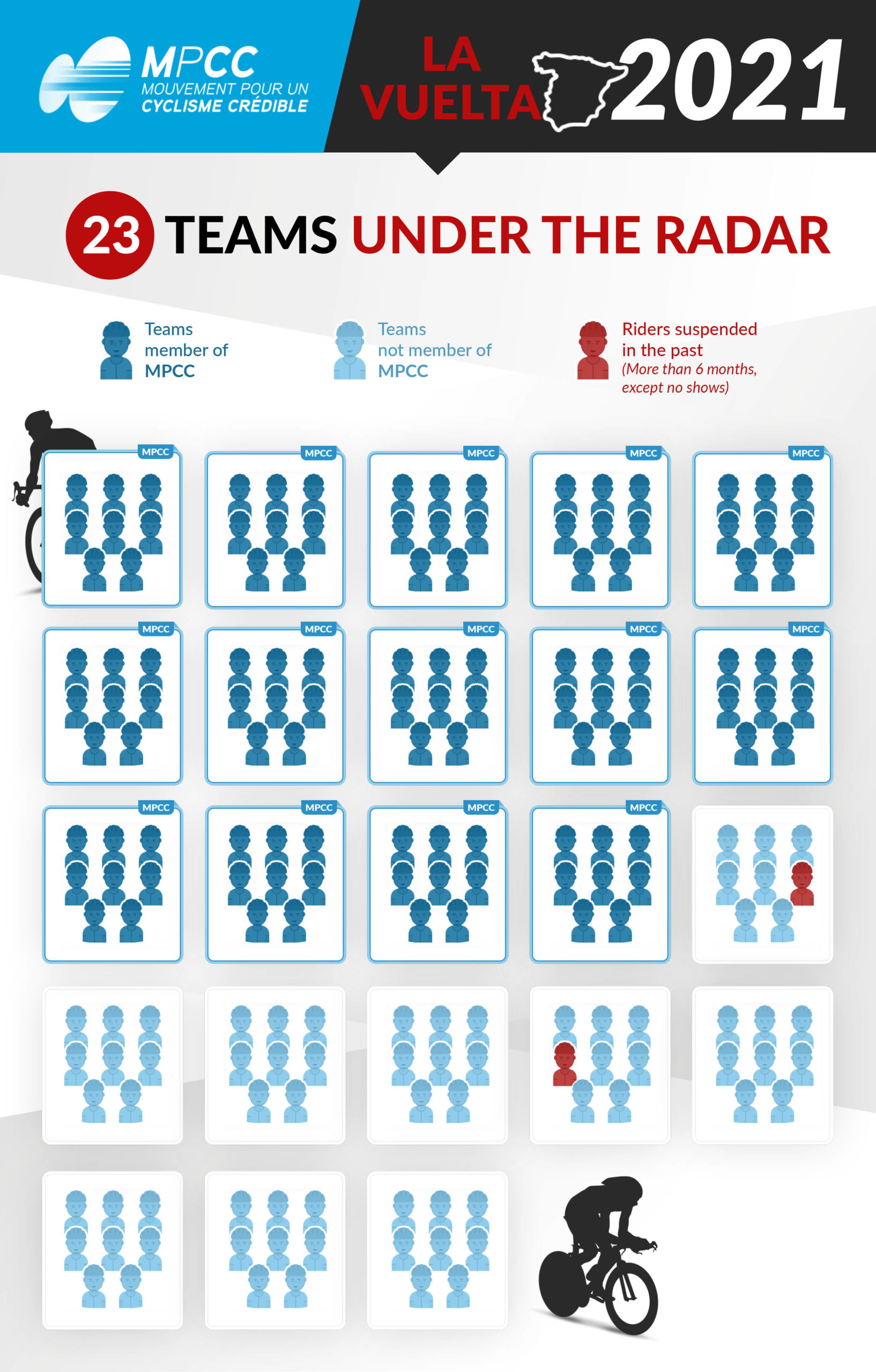
In an infography, we have represented the 2021 Vuelta a España peloton, distinguishing MPCC member teams and non-member teams. Amongst member teams, no rider have ever been suspended. Within non-members, 2 already have
In the event of every grand tour race or big championships, the MPCC highlights how many riders are part of the movement but also how many riders have been suspended for doping in the past.
The spirit of the MPCC is to regroup teams which on a voluntary basis define stricter rules than international organizations. Amongst those, this one: « Don’t hire riders involved in doping cases and banned for more than 6 months, except no-shows, in the two years following the suspension. »
On the 2021 Vuelta a España, MPCC members chose not to pick any riders previously suspended for doping. This choice matches the philosophy of the movement, thus fostering cycling's credibility. There are 14 MPCC members on this year's Tour de France, representing 60% of the peloton.

Team Dauner-Akkon joins the MPCC!
The continental team has been granted membership in the MPCC.
Created in 2017, the Team Dauner-Akkon is part of the continental UCI division since that time. 11 German riders and 1 Belgian rider are part of the team roster. Winner of Milan-San Remo in 2013, Gerald Ciolek is one of the Sporting Directors of the team.
The team manager Philipp Mamos stated: "We comply with the MPCC's rules of procedure. Membership in the MPCC is important to us because we want to show our young Riders, Staff, Publicity, Sponsors and the other Teams that we have zero tolerance to doping." The average age of the team roster is 23,2.

Credibility figures: the pandemic’s backlash
Just like last year, it hasn’t proven possible, over the first six months of 2021, to regain the same quantity of tests (in and out of competition) that was carried out by anti-doping agencies and federations before the pandemic.
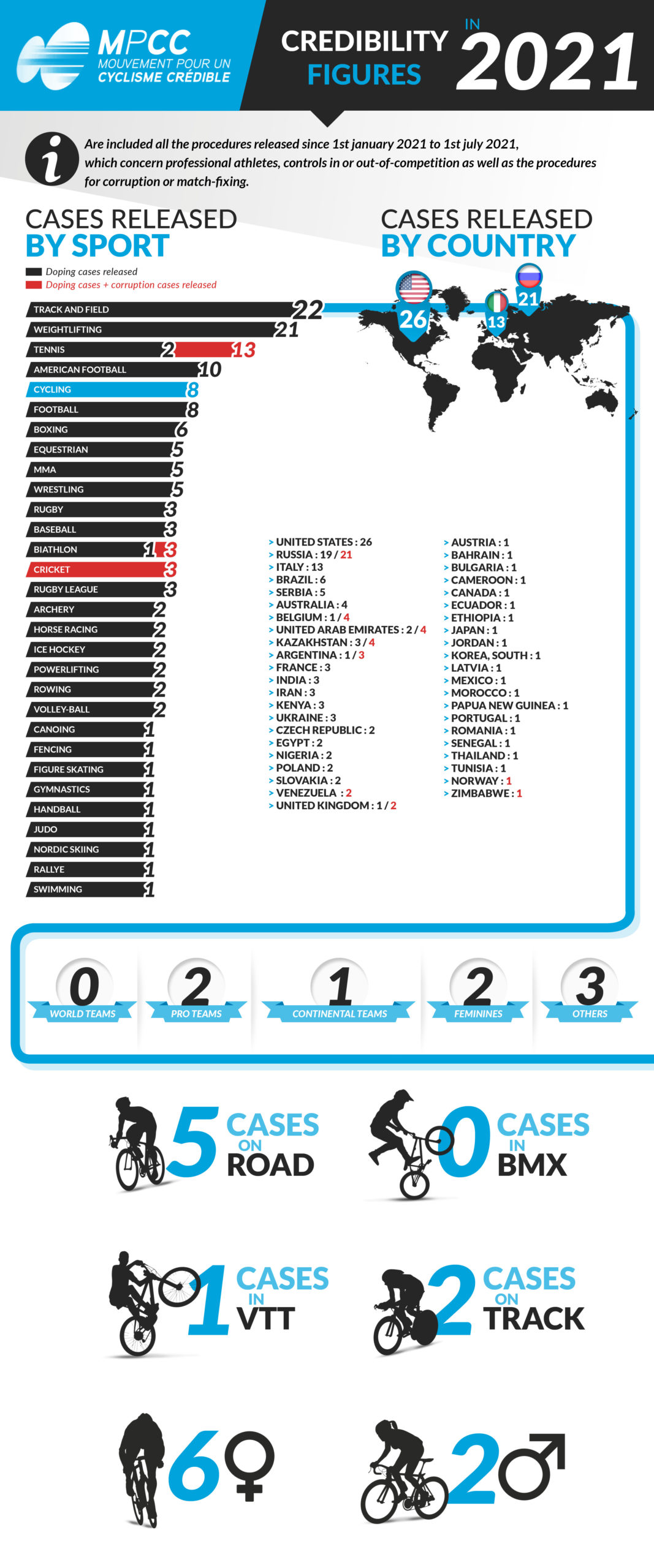
Logically, as fewer controls were carried out, fewer disciplinary procedures were revealed during this first half of 2021 in comparison with recent years. Although our figures might not be exhaustive, we have recorded 139 cases since the beginning of the year, compared to 227 last year and 190 in 2019 at the same period.
Suspected doping cases often refer to samples taken several months prior. There is therefore a significant gap between the date a sample is collected, and the date in which a procedure, or a positive control, is publicly revealed. Some federations do not communicate about a doping case until the end of the procedure, when the athlete is actually punished.
As in 2020, there is a slight decrease in the number of competitions this year. However, its impact on the credibility figures that we have been publishing for the past 7 years must be put into perspective, as the cheaters are mostly caught thanks to out-of-competition controls. For instance, since 2015, no Tour de France rider has tested positive during the race.
With 8 cases (including 3 already punished), cycling holds 5th place. These procedures mainly affect men (6, for 2 women). Two riders come from pro teams, but none from world teams.
3bikes becomes a member of the MPCC!
3bikes, a media founded in 2019 and dedicated to cycling, becomes a member of the MPCC as a “press sympathizer”.
3bikes.fr media, founded by three professional journalists in 2019, is a website covering cycling in all forms (road, cyclosportive, pro racing, gravel, urban mobility) as well as triathlon. At the end of 2020, 3bikes recorded an average audience of 300,000 visitors per month.
3bikes representative Guillaume Judas talked about their membership:
“Your association and the causes it carries match our vision of sport and cycling in particular, and this is the reason why we would like to support it. We believe that the athletes and teams who join it have a desire for transparency and show a good image of cycling, especially for all riders, may they be beginners or not, who are likely to read us”.

Cortisol Level Tests on the Tour de France (stage 19)
4 member teams subjected 26 riders to cortisol level tests on the Tour de France All the riders have been allowed to start.
On the Tour de France, 4 member teams registered for the race submitted 26 riders to cortisol level tests as part of their commitment to the Movement for a Credible Cycling (MPCC):
These voluntary tests have been performed under the ITA (International Testing Agency) on all participants. The ITA has forwarded to the MPCC the results of all riders of the member teams. All results were in compliance with the standard established by MPCC members. The Board notes with satisfaction that the riders of these MPCC member teams registered for the Tour de France have scrupulously respected the clauses of their standing orders.
384 controls have been carried out by MPCC since the start of the season : On Paris-Nice, the Giro d'Italia, the Boucles de la Mayenne, the Criterium du Dauphiné, the Route d’Occitanie, the French Nationals and the Tour de France
BACKGROUND ON CORTISOL TESTS BY THE MOUVEMENT POUR UN CYCLISME CRÉDIBLE (MPCC)
The objective of the MPCC and its member teams is to contribute to restoring the credibility of cycling. One of the organisation’s activities are voluntary cortisol tests amongst the riders of the member teams of the MPCC. In case the results of the test present an abnormally low value, the rider concerned will not race for a period of minimum eight days until the cortisol value has recovered again above that minimum value.
For the sake of clarity: it concerns a voluntary norm and the test does not concern an anti-doping control. Under WADA rules, athletes across all sports, with a cortisol level abnormally low, are entitled to perform their sport in competition (unless an anti-doping test has revealed the unauthorized use of the cortisol hormone).
The reason for the MPCC member teams to introduce this voluntary norm (below which the rider concerned will withdraw from competition for that minimum period of eight days), is an effort towards all stakeholders and fans of the sport of cycling and to confirm its commitment to clean sport and to show that cycling and MPCC member teams wish to be a frontrunner in that.
WHY CORTISOL TESTS ?
Although cortisol hormones are an allowed medicine when pre-scribed by a physician, the use of that medicine has frequently been abused in the history of sports (including in cycling) for the purpose of increasing the performance. Besides, a low level of cortisol can potentially endanger the health of athletes in certain circumstances when he/she is in competition while the athletes perform under high intensity or under stress.
For both reasons and with the objective to contribute to restoring the credibility of cycling, the Mouvement pour un Cyclisme Crédible and its member teams have introduced that voluntary norm below which its riders will temporarily withdraw from competition.

Cortisol Level Tests on the Tour de France (stage 14)
5 member teams subjected 30 riders to cortisol level tests on the Tour de France All the riders have been allowed to start.
On the Tour de France, 5 member teams registered for the race submitted 30 riders to cortisol level tests as part of their commitment to the Movement for a Credible Cycling (MPCC):
These voluntary tests have been performed under the ITA (International Testing Agency) on all participants. The ITA has forwarded to the MPCC the results of all riders of the member teams. All results were in compliance with the standard established by MPCC members. The Board notes with satisfaction that the riders of these MPCC member teams registered for the Tour de France have scrupulously respected the clauses of their standing orders.
358 controls have been carried out by MPCC since the start of the season : On Paris-Nice, the Giro d'Italia, the Boucles de la Mayenne, the Criterium du Dauphiné, the Route d’Occitanie, the French Nationals and the Tour de France
BACKGROUND ON CORTISOL TESTS BY THE MOUVEMENT POUR UN CYCLISME CRÉDIBLE (MPCC)
The objective of the MPCC and its member teams is to contribute to restoring the credibility of cycling. One of the organisation’s activities are voluntary cortisol tests amongst the riders of the member teams of the MPCC. In case the results of the test present an abnormally low value, the rider concerned will not race for a period of minimum eight days until the cortisol value has recovered again above that minimum value.
For the sake of clarity: it concerns a voluntary norm and the test does not concern an anti-doping control. Under WADA rules, athletes across all sports, with a cortisol level abnormally low, are entitled to perform their sport in competition (unless an anti-doping test has revealed the unauthorized use of the cortisol hormone).
The reason for the MPCC member teams to introduce this voluntary norm (below which the rider concerned will withdraw from competition for that minimum period of eight days), is an effort towards all stakeholders and fans of the sport of cycling and to confirm its commitment to clean sport and to show that cycling and MPCC member teams wish to be a frontrunner in that.
WHY CORTISOL TESTS ?
Although cortisol hormones are an allowed medicine when pre-scribed by a physician, the use of that medicine has frequently been abused in the history of sports (including in cycling) for the purpose of increasing the performance. Besides, a low level of cortisol can potentially endanger the health of athletes in certain circumstances when he/she is in competition while the athletes perform under high intensity or under stress.
For both reasons and with the objective to contribute to restoring the credibility of cycling, the Mouvement pour un Cyclisme Crédible and its member teams have introduced that voluntary norm below which its riders will temporarily withdraw from competition.
Tour de France 2021: 23 teams under the microscope
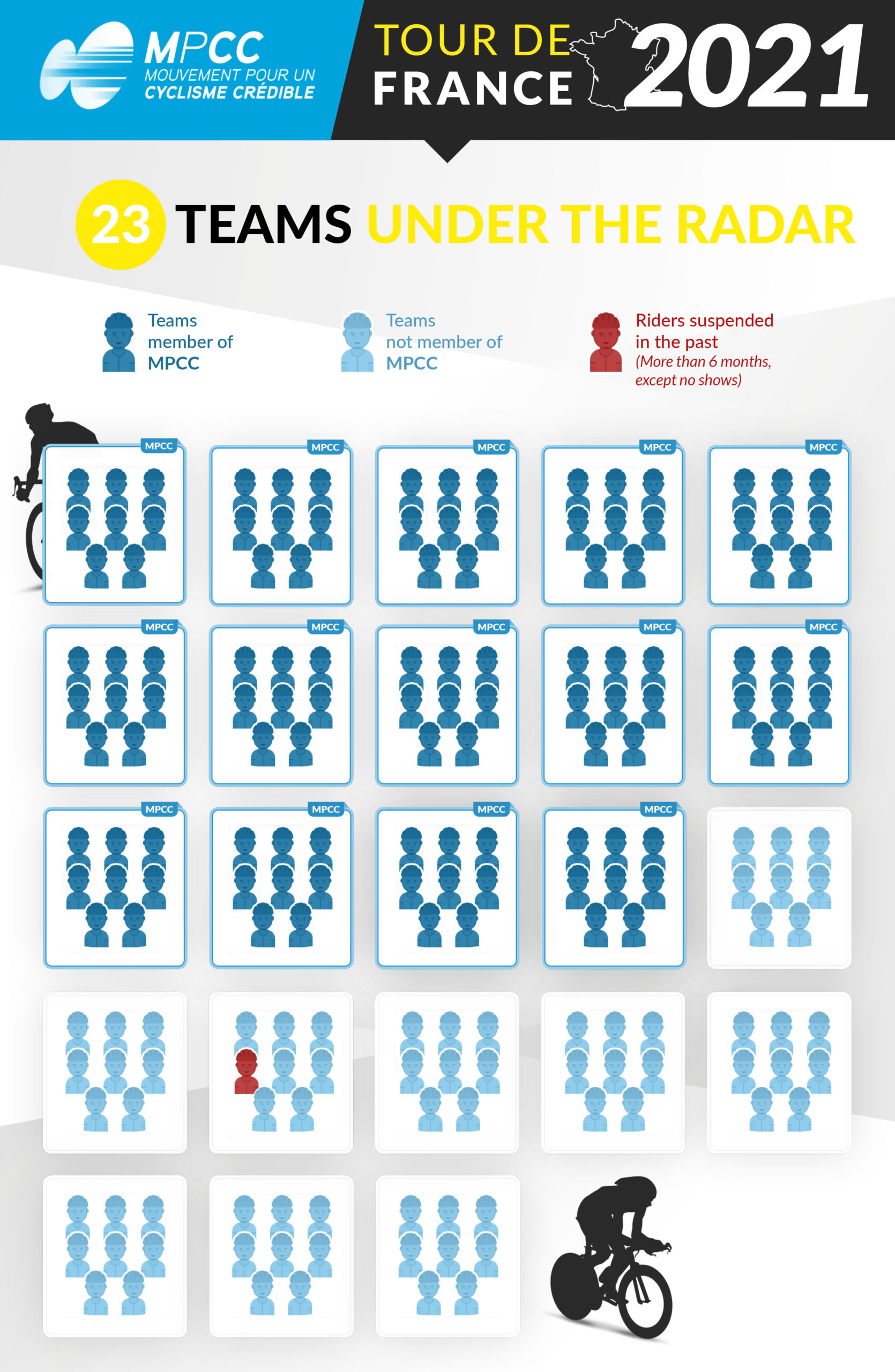
In an infography, we have represented the 2021 Tour de France peloton, distinguishing MPCC member teams and non-member teams. Amongst member teams, no rider have ever been suspended. Within non-members, 1 already have
In the event of every grand tour race or big championships, the MPCC highlights how many riders are part of the movement but also how many riders have been suspended for doping in the past.
The spirit of the MPCC is to regroup teams which on a voluntary basis define stricter rules than international organizations. Amongst those, this one: « Don’t hire riders involved in doping cases and banned for more than 6 months, except no-shows, in the two years following the suspension. »
On the 2021 Tour de France, MPCC members chose not to pick any riders previously suspended for doping. This choice matches the philosophy of the movement, thus fostering cycling's credibility. There are 14 MPCC members on this year's Tour de France, representing 60% of the peloton.

Cortisol Level Tests on the Tour de France
14 member teams subjected 112 riders to cortisol level tests on the Tour de France All the riders have been allowed to start.
On the Tour de France, 14 member teams registered for the race submitted 112 riders to cortisol level tests as part of their commitment to the Movement for a Credible Cycling (MPCC):
These voluntary tests have been performed under the ITA (International Testing Agency) on all participants. The ITA has forwarded to the MPCC the results of all riders of the member teams. All results were in compliance with the standard established by MPCC members. The Board notes with satisfaction that the riders of these MPCC member teams registered for the Tour de France have scrupulously respected the clauses of their standing orders.
328 controls have been carried out by MPCC since the start of the season : On Paris-Nice, the Giro d'Italia, the Boucles de la Mayenne, the Criterium du Dauphiné, the Route d’Occitanie, the French Nationals and the Tour de France
BACKGROUND ON CORTISOL TESTS BY THE MOUVEMENT POUR UN CYCLISME CRÉDIBLE (MPCC)
The objective of the MPCC and its member teams is to contribute to restoring the credibility of cycling. One of the organisation’s activities are voluntary cortisol tests amongst the riders of the member teams of the MPCC. In case the results of the test present an abnormally low value, the rider concerned will not race for a period of minimum eight days until the cortisol value has recovered again above that minimum value.
For the sake of clarity: it concerns a voluntary norm and the test does not concern an anti-doping control. Under WADA rules, athletes across all sports, with a cortisol level abnormally low, are entitled to perform their sport in competition (unless an anti-doping test has revealed the unauthorized use of the cortisol hormone).
The reason for the MPCC member teams to introduce this voluntary norm (below which the rider concerned will withdraw from competition for that minimum period of eight days), is an effort towards all stakeholders and fans of the sport of cycling and to confirm its commitment to clean sport and to show that cycling and MPCC member teams wish to be a frontrunner in that.
WHY CORTISOL TESTS ?
Although cortisol hormones are an allowed medicine when pre-scribed by a physician, the use of that medicine has frequently been abused in the history of sports (including in cycling) for the purpose of increasing the performance. Besides, a low level of cortisol can potentially endanger the health of athletes in certain circumstances when he/she is in competition while the athletes perform under high intensity or under stress.
For both reasons and with the objective to contribute to restoring the credibility of cycling, the Mouvement pour un Cyclisme Crédible and its member teams have introduced that voluntary norm below which its riders will temporarily withdraw from competition.