


Cortisol Level Tests on the Vuelta a España
12 member teams subjected 91 riders to cortisol level tests on the Vuelta a España. All the riders have been allowed to start.
On the Vuelta a España, 12 member teams registered for the race submitted 91 riders to cortisol level tests as part of their commitment to the Movement for a Credible Cycling (MPCC):
These voluntary tests have been performed under the auspices of the Union Cycliste Internationale (UCI) and CADF on all participants. The CADF has forwarded to the MPCC the results of all riders of the member teams. All results were in compliance with the standard established by MPCC members. The Board notes with satisfaction that the riders of these MPCC member teams registered for the Vuelta a España have scrupulously respected the clauses of their standing orders.
442 controls have been carried out by MPCC since the start of the season : On Paris-Nice, Route d'Occitanie, Tour de Ain, Critérium du Dauphiné, French Nationals, Tour de France, Giro d'Italia and Vuelta a España.
BACKGROUND ON CORTISOL TESTS BY THE MOUVEMENT POUR UN CYCLISME CRÉDIBLE (MPCC)
The objective of the MPCC and its member teams is to contribute to restoring the credibility of cycling. One of the organisation’s activities are voluntary cortisol tests amongst the riders of the member teams of the MPCC. In case the results of the test present an abnormally low value, the rider concerned will not race for a period of minimum eight days until the cortisol value has recovered again above that minimum value.
For the sake of clarity: it concerns a voluntary norm and the test does not concern an anti-doping control. Under WADA rules, athletes across all sports, with a cortisol level abnormally low, are entitled to perform their sport in competition (unless an anti-doping test has revealed the unauthorized use of the cortisol hormone).
The reason for the MPCC member teams to introduce this voluntary norm (below which the rider concerned will withdraw from competition for that minimum period of eight days), is an effort towards all stakeholders and fans of the sport of cycling and to confirm its commitment to clean sport and to show that cycling and MPCC member teams wish to be a frontrunner in that.
WHY CORTISOL TESTS ?
Although cortisol hormones are an allowed medicine when pre-scribed by a physician, the use of that medicine has frequently been abused in the history of sports (including in cycling) for the purpose of increasing the performance. Besides, a low level of cortisol can potentially endanger the health of athletes in certain circumstances when he/she is in competition while the athletes perform under high intensity or under stress.
For both reasons and with the objective to contribute to restoring the credibility of cycling, the Mouvement pour un Cyclisme Crédible and its member teams have introduced that voluntary norm below which its riders will temporarily withdraw from competition.


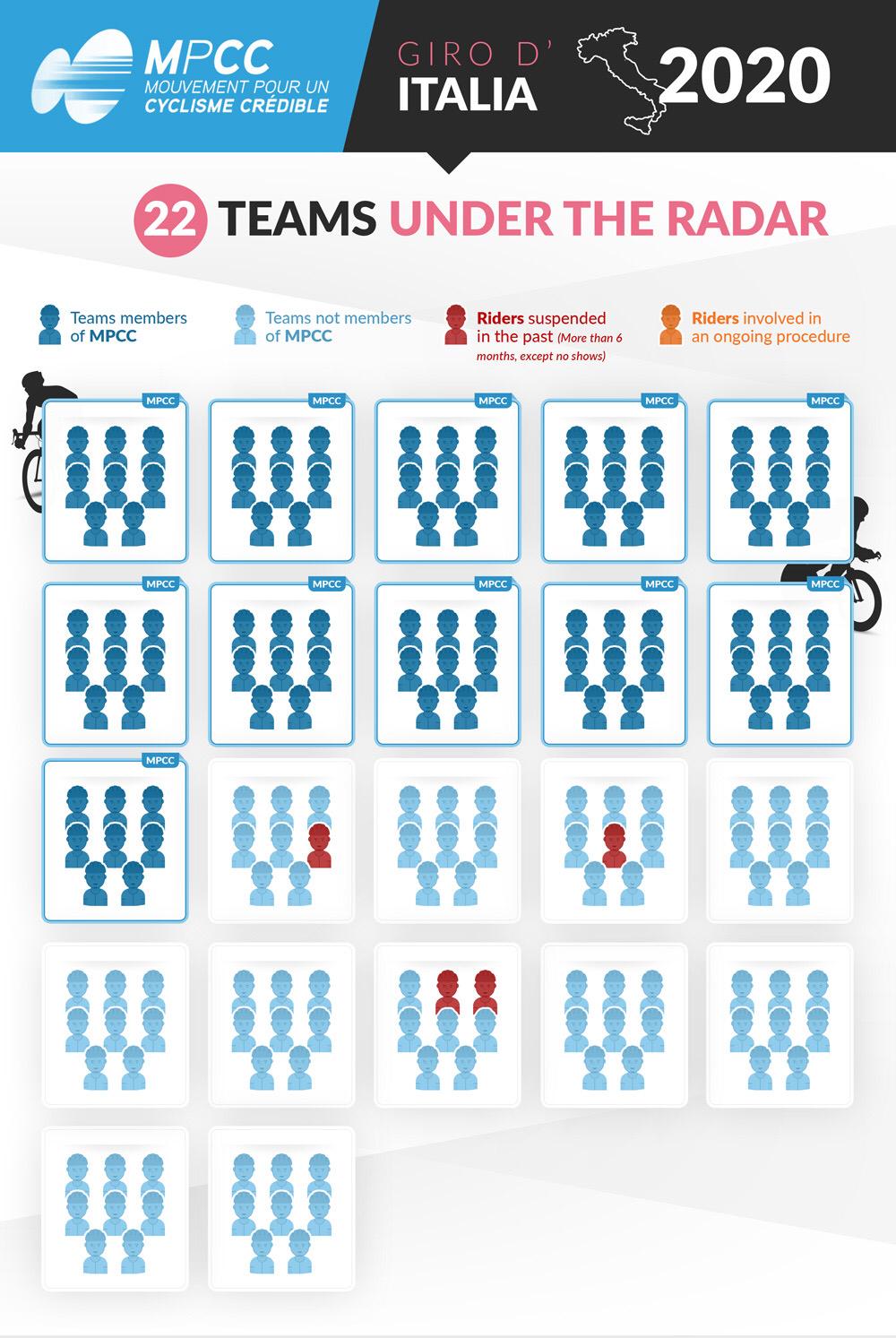
Giro d'Italia 2020: 22 teams under the microscope
In an infography, we have represented the 2020 Giro d'Italia peloton, distinguishing MPCC member teams and non-member teams. Amongst member teams, no rider have ever been suspended. Within non-members, 4 already have
In the event of every grand tour race or big championships, the MPCC highlights how many riders are part of the movement but also how many riders have been suspended for doping in the past.
The spirit of the MPCC is to regroup teams which on a voluntary basis define stricter rules than international organizations. Amongst those, this one: « Don’t hire riders involved in doping cases and banned for more than 6 months, except no-shows, in the two years following the suspension. »
On the 2020 Giro d'Italia, MPCC members chose not to pick any riders previously suspended for doping. This choice matches the philosophy of the movement, thus fostering cycling's credibility. There are 11 MPCC members on this year's Tour de France, representing 50% of the peloton.

Cortisol Level Tests on the Giro d'Italia
11 member teams subjected 88 riders to cortisol level tests on the Giro d'Italia. All the riders have been allowed to start.
On the Giro d'Italia, 11 member teams registered for the race submitted 88 riders to cortisol level tests as part of their commitment to the Movement for a Credible Cycling (MPCC):
These voluntary tests have been performed under the auspices of the Union Cycliste Internationale (UCI) and CADF on all participants. The CADF has forwarded to the MPCC the results of all riders of the member teams. All results were in compliance with the standard established by MPCC members. The Board notes with satisfaction that the riders of these MPCC member teams registered for the Giro d'Italia have scrupulously respected the clauses of their standing orders.
349 controls have been carried out by MPCC since the start of the season : On Paris-Nice, Route d'Occitanie, Tour de Ain, Critérium du Dauphiné, French Nationals, Tour de France and Giro d'Italia.
BACKGROUND ON CORTISOL TESTS BY THE MOUVEMENT POUR UN CYCLISME CRÉDIBLE (MPCC)
The objective of the MPCC and its member teams is to contribute to restoring the credibility of cycling. One of the organisation’s activities are voluntary cortisol tests amongst the riders of the member teams of the MPCC. In case the results of the test present an abnormally low value, the rider concerned will not race for a period of minimum eight days until the cortisol value has recovered again above that minimum value.
For the sake of clarity: it concerns a voluntary norm and the test does not concern an anti-doping control. Under WADA rules, athletes across all sports, with a cortisol level abnormally low, are entitled to perform their sport in competition (unless an anti-doping test has revealed the unauthorized use of the cortisol hormone).
The reason for the MPCC member teams to introduce this voluntary norm (below which the rider concerned will withdraw from competition for that minimum period of eight days), is an effort towards all stakeholders and fans of the sport of cycling and to confirm its commitment to clean sport and to show that cycling and MPCC member teams wish to be a frontrunner in that.
WHY CORTISOL TESTS ?
Although cortisol hormones are an allowed medicine when pre-scribed by a physician, the use of that medicine has frequently been abused in the history of sports (including in cycling) for the purpose of increasing the performance. Besides, a low level of cortisol can potentially endanger the health of athletes in certain circumstances when he/she is in competition while the athletes perform under high intensity or under stress.
For both reasons and with the objective to contribute to restoring the credibility of cycling, the Mouvement pour un Cyclisme Crédible and its member teams have introduced that voluntary norm below which its riders will temporarily withdraw from competition.