
Cortisol Level Tests on the French Nationals
2 member teams subjected 16 riders to cortisol level tests on the French Nationals. All the riders have been allowed to start.
On the French Nationals, 2 member teams registered for the race submitted 16 riders to cortisol level tests as part of their commitment to the Movement for a Credible Cycling (MPCC):
These voluntary tests have been performed under the ITA (International Testing Agency) on all participants. The ITA has forwarded to the MPCC the results of all riders of the member teams. All results were in compliance with the standard established by MPCC members. The Board notes with satisfaction that the riders of these MPCC member teams registered for the French Nationals have scrupulously respected the clauses of their standing orders.
216 controls have been carried out by MPCC since the start of the season : On Paris-Nice, the Giro d'Italia, the Boucles de la Mayenne, the Criterium du Dauphiné, the Route d’Occitanie and the French Nationals.
BACKGROUND ON CORTISOL TESTS BY THE MOUVEMENT POUR UN CYCLISME CRÉDIBLE (MPCC)
The objective of the MPCC and its member teams is to contribute to restoring the credibility of cycling. One of the organisation’s activities are voluntary cortisol tests amongst the riders of the member teams of the MPCC. In case the results of the test present an abnormally low value, the rider concerned will not race for a period of minimum eight days until the cortisol value has recovered again above that minimum value.
For the sake of clarity: it concerns a voluntary norm and the test does not concern an anti-doping control. Under WADA rules, athletes across all sports, with a cortisol level abnormally low, are entitled to perform their sport in competition (unless an anti-doping test has revealed the unauthorized use of the cortisol hormone).
The reason for the MPCC member teams to introduce this voluntary norm (below which the rider concerned will withdraw from competition for that minimum period of eight days), is an effort towards all stakeholders and fans of the sport of cycling and to confirm its commitment to clean sport and to show that cycling and MPCC member teams wish to be a frontrunner in that.
WHY CORTISOL TESTS ?
Although cortisol hormones are an allowed medicine when pre-scribed by a physician, the use of that medicine has frequently been abused in the history of sports (including in cycling) for the purpose of increasing the performance. Besides, a low level of cortisol can potentially endanger the health of athletes in certain circumstances when he/she is in competition while the athletes perform under high intensity or under stress.
For both reasons and with the objective to contribute to restoring the credibility of cycling, the Mouvement pour un Cyclisme Crédible and its member teams have introduced that voluntary norm below which its riders will temporarily withdraw from competition.

Cortisol Level Tests on the Route d’Occitanie
4 member teams subjected 28 riders to cortisol level tests on the Route d’Occitanie. All the riders have been allowed to start.
On the Route d’Occitanie, 4 member teams registered for the race submitted 28 riders to cortisol level tests as part of their commitment to the Movement for a Credible Cycling (MPCC):
These voluntary tests have been performed under the ITA (International Testing Agency) on all participants. The ITA has forwarded to the MPCC the results of all riders of the member teams. All results were in compliance with the standard established by MPCC members. The Board notes with satisfaction that the riders of these MPCC member teams registered for the Route d’Occitanie have scrupulously respected the clauses of their standing orders.
205 controls have been carried out by MPCC since the start of the season : On Paris-Nice, the Giro d'Italia, the Boucles de la Mayenne, the Criterium du Dauphiné and the Route d’Occitanie.
BACKGROUND ON CORTISOL TESTS BY THE MOUVEMENT POUR UN CYCLISME CRÉDIBLE (MPCC)
The objective of the MPCC and its member teams is to contribute to restoring the credibility of cycling. One of the organisation’s activities are voluntary cortisol tests amongst the riders of the member teams of the MPCC. In case the results of the test present an abnormally low value, the rider concerned will not race for a period of minimum eight days until the cortisol value has recovered again above that minimum value.
For the sake of clarity: it concerns a voluntary norm and the test does not concern an anti-doping control. Under WADA rules, athletes across all sports, with a cortisol level abnormally low, are entitled to perform their sport in competition (unless an anti-doping test has revealed the unauthorized use of the cortisol hormone).
The reason for the MPCC member teams to introduce this voluntary norm (below which the rider concerned will withdraw from competition for that minimum period of eight days), is an effort towards all stakeholders and fans of the sport of cycling and to confirm its commitment to clean sport and to show that cycling and MPCC member teams wish to be a frontrunner in that.
WHY CORTISOL TESTS ?
Although cortisol hormones are an allowed medicine when pre-scribed by a physician, the use of that medicine has frequently been abused in the history of sports (including in cycling) for the purpose of increasing the performance. Besides, a low level of cortisol can potentially endanger the health of athletes in certain circumstances when he/she is in competition while the athletes perform under high intensity or under stress.
For both reasons and with the objective to contribute to restoring the credibility of cycling, the Mouvement pour un Cyclisme Crédible and its member teams have introduced that voluntary norm below which its riders will temporarily withdraw from competition.
Press Release - 2th June 2021
On June 2, MPCC's Board of Directors met in the margins of the Critérium du Dauphiné. Important topics were discussed - ketones use was the main concern addressed.
International bodies still have not reported any progress on such an important topic as ketones. Our members are worried of being forced to deal with this failure to take a stand.
On May 3, responding to MPCC's demands, UCI confirmed that it was aware of the prevalent use of ketone-based dietary supplements into cycling. Regarding the current situation, UCI ensured to make a quick decision and to raise awareness among the stakeholders on this topic.
A few weeks before the Grand Départ of the Tour de France, MPCC deplores such a damaging situation. The Board of Directors wants to express its support to our member teams, as they are sticking to the clear line they set: to commit to the non-use of ketones.
Another important topic was the implementation of a the new UCI regulation on glucocorticoids use. MPCC's members are still waiting for information on how this regulation will be shaped.
In the meantine, MPCC will continue to carry out cortisol level tests among its member teams. Since the beginning of the year, 25 MPCC teams have been tested, for a total of 177 riders taking part in 4 different races. No abnormally low values were found.
MPCC's Board of Directors also noted all the members of the movement have respected the very strict regulation they committed to.
During this meeting, Vincent Lavenu (AG2R-Citroën Team) was designated Vice-President of MPCC. He will share this position with Iwan Spekenbrink (Team DSM).

Cortisol Level Tests on the Boucles de la Mayenne
5 member teams subjected 28 riders to cortisol level tests on the Boucles de la Mayenne. All the riders have been allowed to start.
On the Boucles de la Mayenne, 5 member teams registered for the race submitted 28riders to cortisol level tests as part of their commitment to the Movement for a Credible Cycling (MPCC):
These voluntary tests have been performed under the ITA (International Testing Agency) on all participants. The ITA has forwarded to the MPCC the results of all riders of the member teams. All results were in compliance with the standard established by MPCC members. The Board notes with satisfaction that the riders of these MPCC member teams registered for the Boucles de la Mayenne have scrupulously respected the clauses of their standing orders.
156 controls have been carried out by MPCC since the start of the season : On Paris-Nice, the Giro d'Italia and the Boucles de la Mayenne.
BACKGROUND ON CORTISOL TESTS BY THE MOUVEMENT POUR UN CYCLISME CRÉDIBLE (MPCC)
The objective of the MPCC and its member teams is to contribute to restoring the credibility of cycling. One of the organisation’s activities are voluntary cortisol tests amongst the riders of the member teams of the MPCC. In case the results of the test present an abnormally low value, the rider concerned will not race for a period of minimum eight days until the cortisol value has recovered again above that minimum value.
For the sake of clarity: it concerns a voluntary norm and the test does not concern an anti-doping control. Under WADA rules, athletes across all sports, with a cortisol level abnormally low, are entitled to perform their sport in competition (unless an anti-doping test has revealed the unauthorized use of the cortisol hormone).
The reason for the MPCC member teams to introduce this voluntary norm (below which the rider concerned will withdraw from competition for that minimum period of eight days), is an effort towards all stakeholders and fans of the sport of cycling and to confirm its commitment to clean sport and to show that cycling and MPCC member teams wish to be a frontrunner in that.
WHY CORTISOL TESTS ?
Although cortisol hormones are an allowed medicine when pre-scribed by a physician, the use of that medicine has frequently been abused in the history of sports (including in cycling) for the purpose of increasing the performance. Besides, a low level of cortisol can potentially endanger the health of athletes in certain circumstances when he/she is in competition while the athletes perform under high intensity or under stress.
For both reasons and with the objective to contribute to restoring the credibility of cycling, the Mouvement pour un Cyclisme Crédible and its member teams have introduced that voluntary norm below which its riders will temporarily withdraw from competition.
Cortisol Level Tests on the Criterium du Dauphiné
3 member teams subjected 21 riders to cortisol level tests on the Criterium du Dauphiné. All the riders have been allowed to start.
On the Criterium du Dauphiné, 3 member teams registered for the race submitted 21riders to cortisol level tests as part of their commitment to the Movement for a Credible Cycling (MPCC):
These voluntary tests have been performed under the ITA (International Testing Agency) on all participants. The ITA has forwarded to the MPCC the results of all riders of the member teams. All results were in compliance with the standard established by MPCC members. The Board notes with satisfaction that the riders of these MPCC member teams registered for the Criterium du Dauphiné have scrupulously respected the clauses of their standing orders.
177 controls have been carried out by MPCC since the start of the season : On Paris-Nice, the Giro d'Italia, the Boucles de la Mayenne and the Criterium du Dauphiné.
BACKGROUND ON CORTISOL TESTS BY THE MOUVEMENT POUR UN CYCLISME CRÉDIBLE (MPCC)
The objective of the MPCC and its member teams is to contribute to restoring the credibility of cycling. One of the organisation’s activities are voluntary cortisol tests amongst the riders of the member teams of the MPCC. In case the results of the test present an abnormally low value, the rider concerned will not race for a period of minimum eight days until the cortisol value has recovered again above that minimum value.
For the sake of clarity: it concerns a voluntary norm and the test does not concern an anti-doping control. Under WADA rules, athletes across all sports, with a cortisol level abnormally low, are entitled to perform their sport in competition (unless an anti-doping test has revealed the unauthorized use of the cortisol hormone).
The reason for the MPCC member teams to introduce this voluntary norm (below which the rider concerned will withdraw from competition for that minimum period of eight days), is an effort towards all stakeholders and fans of the sport of cycling and to confirm its commitment to clean sport and to show that cycling and MPCC member teams wish to be a frontrunner in that.
WHY CORTISOL TESTS ?
Although cortisol hormones are an allowed medicine when pre-scribed by a physician, the use of that medicine has frequently been abused in the history of sports (including in cycling) for the purpose of increasing the performance. Besides, a low level of cortisol can potentially endanger the health of athletes in certain circumstances when he/she is in competition while the athletes perform under high intensity or under stress.
For both reasons and with the objective to contribute to restoring the credibility of cycling, the Mouvement pour un Cyclisme Crédible and its member teams have introduced that voluntary norm below which its riders will temporarily withdraw from competition.
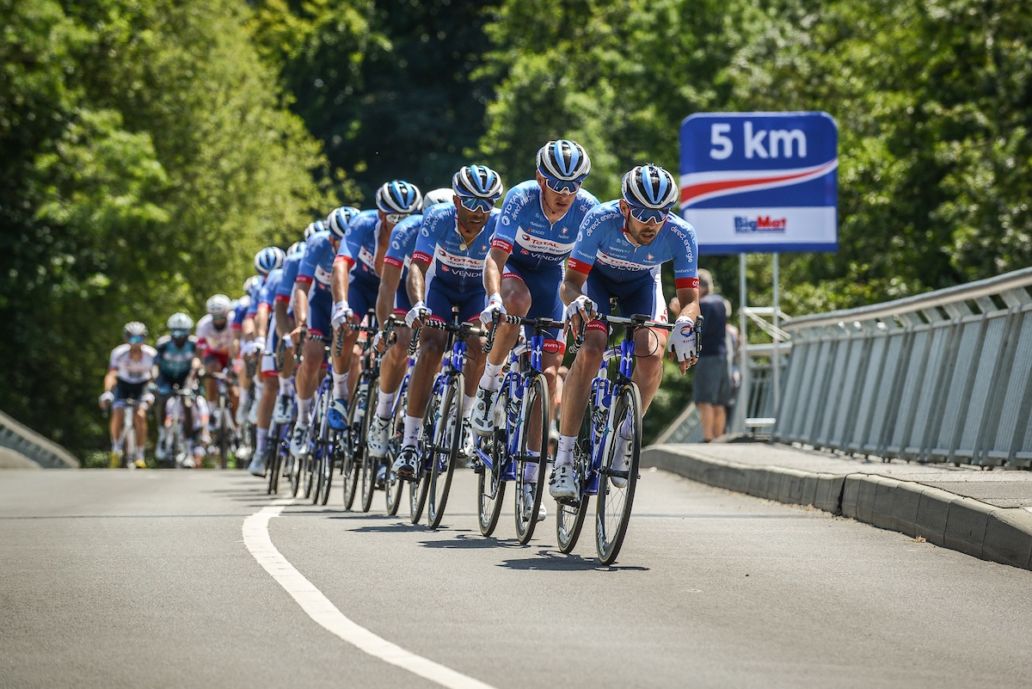
Team Total Direct Energie's fan club joins the MPCC!
Team Total Direct Energie is part of the MPCC for 14 years. Now its fan club also joins the movement as a "sympathizing member".
Passionate about cycling and Jean-René Bernaudeau's team, David Leroux founded a fan club dedicated to Team Total Direct Energie. To date, 9000 supporters are members of this fan club.
David Leroux comments:
"We love our sport so much that we don't want to see doping scandals disfiguring it. As we care about riders having equal opportunities, we believe it's very important the MPCC may benefit from an even greater consideration from the race organizers but also the UCI. We hope we can contribute to this purpose by committing to the MPCC as a "sympathizing member".

Cortisol Level Tests on the Giro d'Italia
13 member teams subjected 103 riders to cortisol level tests on the Giro d'Italia. All the riders have been allowed to start.
On the Giro d'Italia, 13 member teams registered for the race submitted 103 riders to cortisol level tests as part of their commitment to the Movement for a Credible Cycling (MPCC):
These voluntary tests have been performed under the ITA (International Testing Agency) on all participants. The ITA has forwarded to the MPCC the results of all riders of the member teams. All results were in compliance with the standard established by MPCC members. The Board notes with satisfaction that the riders of these MPCC member teams registered for the Giro d'Italia have scrupulously respected the clauses of their standing orders.
128 controls have been carried out by MPCC since the start of the season : On Paris-Nice and the Giro d'Italia.
BACKGROUND ON CORTISOL TESTS BY THE MOUVEMENT POUR UN CYCLISME CRÉDIBLE (MPCC)
The objective of the MPCC and its member teams is to contribute to restoring the credibility of cycling. One of the organisation’s activities are voluntary cortisol tests amongst the riders of the member teams of the MPCC. In case the results of the test present an abnormally low value, the rider concerned will not race for a period of minimum eight days until the cortisol value has recovered again above that minimum value.
For the sake of clarity: it concerns a voluntary norm and the test does not concern an anti-doping control. Under WADA rules, athletes across all sports, with a cortisol level abnormally low, are entitled to perform their sport in competition (unless an anti-doping test has revealed the unauthorized use of the cortisol hormone).
The reason for the MPCC member teams to introduce this voluntary norm (below which the rider concerned will withdraw from competition for that minimum period of eight days), is an effort towards all stakeholders and fans of the sport of cycling and to confirm its commitment to clean sport and to show that cycling and MPCC member teams wish to be a frontrunner in that.
WHY CORTISOL TESTS ?
Although cortisol hormones are an allowed medicine when pre-scribed by a physician, the use of that medicine has frequently been abused in the history of sports (including in cycling) for the purpose of increasing the performance. Besides, a low level of cortisol can potentially endanger the health of athletes in certain circumstances when he/she is in competition while the athletes perform under high intensity or under stress.
For both reasons and with the objective to contribute to restoring the credibility of cycling, the Mouvement pour un Cyclisme Crédible and its member teams have introduced that voluntary norm below which its riders will temporarily withdraw from competition.
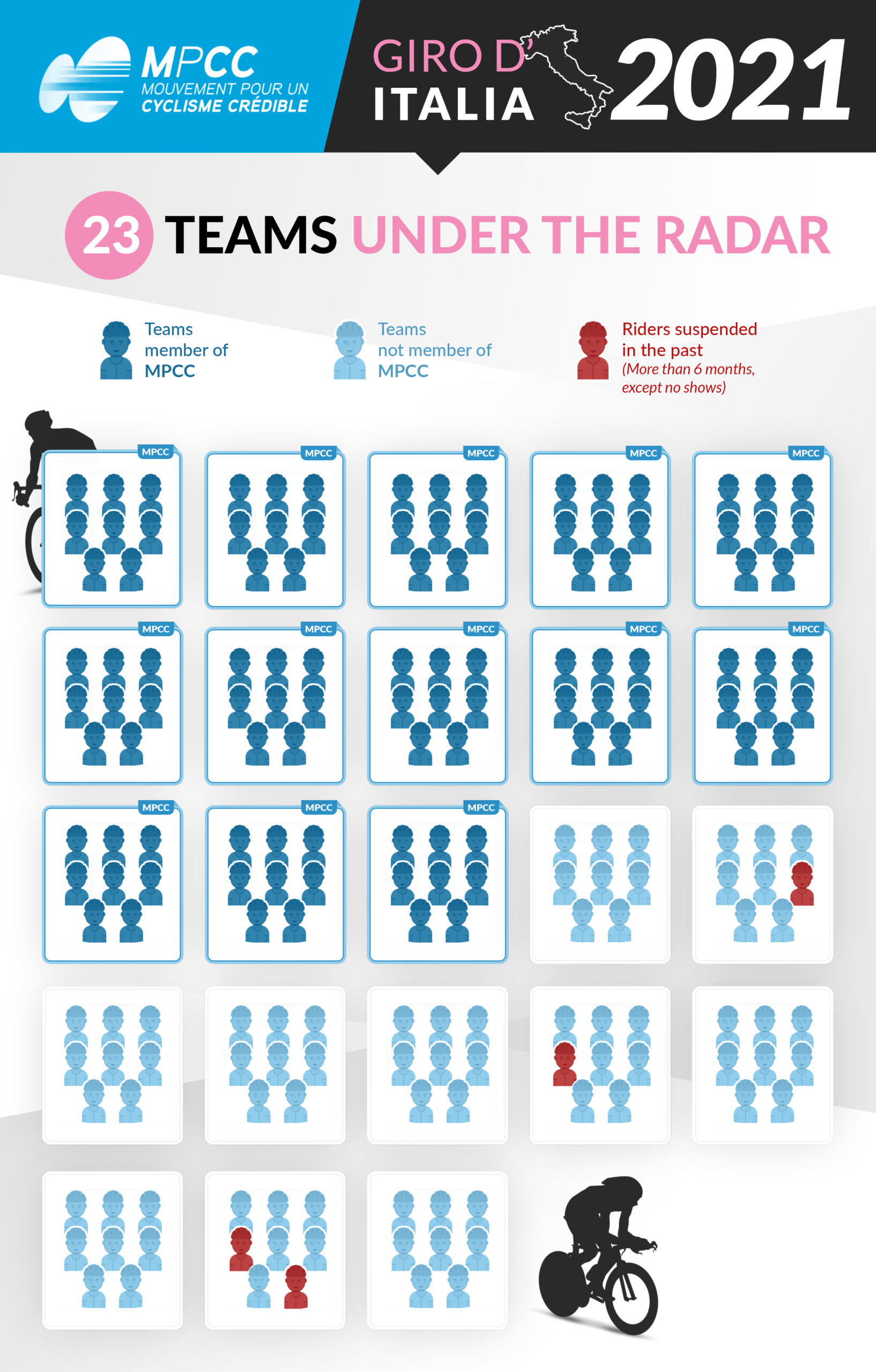
Giro d'Italia 2021: 23 teams under the microscope
In an infography, we have represented the 2021 Giro d'Italia peloton, distinguishing MPCC member teams and non-member teams. Amongst member teams, no rider have ever been suspended. Within non-members, 4 already have
In the event of every grand tour race or big championships, the MPCC highlights how many riders are part of the movement but also how many riders have been suspended for doping in the past.
The spirit of the MPCC is to regroup teams which on a voluntary basis define stricter rules than international organizations. Amongst those, this one: « Don’t hire riders involved in doping cases and banned for more than 6 months, except no-shows, in the two years following the suspension. »
On the 2021 Giro d'Italia, MPCC members chose not to pick any riders previously suspended for doping. This choice matches the philosophy of the movement, thus fostering cycling's credibility. There are 13 MPCC members on this year's Tour de France, representing 56% of the peloton.

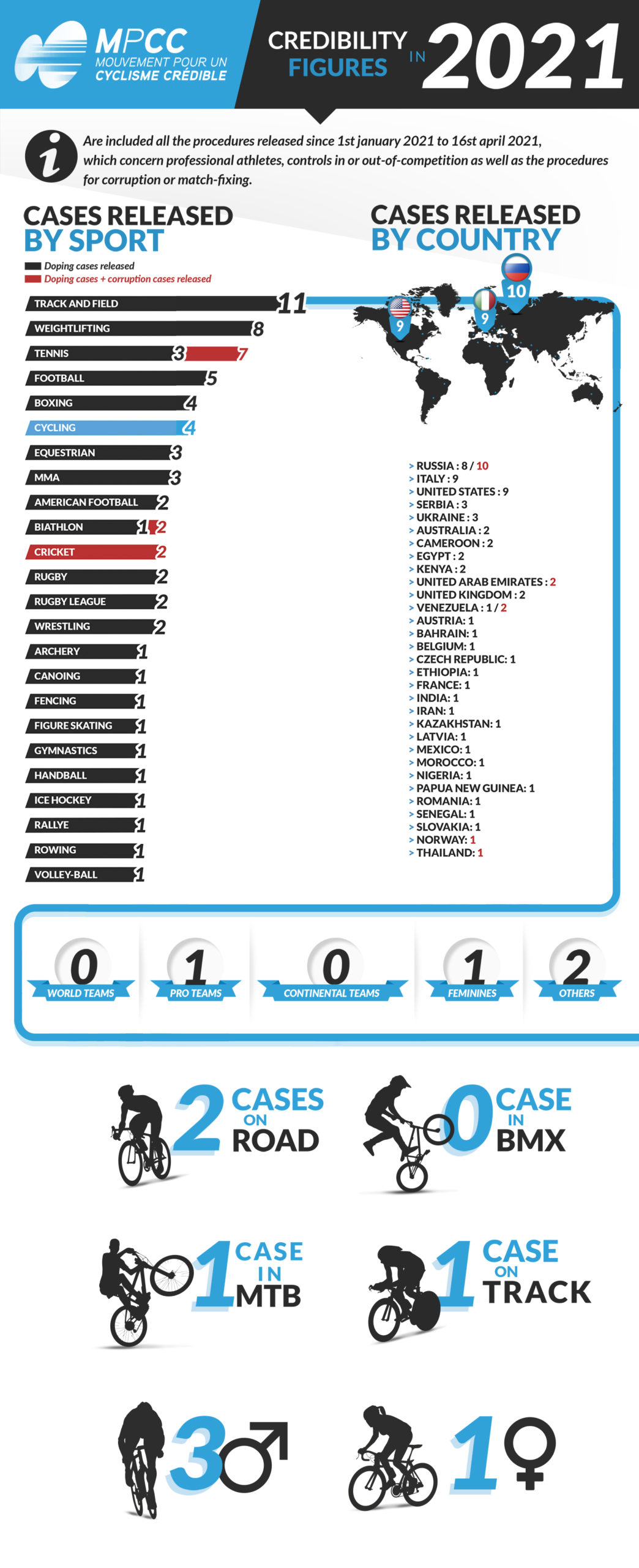
Credibility figures: generalized decrease in the number of disciplinary procedures
In a pre-Olympic period, you may be surprised to hear that the number of disciplinary procedures (doping or corruption) is decreasing, all sports put together. When you compare first quarter figures to previous years, the decrease has always been somewhere between 30% and 50%. Track & Field remains the sport with the highest number of cases by a large margin, even if the total appears three times lower than in the same date last year.
Most probably carrying out antidoping tests (in competition and out of competition) is hampered by the cancellation of a lot of sporting events - a pandemic related situation, just like in 2020. Accurate reports on the application of tests are still to be unveiled by international federations and anti-doping agencies in order to confirm this conclusion.
Cycling: 4 procedures
Based on comparisons with previous years, figures in early 2021 place cycling in a lower range. Only 4 procedures have been made public, all related to 4 different disciplines. For two of them, a sanction has been pronounced:
- A Czech cyclocross national champion suspended for 4 years
- A track elite rider suspended for 6 months
Two other procedures remain ongoing:
- An Italian professional road rider, provisionally suspended due to alleged use of EPO
- An Italian MTB elite rider who also is provisionally suspended
It is worth mentioning that no doping case or alleged doping case are relative to a masculine or feminine WorldTeam.
The MPCC is pleased that none of its members are concerned by any of these 4 cases.

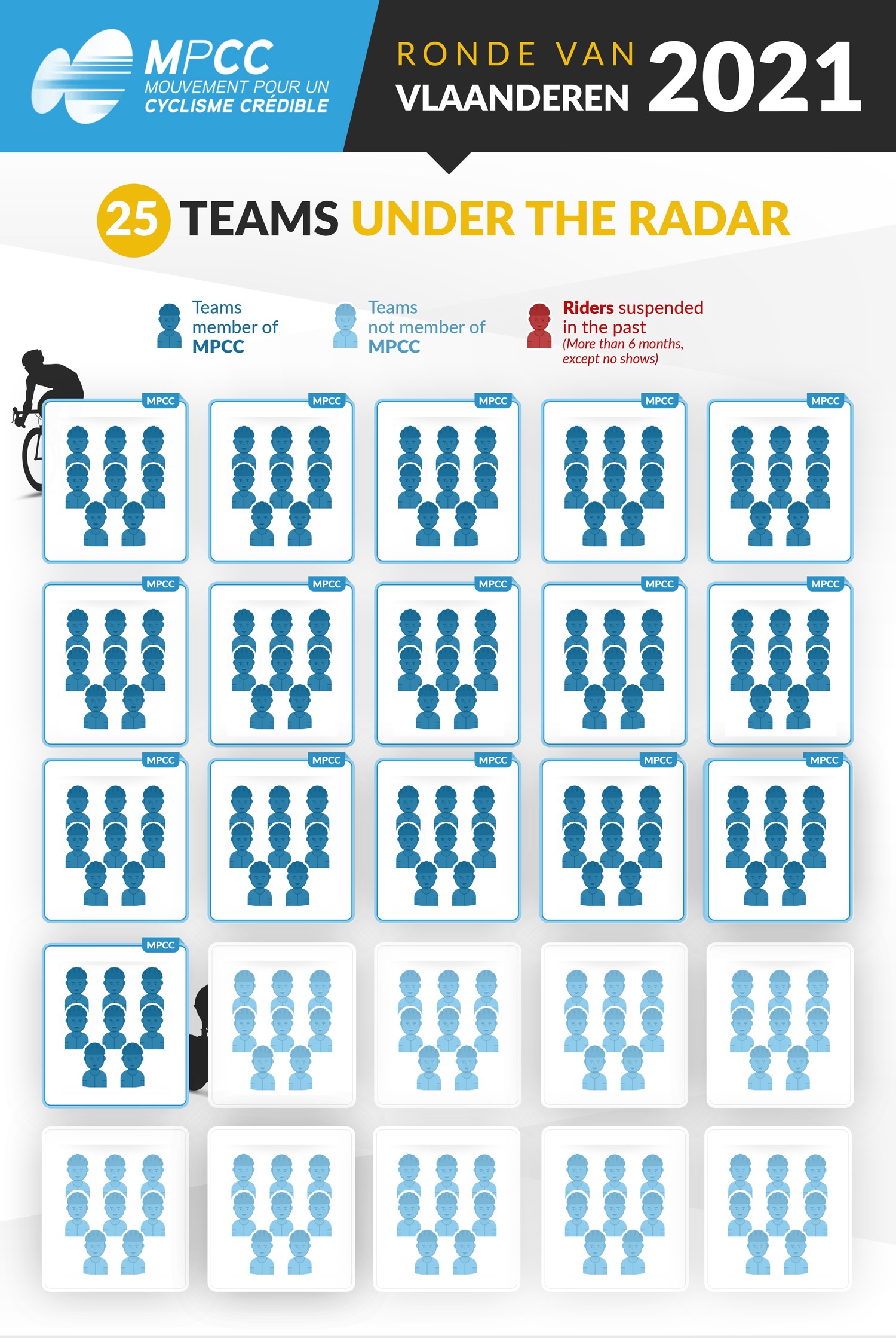
Ronde van Vlaanderen 2021 : 25 teams under the microscope
IN AN INFOGRAPHY, WE HAVE REPRESENTED THE 2021 RONDE VAN VLAANDEREN, DISTINGUISHING MPCC MEMBER TEAMS AND NON-MEMBER TEAMS. AMONGST MEMBER TEAMS, NO RIDER HAVE EVER BEEN SUSPENDED. WITHIN NON-MEMBERS, NO ALREADY HAVE
In the event of every monuments or big championships, the MPCC highlights how many riders are part of the movement but also how many riders have been suspended for doping in the past.
The spirit of the MPCC is to regroup teams which on a voluntary basis define stricter rules than international organizations. Amongst those, this one: « Don’t hire riders involved in doping cases and banned for more than 6 months, except no-shows, in the two years following the suspension. »
On the Ronde van Vlaanderen, MPCC members chose not to pick any riders previously suspended for doping. This choice matches the philosophy of the movement, thus fostering cycling’s credibility. There are 16 MPCC members on this year’s, representing 64% of the peloton.