
Vini Zabù: same old story!
The Italian team holds the record for the greatest number of doping cases over the last decade. Despite a new scandal - the second in the last 12 months, the team expects to attend the next Giro. MPCC condemns the serious damage this affair causes to the image of cycling.
Whatever the amount of resources allocated to the fight against doping, some riders will still choose to cheat. Though, this simple observation is not a thread for the credibility of cycling. However, when these events occur multiple times, year after year, within the same team, and when the institutions fail to break the cycle, it represents a terrible blow to the credibility of cycling.
Team Vini-Zabù gave us a striking example this week, as one of their riders was provisionally suspended by the UCI for assumed doping (EPO). Of course, as the process is still ongoing, we should remain cautious while we wait for the results of the second sample. Though, the previous cases are not cause for optimism. The latest cases happened less than a year ago.
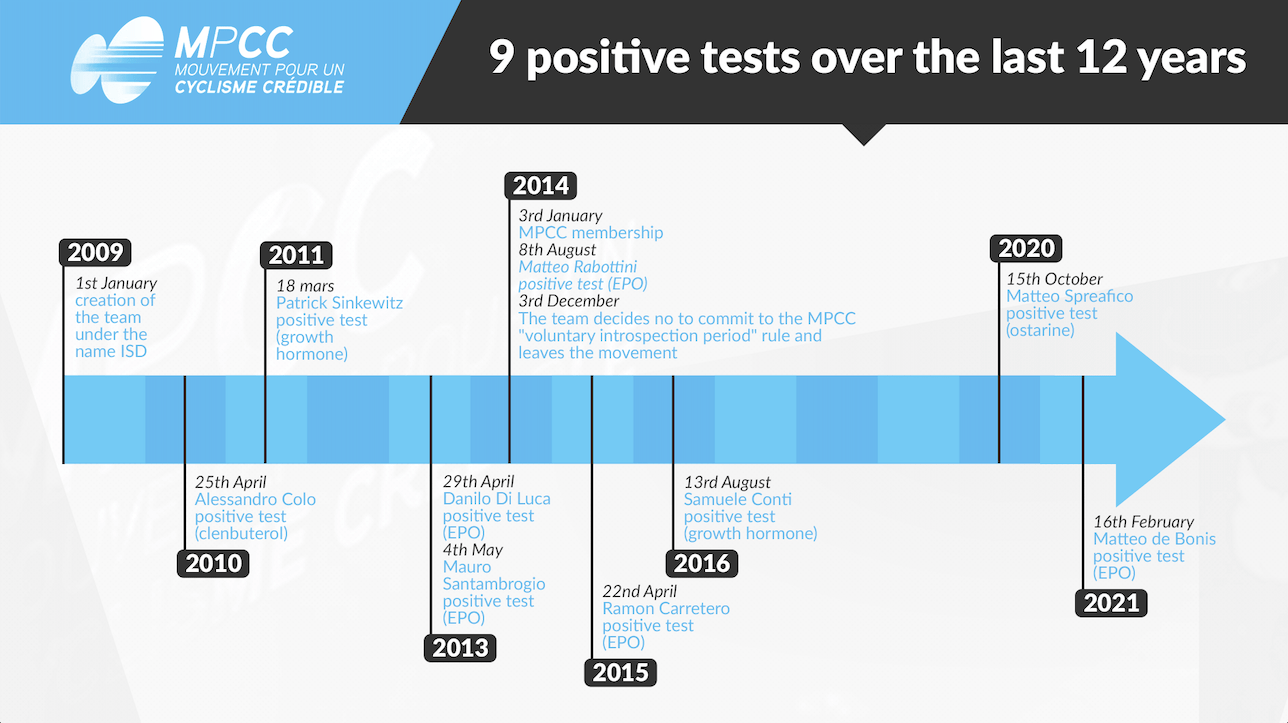
This Italian team, which appeared within the peloton in 2009, has been subject to 9 doping cases in the last twelve years. The incriminated substances are always the same heavy well-known products (5 EPO cases, 2 growth hormones cases, 1 Clenbuterol case, 1 Ostarine case).
MPCC recalls that team Vini-Zabù belonged to the movement for a short time in 2014. Shortly after, despite two doping cases in less than a year, the team decided it was not relevant to commit to the rules of the movement, the same ones that all our members abide by. We immediately suspended the team and decided to exclude it from the movement during the General Assembly of October 2015.
Since its creation in 2007, MPCC set up a principle that we called today "the voluntary introspection" when a team faces several doping cases in a short period of time. Fourteen years later, this principle remains the same: team members commit to stop the activity of all their riders for 8 days or a whole month, depending on whether it faces a second doping case in 12 months, or a third case in 24 months.
In 2016, this MPCC precept even ended up convincing UCI to tighten its own rules as its anti-doping rules now include the opening of a proceeding that could lead to a 15-day or 45-day suspension of a team when two doping cases occur in a period of 12 months.
If UCI deems so, there is a genuine risk for Vini-Zabù to miss out on the Giro, a race for which it received a wild car again. Since 2009, the team is managed by the same people, Angelo Citracca and Luca Scinto. They were already in charge when each of the 9 proceedings were opened against the italian team. Yet, some organizers still trust them.
This new case is another element to support our statement given during our General Assembly of last March 2nd ; our movement was surprised that the Giro d'Italia awarded a Wild Card to a team that suffered a positive test during the last edition. Out of the nine cases involving Vini-Zabù riders, four of them were directly related to the Giro, which seems to not hold any grudge as it still granted 11 Wild Cards to the team in the last 13 years.
MPCC reacts strongly today as the members of it Board deem relevant to defend the integrity of its members (teams and riders) and support their voluntary choice to restore the image of cycling by committing to stricter rules. Our movement deeply regrets that RCS group still does not seem important to react nor give any explanation regarding its choices. As they face yet another doping proceeding, we hope that RCS will take responsibility for the future, even though the Italian organizers already held all the cards to do so after the Giro 2020.
For all these reasons, MPCC calls for all the teams, riders and organizers to join our movement.

CITROEN BECOMES SPONSOR MEMBER OF MPCC
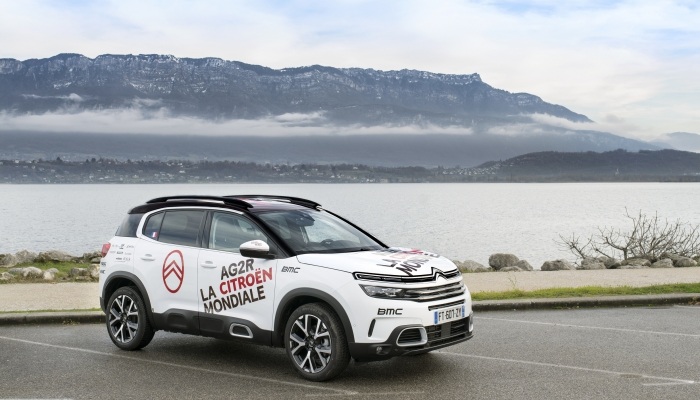
Today, Citroen becomes a sponsor member of Mouvement pour un cyclisme crédible (MPCC). The brand joins AG2R La Mondiale, Bora, Cofidis, FDJ, Groupama, LCL, Lotto and Total Direct Énergie in the ‘sponsor members’ category. MPCC is an association that fights for clean cycling, relying on the notions of transparency, responsibility, and the mobilisation of its members. Those notions are in line with Citroen’s aspirations and its commitment to the development of ‘clean cycling’ for responsible, untainted performances. This partnership advocates for a cycling that complies with ethical rules, in particular with those of Mouvement pour un cyclisme crédible (MPCC), of which the AG2R LA MONDIALE cycling team was the founding member in 2007.
“Citroen adheres fully to the MPCC charter and to the obligations deriving from it. Citroen wishes to promote the image of cycling by fighting against doping and any form of cheating. We care deeply about the notion of responsible performance and our commitment for ‘clean cycling’ underlines human values incarnated by our brand.”
Laurent Barria, Director of Marketing and Communication at Citroen
“The support of sponsors in the fight against doping is a strong symbol of what MPCC stands for today. We are grateful for having a company such as Citroen on board and we hope that this initiative will encourage other sponsors to join the 9 partners engaged to date.”
Roger Legeay, President of MPCC
Since 1919, Citroen has been creating cars, technologies and mobility solutions to meet the evolutions of society. A bold, innovative brand, Citroen puts serenity and week-being at the heart of its customer experience and offers a large range of models, from the singular Ami, an electric mobility vehicle designed for the city, to sedan cars, SUV and utility vehicles, most of which are available in electric version or rechargeable hybrid. A pioneering brand in services and customer orientation, Citroen is active in 101 countries and operates a network of 6,200 points of sale and services worldwide.
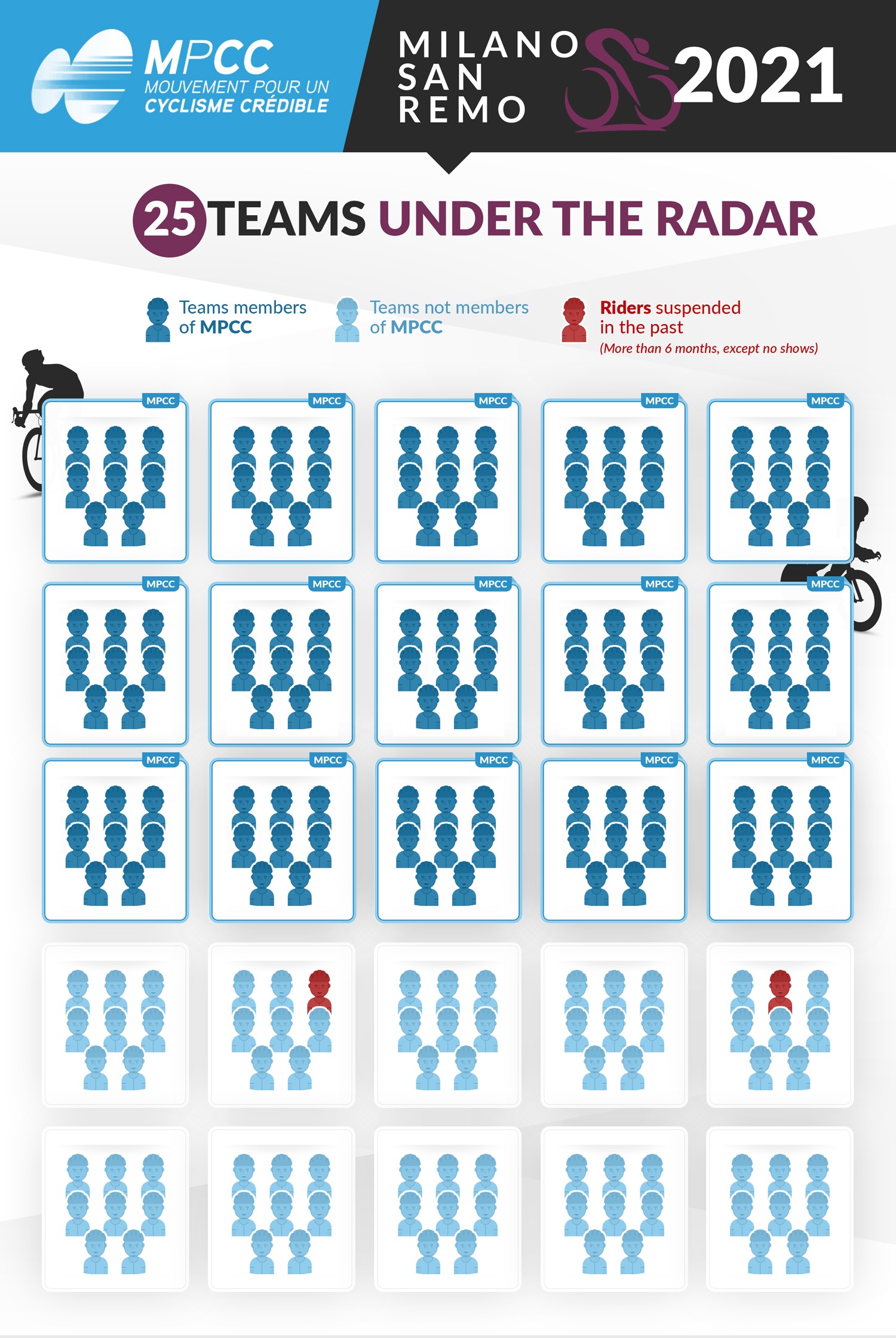
Milano Sanremo 2021 : 25 teams under the microscope
IN AN INFOGRAPHY, WE HAVE REPRESENTED 2021 MILAN – SAN REMO, DISTINGUISHING MPCC MEMBER TEAMS AND NON-MEMBER TEAMS. AMONGST MEMBER TEAMS, NO RIDER HAVE EVER BEEN SUSPENDED. WITHIN NON-MEMBERS, 2 ALREADY HAVE
In the event of every monuments or big championships, the MPCC highlights how many riders are part of the movement but also how many riders have been suspended for doping in the past.
The spirit of the MPCC is to regroup teams which on a voluntary basis define stricter rules than international organizations. Amongst those, this one: « Don’t hire riders involved in doping cases and banned for more than 6 months, except no-shows, in the two years following the suspension. »
On Milan – San Remo, MPCC members chose not to pick any riders previously suspended for doping. This choice matches the philosophy of the movement, thus fostering cycling’s credibility. There are 15 MPCC members on this year’s, representing 60% of the peloton.
Cortisol Level Tests on Paris-Nice
4 member teams subjected 25 riders to cortisol level tests on Paris-Nice. All the riders have been allowed to start.
On Paris-Nice, 4 member teams registered for the race submitted 25 riders to cortisol level tests as part of their commitment to the Movement for a Credible Cycling (MPCC):
These voluntary tests have been performed under the auspices of the Union Cycliste Internationale (UCI) and CADF on all participants. The CADF has forwarded to the MPCC the results of all riders of the member teams. All results were in compliance with the standard established by MPCC members. The Board notes with satisfaction that the riders of these MPCC member teams registered for Paris-Nice have scrupulously respected the clauses of their standing orders.
25 controls have been carried out by MPCC since the start of the season : On Paris-Nice.
BACKGROUND ON CORTISOL TESTS BY THE MOUVEMENT POUR UN CYCLISME CRÉDIBLE (MPCC)
The objective of the MPCC and its member teams is to contribute to restoring the credibility of cycling. One of the organisation’s activities are voluntary cortisol tests amongst the riders of the member teams of the MPCC. In case the results of the test present an abnormally low value, the rider concerned will not race for a period of minimum eight days until the cortisol value has recovered again above that minimum value.
For the sake of clarity: it concerns a voluntary norm and the test does not concern an anti-doping control. Under WADA rules, athletes across all sports, with a cortisol level abnormally low, are entitled to perform their sport in competition (unless an anti-doping test has revealed the unauthorized use of the cortisol hormone).
The reason for the MPCC member teams to introduce this voluntary norm (below which the rider concerned will withdraw from competition for that minimum period of eight days), is an effort towards all stakeholders and fans of the sport of cycling and to confirm its commitment to clean sport and to show that cycling and MPCC member teams wish to be a frontrunner in that.
WHY CORTISOL TESTS ?
Although cortisol hormones are an allowed medicine when pre-scribed by a physician, the use of that medicine has frequently been abused in the history of sports (including in cycling) for the purpose of increasing the performance. Besides, a low level of cortisol can potentially endanger the health of athletes in certain circumstances when he/she is in competition while the athletes perform under high intensity or under stress.
For both reasons and with the objective to contribute to restoring the credibility of cycling, the Mouvement pour un Cyclisme Crédible and its member teams have introduced that voluntary norm below which its riders will temporarily withdraw from competition.
Press Release - 3rd March 2021
MPCC held its videoconferenced Board of Directors on 1 March as well as its General Assembly on 2 March. Several important topics have been discussed.
The Board of Directors performed the election of its 2021 Bureau:
- President: Roger Legeay
- Vice-President: Iwan Spekenbrink (Team DSM)
- Treasurer: Sébastien Hinault (Arkea-Samsic)
- Assistant treasurer: Marc Sergeant (Lotto-Soudal)
- Secretary: Philippe Senmartin (Total-Direct Energie)
- Assistant secretary: Franck Trajber (Cofidis Solutions Crédit)
- Physician: Dr Pierre Lebreton (Hematologist)
- Member: Christophe Brandt (Bingoal-WB)
- Member: Gianni Savio (Androni Giocattoli-Sidermec)
- Member: Vincent Lavenu (AG2R Citroen Team)
Fight against doping, riders safety, saving the environment
MPCC members noted WADA’s decision to ban any type of glucocorticoids injection starting 2022. This topic has been on our Board of Directors and General Assemblies’ agendas for many years. Since the very beginning of the movement in 2007, our members volunteered to commit to stricter rules about glucocorticoids use. Over the past twelve years, MPCC carried out 4 207 cortisol level tests prior to a lot of major races, thanks to the involvement of the member teams and its riders. The announcement by WADA of stricter regulations on glucocorticoids is good news, as MPCC was not created towards this purpose. However, MPCC will be forced to continue setting up cortisol level tests in 2021, within the framework of the health of the riders.
For many years MPCC has fulfilled its whistleblower role on the glucocorticoids matter. The prospect of reaching a consensus is a big step. Though, the movement insists that it will not be fully satisfied until the exact content of this regulation is known. At this moment, this is still in process. We expect WADA and UCI to release more information to ensure this ban will improve cycling’s credibility and offer equal opportunities to teams and riders. MPCC will hold its whistleblower role with care alongside the governing bodies.
MPCC also remains vigilant on others important topics such as ketones. All the physicians of the member teams committed not to encourage their riders to use this substance. MPCC urges WADA and UCI to make progress on their monitoring studies about ketones so we can rely on a complete knowledge about side effects.
Following these new elements, all of the teams which are not part - or not anymore - of the movement because of our strong engagement on the glucocorticoids should change their minds.
MPCC also reviewed the new rules released by CCP about riders’ safety and environment preservation. The fight for the credibility of cycling is not only about antidoping, so we welcome these decisions as they are relevant with our line: cycling needs its stakeholders to set an example to protect its image.
Race organizers & sanitary context
Our members have expressed concerns after RCS Sport announcement of Giro d’Italia’s wild cards. MPCC will not mess with the choices of the organizers. However, we are surprised that ethical criterion was not taken into account: RCS granted two of its four wild cards to non-MPCC members (Eolo-Kometa and Vini Zabu-Brado-KTM). Vini Zabu-Brado-KTM’s case is annoying: this team, once a member of the MPCC, decided to quit the movement, and experienced a positive antidoping test on the 2020 Giro d’Italia. We reckon that this regrettable event should have influenced the decision of the organizer. Given that this has not been the case, we have trouble understanding how RCS Sport sets its criteria, both in sporting and ethical terms.
At the end of each season, MPCC highlights the ProTeams which received wild cards on WorldTour races. In 2020, RCS Sport didn’t follow the example of other main organizers such as ASO or Flanders Classics, by granting fewer wild cards to MPCC teams – a situation already experienced before. We can’t be confident 2021 will promise us a trend change. Once again, MPCC doesn’t want to put pressure on race organizers’ choices but MPCC is convinced that awarding a wild card for races as popular as the Giro d’Italia to a team which ended the previous edition with a positive antidoping test is a wrong signal.
MPCC would like to remind all the cycling race organizers of its support. In 2020, the consequences of the current Covid-19 crisis caused major difficulties, but a large majority of the races achieved to offer high levels of professionalism to comply with the required sanitary constraints. We can’t say all the sports and all the sporting events reveal the same rigor in the application of the rules. This is why MPCC wants to congratulate all the players of the cycling sport: teams, riders, staff members, sponsors, as well as all the different accredited workers attending the races. In these serious circumstances, all the people who keep our sport alive are displaying responsibility. This is an evidence of the great strength of cycling, a sport which is able to do what has to be done in order to maintain credibility.
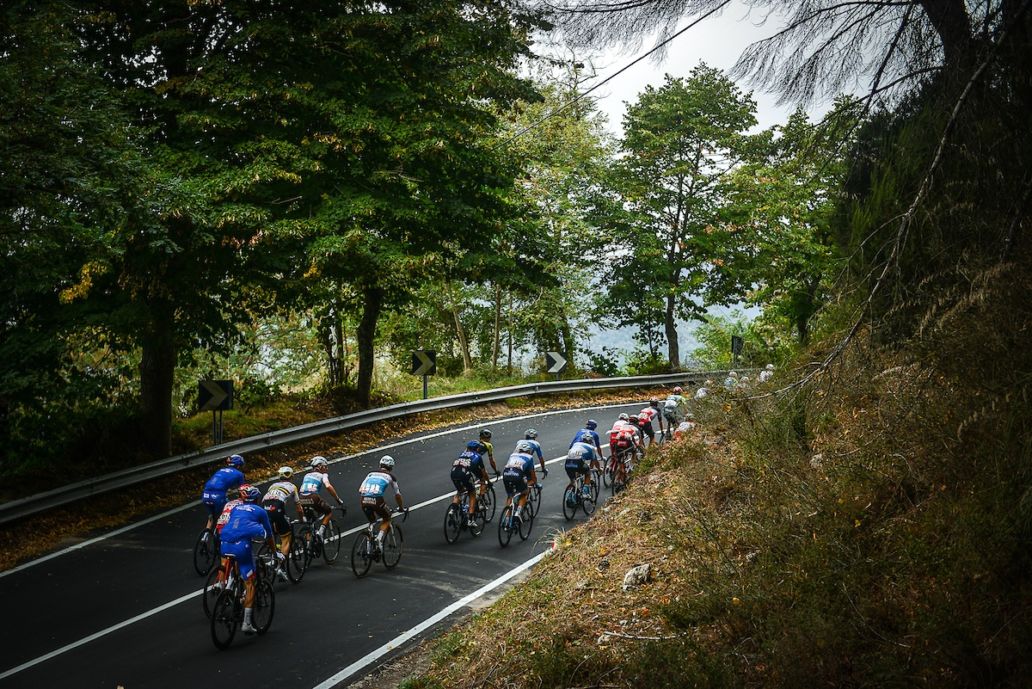
Team INCA and the Esteban Chaves Foundation join MPCC as sympathizing members!
« Team INCA » is a U23 team based in Cantal, France. It is dedicated to nurturing South American young riders. The Esteban Chaves Foundation helps the development of cycling in South America.
Here are some words from Team INCA’s Martin Chavignier, Jean Jacques Goullieux and Esteban Chaves Foundation’s Javier Rodriguez:
« Since its creation, the team fights against any form of cheating, doping and mechanical fraud. Our core values are hard work, ethics, humility and team spirit. We have been partners with team AG2R La Mondiale-Citroen since the beginning of the year, and we share these core values with them. Joining MPCC was an obvious choice as we want to clearly commit to a clean cycling.
Our work, beyond the sport, lies in the support of young riders. We wish to help them thrive and build a life which makes them happy. We build the rider’s path of life following this purpose. We want to play our part in such an important movement which is MPCC. »
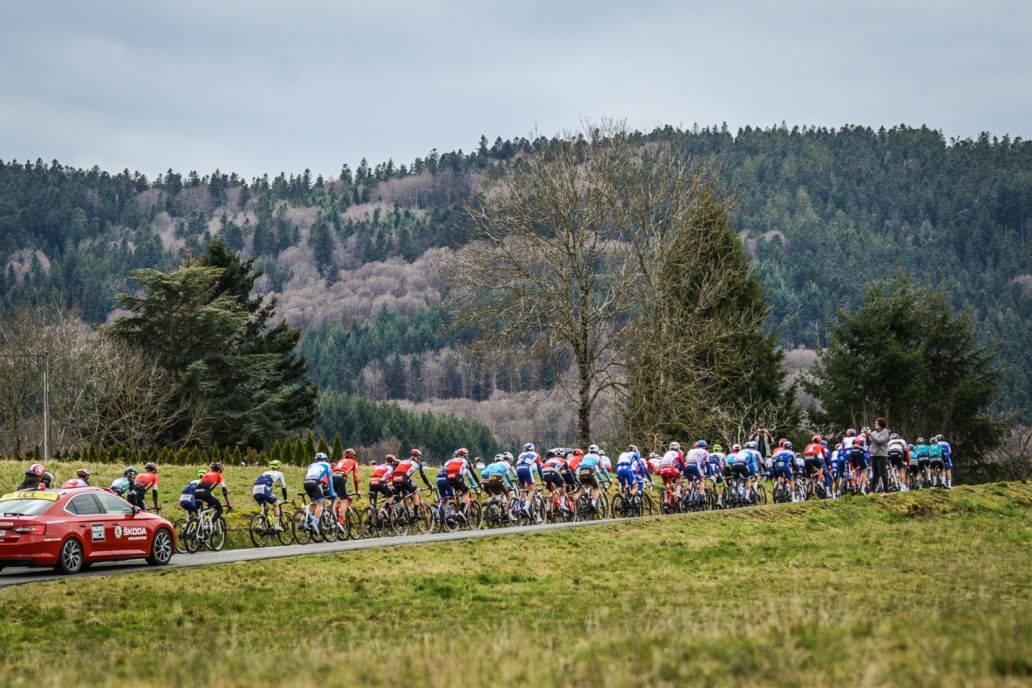
Cycling more credible than last year?
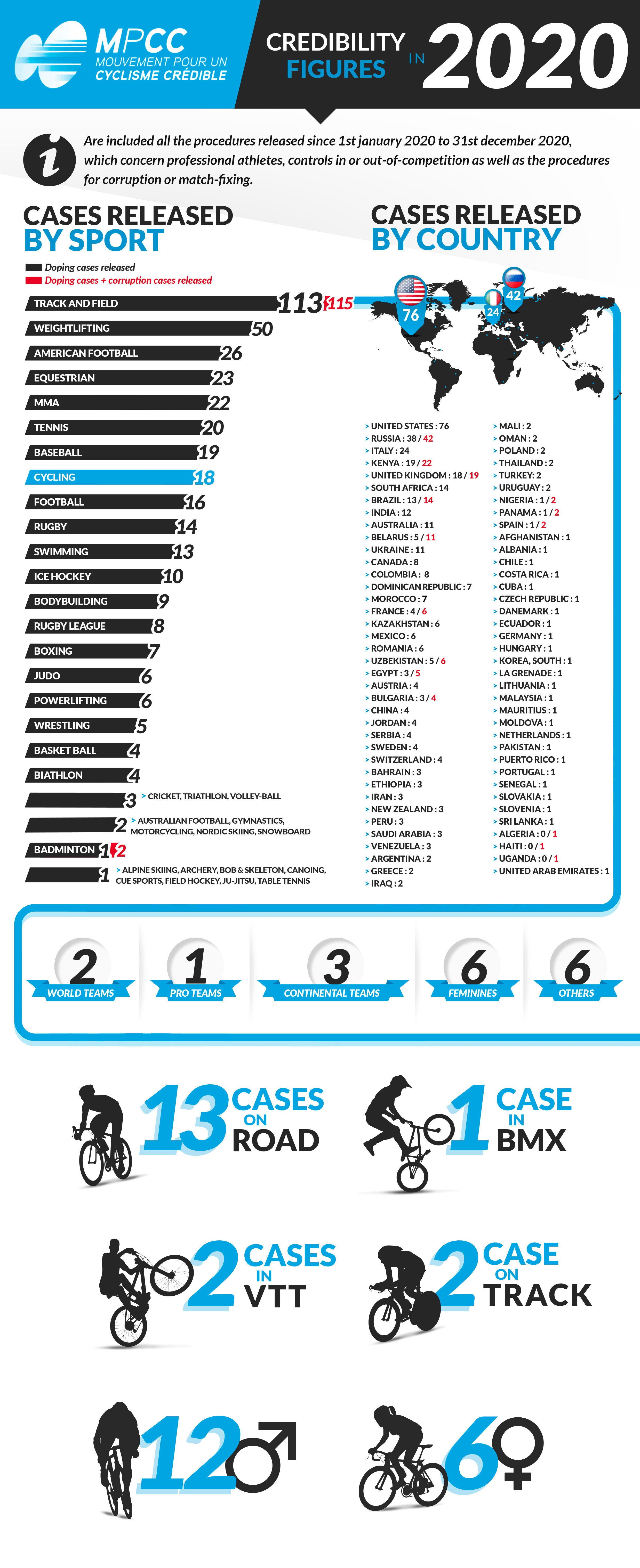
For the year 2020, our credibility barometer places cycling as the 8th sport worldwide in terms of number of suspected doping cases. The previous year, it was ranked 5th.
The pandemic and its negative effects on the organization of doping controls this year make it more complex to interpret our credibility barometer, which we are presenting for the 7th consecutive year.
The World Anti-Doping Agency (WADA) as well as many international federations confessed that they had not been able to carry out as many anti-doping tests as in previous years, especially regarding the "out-of-competition" tests. As a large number of events were cancelled or postponed (such as the Tokyo Olympics), the number of “in-competition” tests logically decreased as well. Therefore, it is no surprise to notice a significant drop in the number of publicly disclosed cases in 2020 compared to previous years: it went down by 18.6% compared to last year and by almost 30% compared to 2018 (all sports combined).
In such circumstances, the 113 cases revealed in athletics come as a surprise since this is the most doping cases ever recorded for the sport according to our barometer. Inversely, only 19 cases were sanctioned in baseball in 2020 compared to between 60 and 108 cases in other recent years for the US Sport. However, due to the pandemic, only 60 of the 162 scheduled MLB games have taken place, which may arguably be the main explanation.
Nonetheless, the United States still remains at the top of our ranking (for the 5th consecutive year), ahead of Russia, whose ban from all major events for the next two years was confirmed by the Court of Arbitration for Sport (CAS) in December. In Europe, Italy and the United Kingdom remain the two countries most affected by doping cases for the year 2020.
Generally, in large part due to the global pandemic, the sports that are usually the most affected by doping have seen fewer cases in 2020. This is notably true for cycling, which experienced a brutal year back in 2019, with a record of 32 revealed cases (more than double the previous year’s number).
In 2020, 18 procedures have been opened in cycling for high-level athletes (all disciplines and genres combined). Although this is far less than the previous season, the number remains significant given the context of a season shortened by several months and with a significantly lower number of tests.
Let us conclude this 2020 report with an encouraging figure: among the suspected doping cases, only 3 riders (men) belong to worldteams or proteams (there were 8 last year). Not since the creation of the WorldTour 15 years ago has this number been so low.

Press Release of 11 December 2020
The members of the MPCC Board took part in a video meeting on 11th December 2020. Roger Legeay, President of the Movement, praised the motivation and the tenacious engagement of its members at the end of a special year 2020.
Corticosteroids: we’re moving forward!
One of the main topics of the Board meeting was the prohibition by the UCI of corticosteroids use. This prohibition, initially planned for 1st January 2019, has still not been enforced as of today. The fight against corticosteroids usage has been the banner of MPCC for numerous years. MPCC’s internal rules, since their creation, followed the same path. For thirteen years now, the members of the movement have been annoyed to see that they have been on their own when it comes to committing to strict and transparent rules on cortisol levels. WADA’s Executive Committee recently decided to prohibit any injectable form of glucocorticosteroids usage starting 1st January 2022. This is a real step ahead, praised by MPCC on its whole. The movement will nevertheless keep on carrying cortisol tests in 2021 during the wait.
Concerning the current year, MPCC carried 449 cortisol level tests during the season, all of which came clear of any anomaly. Broadly speaking, the movement highlights the fact that every MPCC team committed to the internal rules of the MPCC.
Ketones: it’s stalling!
The concerns of the members of the MPCC Board about the misuse of corticosteroids are as strong as the concerns about the usage, on clear sight, of ketones. On this subject, we can only observe baby steps ahead. UCI, through the voice of its Medical Director, confirmed to our movement that it advised not to use ketones: this is a good start. As of today, ketones are not part of the UCI list of prohibited substances and methods. On own their side, members of the MPCC, following the advice of their doctors, decided to commit to not using ketones and asked, following the corticosteroids path, not to be left alone in this strict commitment. Considering that ketones can enhance performance but can also damage the health of the riders because of the potential side effect, this substance is a problem per se, and will continue to be so in the future if no decision is taken.
MPCC does not wish to see cycling viewed as a sport in which one can use dangerous substances. The Movement is also surprised by the absence of a consensus on the topic. Thus, MPCC will submit a formal request to WADA on the subject. Adding ketones to the WADA Monitoring Program would facilitate a potential consensus. Though, MPCC is glad to see a study on ecdysteroids being added to the Monitoring Program this year, as the members of the movement have been preoccupied by the possible usage of this substance in cycling.
Aderlass: we’re not making real progress!
The Board of the MPCC also raised questions about the Aderlass case. Contacted by MPCC to alert UCI about the significance of this case, President Mr. David Lappartient’s answer stated that CADF carried more than 800 tests on already tested samples from 2013 to 2019, and all of them came clear of any substances prohibited by WADA. M. Lappartient confesses that “no quick conclusion can be drawn from these tests. In any case, the totality of these samples will be preserved for potential future tests should circumstances so require”
MPCC acknowledges this situation but warns that it will stay cautious about this case that shed a harsh light on the difficulties encountered by our anti-doping system to stay in touch with reality.
MPCC and its members, who amounts for 68% of the first and second division teams, consider themselves to be legitimate whistleblowers: it has been one of the keystones of the movement since its creation. Though, MPCC must also ensure that this alert goes the distance. Reunited during the meeting of December 11th, the members of the Board proved determined to maintain this course.
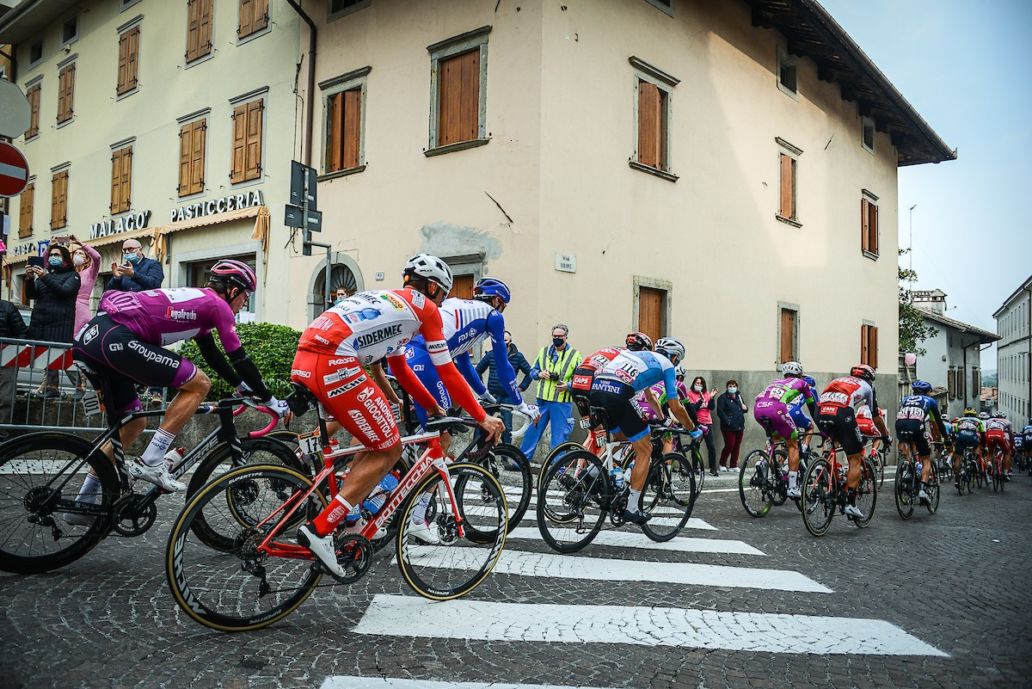
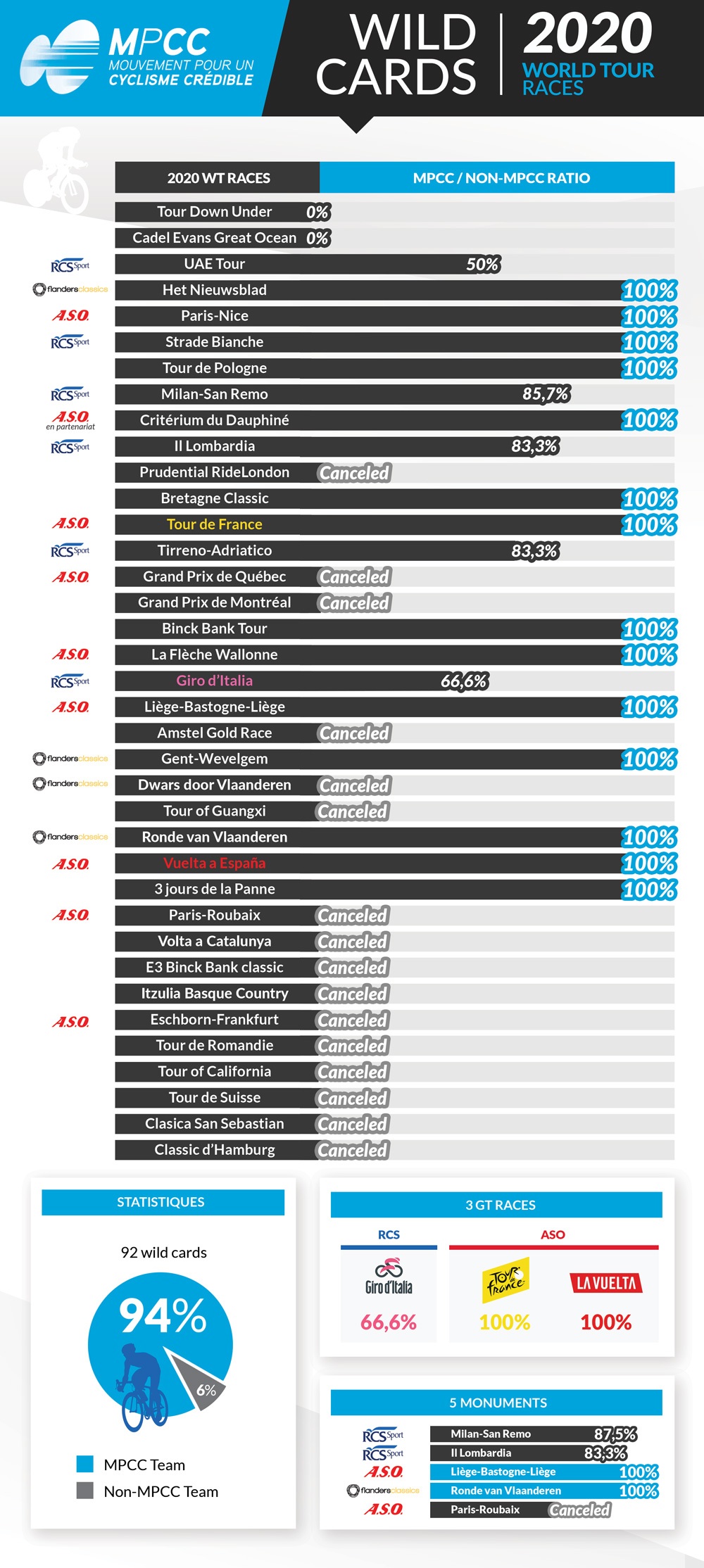
94% of the Wild Card were granted to MPCC teams in 2020
In 2019, 91% of the wild cards were given to teams belonging to MPCC. In 2020, this figure rose again, reaching 94%. 100% remains the objective.
At the end of each season, MPCC delivers an infographic to sum up the choices made by the World Tour races regarding wild cards. This infographic aims at showing whether the wild cards were granted to MPCC teams or not.
In 2019, 91% of the World Tour wild cards were granted to MPCC teams. There are usually 3 or 4 wild cards on stage races, and up to 11 on one-day races. This percentage is already a success, but the movement is still aiming at 100% for all these organizers. Reaching this objective would be a great reward for our strong commitment, on a voluntary basis, to stricter ethical rules.
In 2020, the proportion of MPCC teams climbed up to 94% from 91% last year. The World Tour organizers never stopped trusting the Continental Pro members of our movement, and we can only be glad for that. Let's point out that 97 fewer wild cards granted due to unplanned race cancellations and because the number of World Tour teams went from 18 to 19.
The movement regrets the fact that not all the Grand Tour wild cards went to MPCC teams, contrary to last year when the objective was reached. Once again, RCS Sport, the organizers of the Giro d’Italia, granted one wild card to a non-MPCC team – with one rider of said team tested positive to Enobosarm, a substance forbidden by WADA, on this year’s Giro d’Italia. The movement also notes that Milan – San Remo and Il Lombardia, two Monuments, followed the same path. These two races fall under the responsibility of RCS Sport. MPCC is fully aware that it cannot enforce the choice of the wild cards by an organizer which is not part of the movement. However, MPCC reckons that restraining these wild cards to MPCC members would be a strong signal for the credibility of cycling.
MPCC wishes to underline the strong and remarkable commitment of numerous organizers. Together, they strengthen the credibility of our sport. It is quite a shame that all the other organizers do not follow the same path knowing that the future of cycling relies strongly on this. As usual, MPCC makes the same strong wish: to see all of the 2021 wilds cards delivered to teams belonging to the movement and encourages teams and federations which are still not part of the movement to commit to stricter rules.
In 2020, 17 of the 19 Continental Pro teams, the ones eligible for World Tour wild cards, were part of the MPCC. The two non-members were Uno-X Norwegian Development Team et Vini Zabu KTM.
An unusual year means unusual Credibility Figures too.
Because of the global pandemic, MPCC is fully aware that these figures are altered by a lower number of anti-doping tests carried out through the year. Though, reality can sometimes be unsettling.
The global coronavirus pandemic was a serious obstacle to the antidoping fight this year. The World Anti-Doping Agency (WADA), through its General Director Olivier Niggli, conceded a few days ago that the pandemic may have created some « holes » in the anti-doping programs in several countries.
Multiple international federations agree with this unpleasant statement. The Cycling Anti-Doping Foundation (CADF) admitted a 90% decrease in the out-of-competition tests during the two months following the start of the pandemic compared to the same period last year.
Across all sports, we logically account for a lower number of cases than during the previous years. There is one notable exception: track and field, where almost 100 cases have been revealed throughout the first three quarters of the year 2020 (as against 81 cases during the whole year 2019).
Within the same period, cycling had to deal with a dozen of cases (two within World Teams), a lower figure than last year at the same time, but still very close to the data of the last 5 years. This last observation is a great source of worry for MPCC, given the lower number of tests in 2020.
