
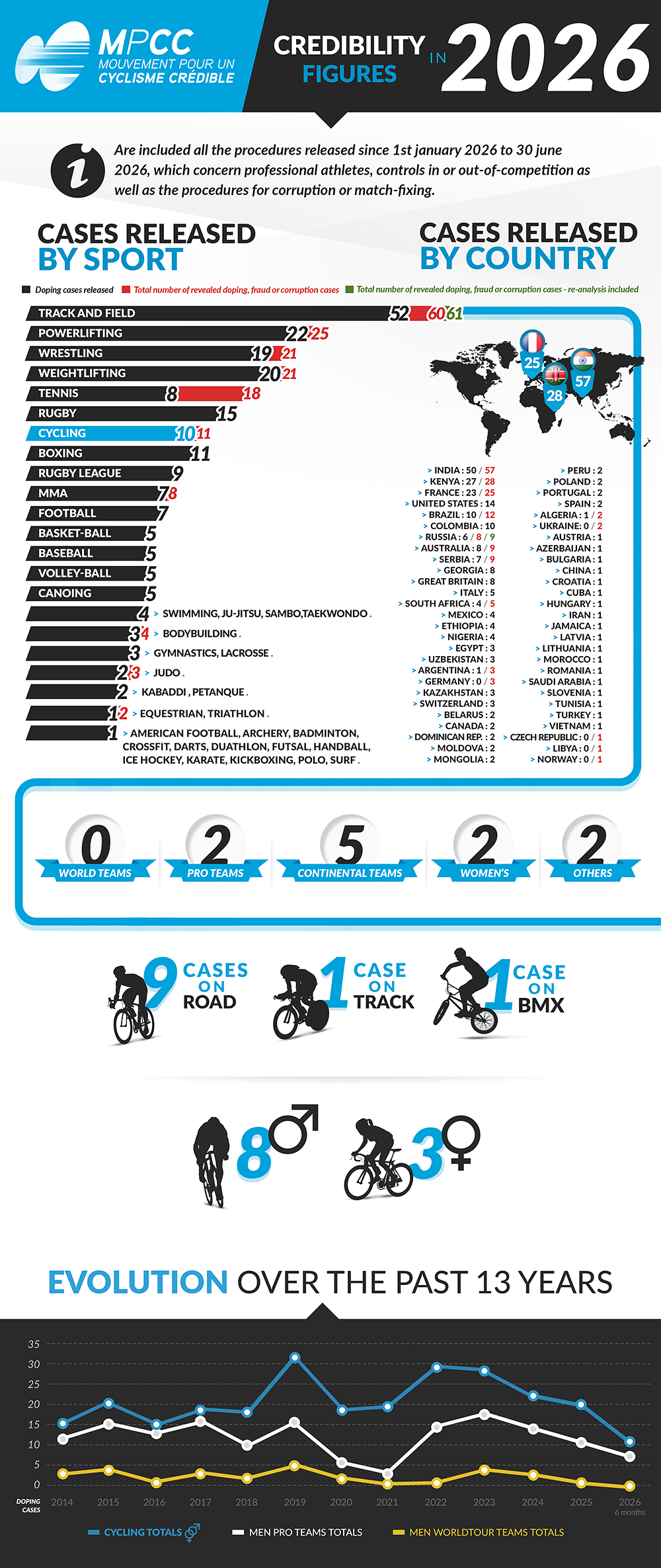
Following the first two quarters, the MPCC has recorded 11 cases of anti-doping rule violations amongst professional cyclists. The Credibility Figures, which monitors the sport’s credibility on a large scale, is also part of a broader approach in which transparency of information must be regarded as essential in the fight against doping.
The fight against doping is inextricably linked to sport, reinforcing its credibility amongst all those inspired by sport – from amateurs to professionals and spectators alike – forming an integral part of its identity. Sport conveys noble values such as fighting spirit, courage and tenacity, as well as camaraderie and sharing, uniting athletes around common values and beyond their differences. To protect sport from cheating and risky behaviour, international bodies have taken action over the years to ensure that the credibility of sport remains key.
When the MPCC was founded in 2007, its founding members sought to send a strong message in response to the delicate situation cycling found itself in: the Festina scandal, which undermined the credibility of cycling in 1998; a proliferation of doping cases, including Operacion Puerto in 2006; and sanctions that were not sufficiently dissuasive. Our movement has adopted a zero-tolerance approach to doping and is committed to the health of riders. It has subsequently sought to take a proactive stance by organising cortisol tests amongst its member teams, by acting as a whistleblower on the use of some substances – including Tramadol more than ten years ago – and by maintaining a cautious stance on some practices considered to fall within ‘grey areas’, bordering on doping.
FEWER CASES, LESS DOPING ?
The drive for respectability is also accompanied by a level of transparency, which is necessary to show the efforts made by those involved in cycling to tackle doping. The anti-doping community, led by the World Anti-Doping Agency (WADA), has done a great deal of work over the past twenty years, and we at the MPCC provide a snapshot of this through our Credibility Figures. These figures are not intended to be as comprehensive as possible, but they serve as an outlook of the fight against doping worldwide and of the sports that have chosen to take a stand against this scourge.
Following the first two quarters, national and international anti-doping agencies, as well as the press, have reported 280 cases of doping and/or sports fraud involving elite athletes, representing a significant drop of nearly 30 per cent compared with last year. This decline raises questions, as some countries have not opted for full transparency regarding sanctioned athletes, thereby calling into question the pact to which all stakeholders in sport – national and international federations, anti-doping agencies and accredited laboratories – are committed. At national level, India continues to raise questions by topping this list with 57 cases of doping and sports fraud, ahead of Kenya (28) and France (25).
CYCLING MUST REMAIN WARY
By sport, athletics remains at the forefront with 61 cases, including those of Kibiwott Kandie, former half-marathon world record holder, and Rita Jeptoo, two-time Boston Marathon winner. Powerlifting (25), wrestling and weightlifting (21) follow in this ranking. As for cycling, it ranks 7th with 11 cases recorded since the beginning of the year. The cases involving seven Continental riders and made public in 2026, confirming the trend described over several years in our previous reports, indicates that the third tier of world cycling remains the poor relation of the sport.
Furthermore, an other Pro Team-level rider was provisionally suspended during the second quarter, whilst cases had been particularly unusual at this level of competition for nearly four years. These figures indicate that we must remain wary despite all the initiatives taken by our sport’s stakeholders to ensure its credibility. At the MPCC, we would like to emphasise once again that, although the results of the fight against doping are satisfying, this does not mean that other practices or training methods are not on the verge of constituing doping. We therefore encourage as many stakeholders as possible – riders, teams, medical staff, amongst others – to show transparency and a willingness to educate when suspicion arises.
We need these values and virtues to strengthen the fight against cheating, and we will achieve this with the support of everyone involved in cycling: from riders to spectators lining the roadsides, including team managers, sponsors and race organisers. Let us be responsible and transparent to remain credible.