
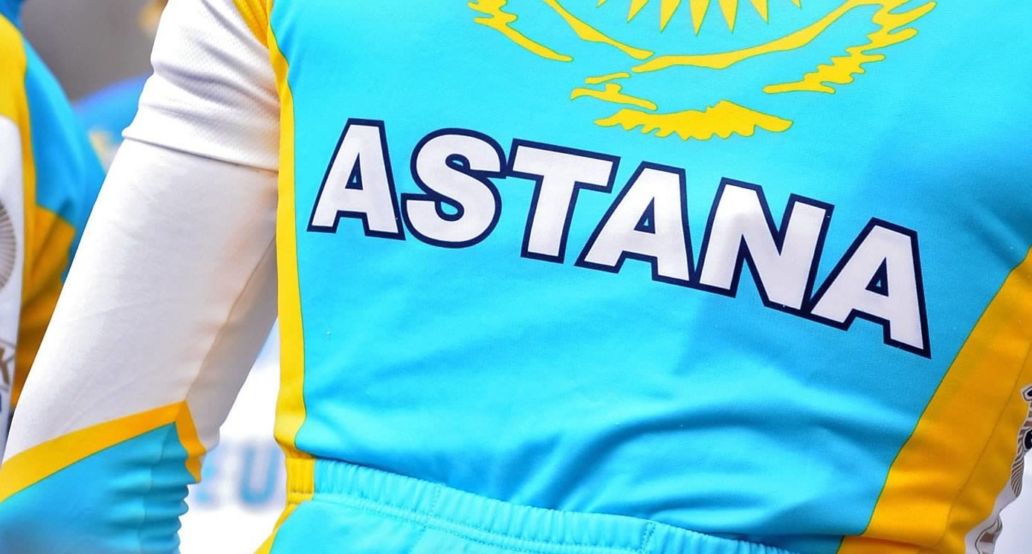
Astana team suspend themselves for Beijing
On Monday, October 6th, Astana team have communicated the decision of their rider Maxim Iglinskiy "not to stand against the second opinion following his positive test on August, 1th 2014." This is the confirmation of the second positive control suffered by the Astana team in less than twelve months after the one of Valentin Iglinskiy.
The MPCC has established, on the basis of commitment and volunteerism, a more stringent settlement than international bodies. In this context, Astana team, which have adhered to MPCC since 2013, apply the regulation, which provides self-suspension from the team for a period of eight days, from the first day of the next World Tour race.
This self-suspension will therefore apply from October,10th, the date of start of the Tour of Beijing, to October,17th , and will also concern the Tour of Emilia and GP Bruno Beghelli. The whole team will be off during this period. This temporary suspension of the team’s activities is to implement any corrective action they deem appropriate.

10/02 Press Release
This Wednesday, UCI released a positive test for EPO concerning the rider Maxim Iglinskiy (Astana).
The team manager, Alexandre Vinokourov, warned personally Roger Legeay, president of MPCC, to give an explanation about this new case.
This is the second alleged doping offense involving riders of the Astana team in less than twelve months, after the one of Valentin Iglinskiy, who tested positive on August, 11st. In this case, according to the MPCC regulation, a member team agrees on a voluntary basis to temporarily suspend operations for eight days from the next World Tour race.
This approach does, however, apply only after the result of the counter-analysis, if the rider requests it. MPCC has specifically asked the Astana team to hear its rider Maxim Iglinskiy, in order to know if he makes a confession or requests counter-analysis.
If this counter-analysis is claimed, MPCC wishes that the result will be quickly released, as it was already the case in similar circumstances last year.
09/02 Press release
Several changes to MPCC rules
The movement considers useful to clarify the different routes of administration of corticosteroids included in its rules, namely : oral, intramuscular and intravenous. These administrations of corticosteroids by general routes also trigger an eight-day shutdown of the competition. The comeback will be made after verification of normal cortisol.
A letter will be sent to the World Anti-Doping Agency (WADA) to examine again the issue of the abnormally low cortisol. An appointment with WADA will be requested to discuss all the MPCC proposals.
The board also decided that the opening of disciplinary proceedings by the UCI for abnormal biological passport of the rider now generate , the same measures as a positive control for the teams members of the Movement.
Finally, MPCC raises the awareness among the players in our sport of fighting against anything that undermines the credibility of cycling : the use of an electric or motorized bicycle, illegal sports betting, etc. That is why the board decided that the opening of disciplinary proceedings by the UCI to the facts above will also result the same actions as a positive control for teams members of the Movement.
67 teams members
The MPCC board chooses to open its membership to the agents of riders and will set in that sense a document listing the commitments due to join the movement. The most important point being not to work with riders who have committed a doping offense code in the past.
The final accession of the Dutch Cycling Federation and of the continental team De Rijke (NED) were passed and approved by the Board. From September 2, 67 teams have been members of MPCC, including 11 in World Tour. The Board notes with satisfaction that all the members of MPCC teams have scrupulously complied with its internal rules.
The General Assembly of MPCC will be held on October 21, 2014 in PARIS. On this occasion, it will be organized on October 20, a meeting gathering the doctors in charge of the teams members of MPCC and the sponsors members of MPCC to be held on October 21.
De Rijke joins MPCC
Member of the third division, the Dutch team De Rijke has requested its membership to MPCC. The board of directors approved the application this wednesday : the team runned by Cor Van der Wel is now provisional member of the movement.
The full list of members is here.
Does a sponsor go against the wind if he is interested in cycling ?

The speech of Michel Thétaz lays the foundations of the debate. In the opinion of the company IAM’s director, stick its image on a cycling team is a risky gamble today. But it's a gamble that he decided to take, being fully aware that the wheel will turn in the future, and then, it will be much more complicated to get a place in the cycling world. This "countercyclical" choice is difficult to make in a business logic, and yet, the payoffs are well worth it.
The interview with Michel Thétaz, director of IAM :

Like Michel Thétaz, Vincent Lavenu regrets that cycling maintains a relatively tarnished image in the eyes of the general public and a fortiori, of potential investors. To the AG2R-La Mondiale’s manager, cycling has changed, but it needs to reflect this situation outside the rather closed circle of this sport. Lavenu is however delighted with the attitude and loyalty of the French teams’ partners. He is himself at the head of his team for 25 years...
The interview with Vincent Lavenu, AG2R La Mondiale manager :

If sponsors do not come to cycling, so cycling should go to them. This is somehow the general idea of Yvon Sanquer, also well aware of the label still sadly sticked on cycling. The manager of Cofidis also appreciates the loyalty of partners in France, but knows that it is not these companies cycling needs to convince. Convince means giving arguments and evidence of the merits of sponsorship in cycling. And to Sanquer, there is plenty.
The interview with Yvon Sanquer, Cofidis manager :

MPCC chairman Roger Legeay adopts a more optimistic approach. According to the former manager of Crédit Agricole, the partners are still present, even more than in the past, and they inject more money than they did a few years ago. He conceives that the market is a bit blocked at the French level, but argues that there is room for new sponsors internationally.
The interview with Roger Legeay, MPCC chairman :

Marketing director of the Belgian lottery, Marc Frederix is the only representative of a sponsor in this debate, together with Michel Thétaz. To him, it is clear that the dark page of the cycling history was turned, and that is what cycling have to put forward and present to potential new partners. According to Frederix, cycling still lacks a "communications platform" that would allow the sport to seduce and attract even more new sponsors.
The interview with Marc Frederix, marketing director of Lotto:
La retranscription de l'entretien :
"A lot of teams are very well aware, and especially the riders are aware that doping is not the future of cycling. I think that the sponsors that come on board today have more chance to find a cleaner sport than they did ten years ago. And they have more chance to have a sport with cycling than in others sports. Pressure in cycling is so high and there are so many controls that doping in cycling has become a minor case and not a major case anymore.
Cycling would need a communication platform to prove to big companies that cycling is cleaner now than a lot of other sports. There is a lot of passion amongst the fans of cycling. So the popularity and the passion. I think too that the name of the team is the name of the sponsor, and also the accessibility. I think that is very important that you can approach the riders. It is a little bit different than in a lot of other sports where the champions are the kings and you can not approach them anymore. So, it is very accessible for the general public."
Cycling, a driving force of anti-doping
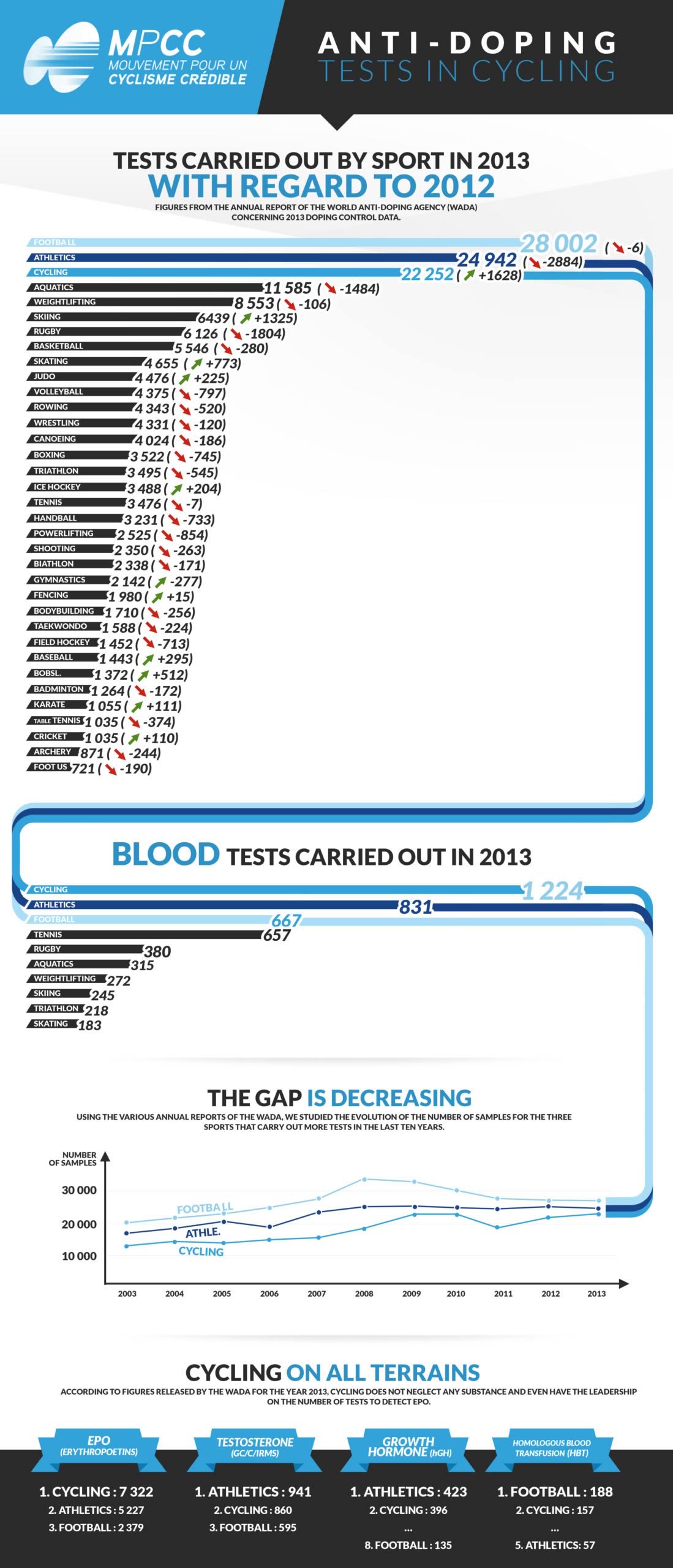
The gap is decreasing, cycling presents the fastest growth
MPCC keep regular accounts of the number of positive tests by sports, which highlights the significant number of cases in the two most affected sports: baseball and athletics. But what about in terms of volume of tests led by the different federations ? Three sports rise to over 20,000 tests per year if we refer to the annual report released by the AMA in July: cycling is one of them, with football and athletics. For comparison, there are 1,300 professional cyclists in the world, that is to say 600 less than the only number of participants to the only Athletics World Championships. And football lists 113,000 professional players on five continents...
Among all sports considered by the World Anti-Doping Agency, cycling is also the one that shows the most eloquent increase in number of controls carried out. 1628 more between 2012 and 2013, when football is stable (-6) and athletics decline sharply (-2884). Cycling has never been so high with 22,252 controls, now pointing to 5750 units of football, when in 2008, biggest year of football with 33,445 controls, the difference was 14,009!
Leader in blood tests, a precursor of Adams and of the biological passport
It's not only quantitatively that cycling sets an example: regarding the number of blood tests done in 2013, it peaks at 1224, against 831 for athletics and 667 for football. Cycling is also a leader in the detection of EPO, with 7322 controls against 5227 for athletics and 2379 for football. Of all the "heavy" substances that are EPO, testosterone, growth hormone and homologous blood transfusion, cycling is never further than second. Football forsakes growth hormone (8th), and athletics transfusion (5th).
A quantitative and qualitative anti-doping campaign which shows that cycling does not leave anything to chance, not to mention his pioneering role in the development of geolocation (adopted from its inception in 2005) and the biological passport (also adopted from its inception in 2008 ), while football, for example, has still not decided to integrating Adams to its plan.
Doping figures to 31st of July
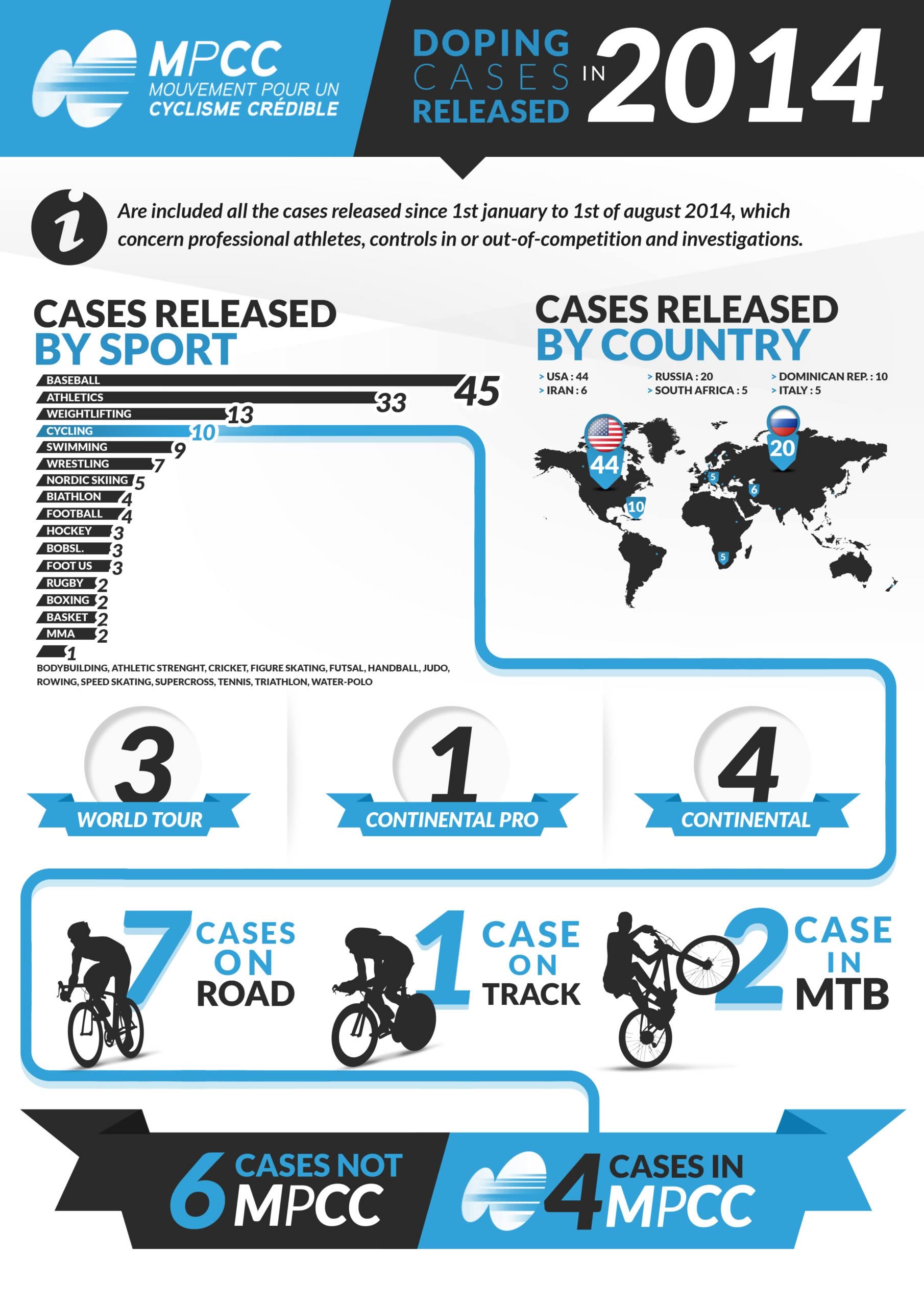
Identifying cases of doping is not an easy task and is subject to discretion if required by their respective international federations, some do not advertise doping cases in their discipline. Cycling, in contrast, reveals each positive test. Our numbers are therefore based on proven cases in 2014, according to official communications federations and anti-doping agencies, etc..
The result is: already 45 professional baseball players tested positive in 2014 (only 28 two months ago) and 33 in athletics (only 10 two months ago). The gap with the third most affected sport, weightlifting (13 cases), is considerable. Cycling is behind with ten cases revealed this year to the 31st of July : less than a third of athletics figures, less than a quarter of baseball figures.
First cases in 1st Division
Of the ten cases of proven doping affairs in cycling in 2014, three are relative to the World Tour, one involves a member of a Pro Continental team, and all the others refer to the third division.
MPCC counting includes :
- Road cycling: seven cases identified for this most mediatised discipline.
- Track-cycling : one case.
- Mountain-Bike : two cases.
Four cases revealed in cycling concerned a member of MPCC team. Each time the MPCC regulations were followed to the letter, suspension and dismissal.
Howman: “The public demands more transparency”
"There are a couple of gaps that need to be filled"
WADA just released its last yearly report listing all the antidoping tests carried out by the different sports in the world. Should we encourage federations to tend increasingly towards greater transparency regarding controls?
Absolutely, and that’s what we need in terms of annual reports, because we need each of the federations and the national anti-doping agencies to file full reports, indicating the whole test distribution plan, and the way in which their tests were conducted, and the outcomes. But we can only publish what we get, and we can only publish in full, what we get from the laboratories. So there are a couple of gaps that need to be filled, and we’re hoping that as we go forward they will be filled by more cooperation from the anti-doping organizations.
What are the associations or organizations remain more discrete about it?
We never rate or rank the anti-doping organizations; I think that is for you to do. You can look at the figures and make some opinions. We prefer to work with everybody, because we know everybody needs some help, and we know everybody can do better, but sometimes they can’t do it by themselves. So our job is to work with them to increase their quality.
What are the federations or organizations involved in transparency regarding the anti-doping fight?
It depends on what you classify as transparency, because a lot of the time, when some federations publish the list of the names of the athletes they tested--and they are reluctant to do that now because of privacy laws and data protection laws--so you can’t be as transparent as you perhaps want to be. There are other laws that prevail in some countries which preclude them even naming those who break the rules, or naming them only in a semi-public way by posting them on a website, rather than issuing a press release. So there are areas where things can be more transparent, if people can see the good benefit in that, and we would like to promote it if we can.
"We are trying to do things to change those rules"
What’s the benefit for these federations?
I think the public really demands more transparency nowadays, and is not happy when things are swept under the carpet or not disclosed. It sounds as though there’s a cover up, or a secret, which is being hidden from them, and they don’t like that. So we would always, I think, make sure that transparency was one of the number one issues, and we try to set the example on that. Again, however, we’re constricted by rules and laws sometimes that we are not really happy with, and we are trying to do things to change those rules. So, I think transparency is a value that the public really does wish to have, and wish to see in sport.
What are the obligations that the federations must submit about transparency of controls and results?
In terms of publication you will see that there’s an article in the code that tells each of the anti-doping organizations what they need to do in terms of publishing the cases of those who break the rules, and we’ve got ways of monitoring that to ensure that that is done. That would include sanction periods and so on, and we’ve got rights of appeal. So we can keep an eye on that. What we also have is an obligation on the anti-doping organizations to publishing annually their statistics, to show the tests are done, and the results, and so on. That’s where we think there needs to be some improvement, as we enter into the revised code of next year, I think there will be significant improvement. We’ve tried to lead the way by the way we’ve published ours, because you might remember that three or four years ago we were only issuing a ten-page report. Now it’s very detailed, and we think that those sorts of details can be copied by others.
Does the idea of a biological passport widespread in other sports is a track as you explore to strengthen anti-doping fight?
We are trying to do that. It’s not mandatory--as you know--it’s a discretionary thing. But we have worked with FIFA, for example, and they’ve launched their biological passport in Brazil. We think that others will join, because the benefits of profiling are significant. It not only allows the athlete to say that they are clean, because they’ve been profiled—but it also allows more information to come to the testing authority to check whether someone is suspicious. And, finally, it also shows someone who’s cheating. So there are benefits involved in the passport, which we think ought to go across boards.
Cortisol : More than 50 riders tested on Tour de France
No medical contraindication has been made
As since 2008, within the framework of health and on the basis of voluntary teams, MPCC has made controls of cortisol during the Tour de France. Reminder: an abnormally low cortisol triggers a medical contraindication in sporting activities and immediate cessation of the competition. Saturday, July 19, 2014, 49 riders of all members of MPCC teams, plus French riders of non- member teams, were taken this morning between 6:30 AM and 9 AM. No medical contraindication has been made.
Must a sponsor dictate its law?

The sponsor's confidence to the management is the key according to Vincent Lavenu. The general manager of the AG2R La Mondiale team is in a good position to speak and to sing the praises about it: after two doping cases in less than a year, his team made the choice to suspend itself last year and did not participate to the Critérium du Dauphiné. Both the sport and sponsor entities of the team are members of MPCC, which allowed the sponsor to establish a course of action.
The interview with Vincent Lavenu, AG2R-La Mondiale manager

Yvon Sanquer, general manager of the Cofidis team, agrees with Vincent Lavenu. Trust must be total between the sport and the sponsor structures, around a course of action set from the start. However, Sanquer also insists on the fact that the sponsors are now well aware of the unavoidable concern that ethics represents.
The interview with Yvon Sanquer, Cofidis manager :

MPCC's chairman Roger Legeay validates the ideas of Vincent Lavenu and Yvon Sanquer. Absolute transparency must be effective between the sponsor and the men it chooses to install at the head of the team. Especially since cycling is not always the chosen field of the partner. The MPCC's "club of sponsors" allowed to get everyone around the table.
The interview with Roger Legeay, MPCC chairman :

Marketing Director of the Belgian Lottery (Lotto), Marc Frederix brings the contribution "representing sponsors" in this debate. And his vision is clear: the sponsor must protect itself against every bad publicity affiliated with its brand. Thus, in addition to agree on a directive with the management staff, the company Lotto, itself a member of MPCC, requires its employees to sign a code of ethics in order to cover itself as much as it can.
The inteview with Marc Frederix, marketing director of Lotto :
The transcript of the interview :
« If we're talking about image, for the company like the national lottery, it is very important that there is an ethical charter, and that we can avoid all negative publicity regarding drug abuse, doping, etc. We impose the management that they, and the sport directors, and all the riders, that they sign the ethical charter, and that they are ambassadors of the brand, and as ambassadors of the brand, we cannot accept negative publicity around the brand.
I think that for some older sponsors, commercial sponsors, 10 years ago, all publicity was publicity, no matter if it was negative or positive. Now I find within our co-sponsors that they say “okay, the image of cycling is changing, and we as co-sponsors, we have to contribute to that changing image”. Today they even more ask an ethical approach of the team than 10 years ago.
The co-sponsors, the government and the company, we have had this doping free policy since 20 years in fact. It would be better to have solidarity, equality between all the teams. And today a majority of teams are members and a minority stays out of MPCC. Definitely it would be better that all the teams would be part of MPCC. »