
French Ministry of Sports meets MPCC
Thursday, July 3, the French Secretary of State for Sport Thierry Bawler met Roger Legeay, President of MPCC, accompanied by Armand Megret, medical consultant of MPCC and Christophe Lavergne, General Counsel of French Cycling Federation. It happened one day after the presentation, during the Council of Ministers, of a bill to strengthen and harmonize at the international level the control and sanction regimes in the antidoping framework. However, the Ministry affirms that "in addition to the controls, support and encouragement should be given to collective and positive actions driven by sporting communities, which implement efforts based on prevention and protection of athletes' health and sport integrity."
This appointment echoes the request of MPCC to the French Ministry of Sports in February. Following initial discussions dating from 2013, MPCC had wanted to raise awareness among the French government about cortisol. Our request was clear: apply the rules of cortisol controls for all teams, members or non-members of MPCC on competitions held in France. The appeal was heard by Thierry Bawler who "promised to integrate, into his work on athlete status, a reflection on adaptation of occupational medicine regulations to the specific nature of high-level athlete activity, to ensure better protection of their health."
Press release of the Ministry :
Fight against doping is a shared concern
Doping is a curse for the sport and for the health of athletes at all levels.
The fight against doping remains a priority of the Ministry of Sports which leads a resolute action at both national and international levels.
Wednesday, July 2, Najat VALLAUD BELKACEM and Thierry BRAILLARD presented during the Council of Ministers the bill that will allow the transposition by way of reasoned order of the third version of the World Anti-Doping Code, which will be effective on the 1st January 2015.
The purpose is to strengthen and harmonize at the international level the control and sanction regimes. This effort of international convergence is absolutely necessary, both from the point of view of the effectiveness of the fight, and the acceptance of the rules by the world of sport stakeholders, considering that rules must be the same for all.
France remains an actor at the forefront of the fight against doping, adopting a proactive approach internationally recognized. Valérie FOURNEYRON continues to represent the Council of Europe in the Executive Committee of the World Anti-Doping Agency (WADA), and France will host the Executive Committee and Foundation Council of WADA in November 2014.
On a national basis, this harmonisation is enlarged by a reinforcement of the efficiency of anti-doping tests, with a better targeting thanks to the biological passport, a better exchange of information and the use of new ways of investigation.
Fight against doping needs a mobilization and coordination of all the sporting and public entities involved : sporting federations, organizers, AFLD and state services, including police and customs.
In addition to the controls, support and encouragement should be given to collective and positive actions driven by sporting communities, which implement efforts based on prevention and protection of athletes' health and sport integrity.
In this context, Thierry Braillard, Secretary of State for Sport, met on Thursday 3 July M. Roger Legeay, Chairman of Mouvement Pour un Cyclisme Crédible (MPCC), accompanied by M. Christophe Lavergne, General Counsel of French Cycling Federation (FFC) and Dr. Armand Megret, medical consultant of MPCC, whose innovative, responsible and exemplary approach deserves to be supported and promoted. Besides that, 15 teams at the start of the Tour de France, out of a total of 22, are members of MPCC and signed up its charter.
Following that meeting, Thierry Braillard promised to integrate, into his work on athlete status, a reflection on adaptation of occupational medicine regulations to the specific nature of high-level athlete activity, to ensure better protection of their health.
The fight against doping, as part of protection of integrity, ethics of sport and athletes' health, remains a shared concern.


Dr. Boelens : Corticosteroids, "eliminate the grey area"
What MPCC's rules say
Recently interviewed for the debate « Can a medicine of performance be credible ? » launched by MPCC, Anko Boelens has been able, thanks to the solicitation of Cyclingnews’ journalists, to further comment on his conception of medicine in cycling. The referring doctor of Giant-Shimano, member of MPCC, highlights the differences of process between a MPCC team member and a team only required to respect the WADA and UCI's regulations.
« Corticosteroid is still a legitimate medicine if you need it but you need to take a period of time to get well, he said. It’s the same with corticosteroid injections. It’s a valid way of dealing with tendon problems, for example, but if you need to take it then you need to take eight days off from racing. The most important reason in all of this is because we want to eliminate the grey area. »
« I’d like to see the MPCC rules for all the teams »
To eliminate this « grey area », MPCC wants to reduce as much as possible the room for doubt, and thus decrees on its members, all members on a voluntary basis, more stringent rules than those of the World Anti-Doping Agency (WADA) and the Union Cycliste Internationale (UCI). The eight days « forced break » after taking corticoids are part of that: « Some people might feel like that and it might seem like we’re putting ourselves at a disadvantages, he continued. I don’t see it like that because I think it gives us clarity and it gives us clear boundaries to compete in sport. Also the systems in place by WADA are there to stop people abusing the system but in order to eliminate all doubt we as the MPCC have our rules. »
Today, 75% of the international peloton's pro teams (D1 and D2) have joined the movement. The Giant-Shimano's doctor wants to believe that this quota can still grow: « Of course we hope that more teams join us or that WADA do too but until that day someone has to start, he concluded. If no one does it then it definitely won’t happen. I’d like to see the MPCC rules for all the teams, definitely. That’s what we’re regularly asking the UCI and WADA. It’s working because Tramadol is under investigation and Xenon has been banned quickly by WADA. We hope Tramadol will be on the banned list in the future and we feel that glucocorticosteroid and riding races shouldn’t be combined. »
Doping figures to 31st of May
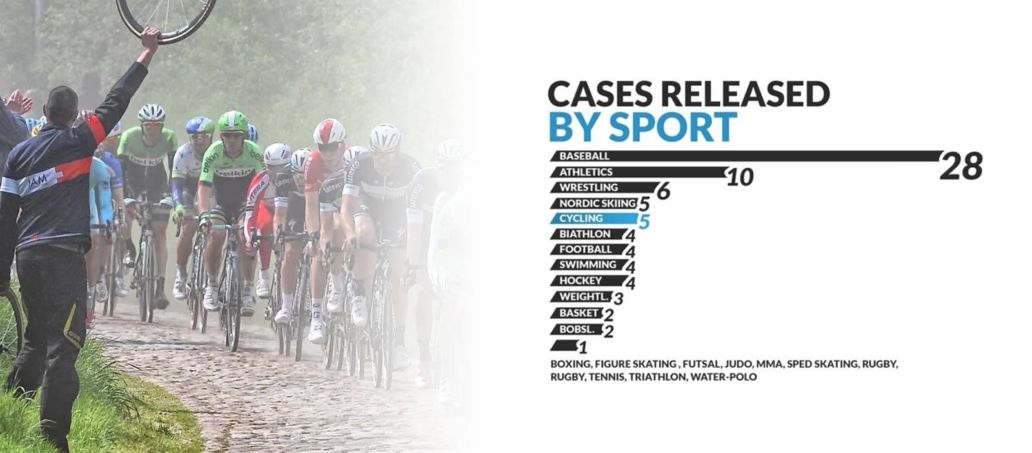
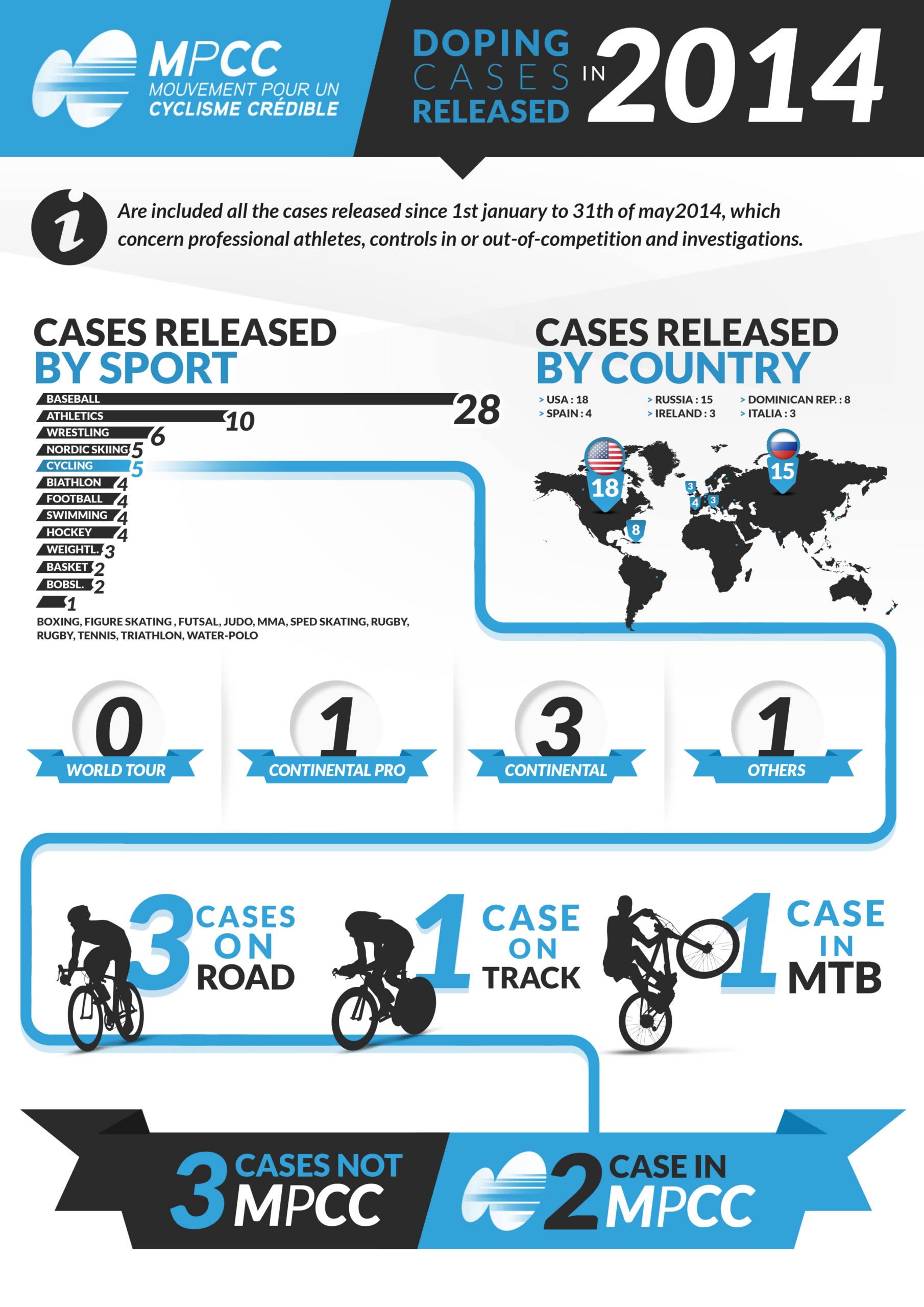
Identifying cases of doping is not an easy task and is subject to discretion if required by their respective international federations, some do not advertise doping cases in their discipline. Cycling, in contrast, reveals each positive test. Federations are required to report the information to the World Anti-Doping Agency for an annual report, but is made during the month of June. Our numbers are therefore based on proven cases in 2014, according to official communications federations and anti-doping agencies, etc..
The result is: already 28 professional baseball players tested positive in 2014. The gap with the second most affected sport, athletics (10 cases), is considerable.. Cycling is far behind with five cases revealed this year to the 31st of May, after Wrestling and tied with Nordic skiing, sports where the number of urine and blood tests, in or out of competition, is more than four times less numerous according to the numbers of WADA.
No rider in First Division
Of the five cases of proven doping affairs in cycling in 2014, none mentions the World Tour, one involves a member of a Pro Continental team, and all the others refer to the third division. This means that athletes caught by the patrol this year have never participated in a major event in our calendar.
MPCC counting includes :
- Road cycling: three cases identified for this most mediatised discipline.
- Track-cycling : one case.
- Mountain-Bike : one case.
Two cases revealed in cycling concerned a member of MPCC team. Each time the MPCC regulations were followed to the letter, suspension and dismissal.
06/17 Press release
Dutch federation new MPCC member !
Meeting on Monday, the 9th of June in Andrezieux, alongside the Critérium du Dauphiné, the MPCC Board has validated the final accession as members the continental and women's teams: Itera-Katusha, Tirol Cycling and Tibco-To the top.
MPCC also valid the accession of the Dutch Cycling Federation. MPCC welcome this membership, hoping now relying on other applications of federations.Contacts have been initiated with several of them.
MPCC now has 11 World Tour teams of 18 (61%), 16 Continental Pro teams of 17 (94%), 31 Continental teams of 181 (17%), 8 UCI women's teams of 32 (21%) and 9 national federations, including the European Cycling Union (UEC).
WADA bans xenon, what about tramadol ?
MPCC noted the addition of xenon on the list of substances banned by the World Anti-Doping Agency (WADA) and welcomes the instance to the effectiveness of the procedure. Since February, MPCC had alerted WADA about the dangers presented by the use of this product in sport and cycling in particular.
MPCC hope the same awareness about Tramadol, dangerous drug to the health of athletes, that continues to be the object of a general study of all analgesics by WADA during 2014.
Cortisol tests on Paris-Nice, Giro, Dauphiné and Tour
In collaboration with the French Cycling Federation (FFC) and the French League Cycling, MPCC has practiced tests for cortisol at Paris-Nice, on March the 15th, with 14 member teams registered for the competition, for a total of 42 samples. All were negative.
During the Tour of Italy, other cortisol samples were done the day before departure, under the auspices of the Union Cycliste Internationale (UCI) on all participants. The UCI has transmitted the Movement the results of all teams members of MPCC riders, on condition of anonymity. All were negative.
New tests for cortisol were planned during the Critérium du Dauphiné, others will be made in the future especially during the upcoming Tour de France.
The Board notes with satisfaction that all the teams members of MPCC have scrupulously respected the clauses of tehir standing orders.
On February 2014 the 25th, and April 2014 the 23th, a new letter was sent to the French Ministry of sports to raise awareness about the need to apply the rules of cortisol controls for all teams, members or non-members of MPCC, on competitions held in France.

Dutch federation joins MPCC !
Through its president Marcel Wintels, the Royal Dutch Cycling Federation (KNWU) has request its membership to MPCC. An application accepted by the movement on 11 june. It's the 9th federation to join MPCC, after France, Belgium, Swiss, Marocco, Ireland, Israel, Norway and European Union of Cycling (UEC).
MPCC initiated contacts with some others federations and hopes to receive new membership applications.
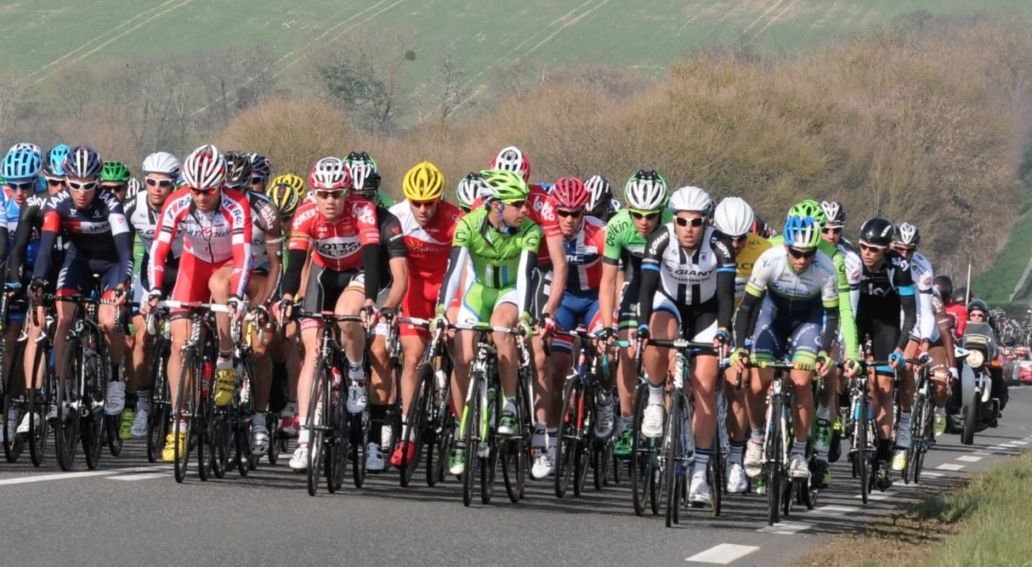
Can a medicine of performance be credible ?

The starting point for this debate is Gérard Guillaume, who is putting his foot in his mouth. His requirement is quite radical : no profit sharing, no performance bonuses. Doctor of FDJ.fr team, referring doctor of MPCC, he exposes his views with conviction : he believes that only the health control of the riders should concern him and that participate in the optimization of the training is incompatible with medical ethics. A point of view on which we have been collecting his colleagues' feedback (see below). So, what do YOU think ?
The interview with Gérard Guillaume, FDJ.fr doctor :

Prentice Steffen, doctor of team Garmin-Sharp, tempered Gérard Guillaume’s position while emphasizing the importance of trust, which must be consolidated with a doctor who has an expertise in physiology. Nevertheless, he joined Gérard Guillaume on the question of performance bonuses, which are also expressly prohibited by the UCI regulations.
The interview with Prentice Steffen, Garmin-Sharp doctor :

According to Eric Bouvat, doctor of the team AG2R La Mondiale, a physician with expertise in training may be more effective in this field because he will think of the health prevention. He considers the the problem arises when you have the two functions.
The interview with Eric Bouvat, AG2R La Mondiale doctor :
The transcript of the interview :
"According to our curriculum and our expertise, we visit our patients, because they are our patients, for me they are all patients even if they are athletes, we visit our patients to express our skills. I am not a specialist in dermatology, so when I have a problem, I call a friend who is a dermatologist. So I don’t get why, because you're a doctor, you could not participate in training. That's it. Nevertheless, make the two becomes problematic. Can we be the doctor of the athletes and both their coach. It is a matter of debate. It is not as clear-cut as that, if the doctor respects the rule of 100% of the capacity of people, he surely may be effective in training and maybe even more effective because he will think of health prevention in the quantity of training he is going to propose. And regarding the injury prevention, he’ll be even more likely to prevent injury than a coach could be."

Reflection of Anko Boelens, the Dutch team doctor of Giant-Shimano, focuses on the difficulty of defining what we really mean by medicine of performance. He takes the example of paracetamol, which treats the pain and discomfort, but might be counted as a performance drug if it's taken "just in case".
The interview with Anko Boelens, Giant-Shimano doctor :
"Performance medication is a very grey area. Where does it start, where does it end ? Sometimes it is easy : for instance EPO is always a performance medicine, and should therefore always be banned. But what for instance about a paracetamol ? Riders will feel discomfort during races, so they might take two paracetamol during the race. Is this performance medicine ? I think medication that serves only one purpose - to make a rider go faster - can be called a performance medicine.
In the example I gave before, paracetamol would not be called a performance medication because it counters pain and discomfort. However if they would always take it just in case, it might be called performance medication and riders who do such a thing should be discouraged to do so. On a more practical sidenote, medication that might have sight effects or when it is not known if there are side-effects, is in my opinion always a no-go. Tramadol is a very fine example. It might be responsible for more accidents during the race and can therefor not be tolerated.
And finally, I absolutely agree that the medical staff should never receive performance bonuses. As a doctor you are charged with two things : to make sure your riders stay in the best health possible, and that once they are sick or injured that get well. Making them go faster is not a direct goal, you try to make the team a better team trying your best to keep everyone fit. This I think can not be measured by the number of victories a team gets, so as a doctor you should not expect a bonus."
WADA bans xenon: this effectiveness satisfies MPCC
A request based on a large concern
During the last Olympic Winter Games in Sochi, the press revealed the presumed use of xenon gas by Russian athletes, in order to improve their performance. From March 6, MPCC had written to the President of the World Anti-Doping Agency Sir Craig Reedie, asking him to add this product to the list of prohibited methods. Xenon gas has nothing to do with the health of athletes, it is only a method used to get round regulations and is contrary to the philosophy of anti-doping. MPCC demand was mainly driven by a sense of concern about a dangerous practice.
In less than three months, WADA officially added the xenon gas to the banned list: this decision and the speed of execution of WADA fully meet MPCC's expectations, which now hopes the same awareness about the effects of tramadol in competition.
Tramadol : MPCC alerts WADA to riders’ health
WADA continues to observe and evaluate
During their last meeting in Montreal, the World Anti-Doping Agency (WADA) and its group of experts have examined the issue of integrating Tramadol in the list of banned drugs or not. The non-use of Tramadol in competition is a formal commitment of the teams' doctors MPCC at the General Assembly in October 2013. The conclusion of WADA is as follows: "Tramadol is maintained for the moment in the supervision program on the 2015 list of prohibited substances and methods. The experts group will conduct an overall evaluation of analgesics, narcotics and tramadol included, during the year." WADA adds that "recent discussions with experts of the pain management of athletes indicated that opiates or narcotics were more appropriate on a sports point of view, than other non-prohibited analgesics."
Gérard Guillaume: “It is irresponsible to give this medication to a cyclist in the context of the competition”
WADA believes that the use of tramadol affects cycling more than any other sport: "The latest data collected by the control group continue to indicate that Tramadol is used more in cycling than in any other sport." Referring physician with MPCC, Gérard Guillaume goes against this feeling: "Tramadol is used equally, if not more, in sports such as football, rugby sports where athletes receive shocks. But in these sports, Tramadol is administered as a pain-killer after matches. In cycling, the problem is that it is administered in competition, on stage races. With the sequence of races, Tramadol exposes the rider to health problems because of its side effects: drowsiness, dizziness. From a medical point of view, it is irresponsible to administer this medication to a cyclist in the context of the competition."
A common sense request, from a health point of view ; a response from a purely anti-doping perspective
MPCC does not require the prohibition of Tramadol out of competition but in competition. "All sports are not exposed to risks in the same way. Speed sports are hardly compatible with taking Tramadol in competition. We ask a question from a health point of view. The stake is health and safety of the riders, not anti-doping. And WADA replies us just from an anti-doping point of view. We address a common sense request. Any doctor knows it and sees it every day with his patients: Tramadol causes real side effects."
Read the letter of WADA
Tibco / To the top, 8th women team to join MPCC
MPCC has receveid and accepted the application for membership of Tibco / To the top. The american women team is the eighth to join the movement, out of a total of 32 teams registered with UCI. Now 21% of those teams are part of MPCC.
{module [127]}{module [126]}{module [129]}{module [131]}
MPCC, a force of proposition recognized by UCI
"When the UCI and the PCC spend one hour debating on MPCC, saying “they agree with our philosophy and objectives", it does mean we go in the right direction."
The meeting of PCC last week has strengthened the links between the UCI and MPCC. What conclusions do you draw?
First of all, it was very important to introduce MPCC to all new members of the Professional Cycling Council (PCC) chaired by David Lappartient and UCI President Brian Cookson. MPCC today represents 75% of the World Tour and Pro Continental teams. That means 75% of runners, 75% of physicians, 75% of sponsors ... and also Continental and Women's teams, national federations, organizers. Obviously, this gives great importance to our work. MPCC has a large majority in professional cycling and embodies a true philosophy. Our movement continues to grow with the opening to the women's teams, which will be more numerous in the movement in the coming weeks. International bodies recognize MPCC. When the UCI and the PCC spend one hour debating on MPCC, saying “they agree with our philosophy and objectives", it does mean we go in the right direction.
How can we determine the exact role of MPCC with the UCI?
MPCC is an essential complement to the action of the UCI and WADA, we are on their side. In the past, major doping scandals that have shattered the sport in general, were not only triggered by the authorities, but also by external investigations. Legally, the UCI cannot do what they want to fight against doping. They must fully comply with the rules established by WADA. MPCC's basic principles are volunteering and personal commitment: this is a major trail that had not been exploited so far. It is in this sense that we are fully complementary to the actions of the UCI and WADA. We can take action they cannot lead. Authorities have their limits. For example, when the IOC had forbidden the participation of positive athletes at the London Olympic Games, the Arbitral Tribunal of Sport, whose all decisions are "right" under the law, had invalidated the decision. This has been the case in many other actions led by our leaders. Volunteering can override this: the manager, organizer, President of Federation, member of MPCC, has a decision-making power, the power of respecting the international rules, but also the rules issued together by MPCC.
"Now everybody knows how MPCC works, which stricter rules are observed by the members, how strong and significant their commitment is."
What will the consultation of the UCI with MPCC consist of ?
The UCI said: "What you do helps us, bravo! Volunteering is obviously an essential complement to our action". The UCI will examine the possibility of incorporating in its regulations MPCC rules that do not involve legal blockage. MPCC will make an annual report on its activity to PCC. At this meeting of the PCC, we realized that everyone agreed with the philosophy of MPCC. Everybody! The keystone remains voluntary participation and that is the reason why MPCC was created and grown up. Few teams already applied some of our rules before the creation of the movement, and now, they are 75% to get involved. This changes the game and become a key addition to the UCI and WADA. MPCC formally complete the anti-doping device desired by all.
And the strict compliance with the rules of MPCC is no stranger to the growing support of these authorities?
In 2013, following the massive wave of accessions recorded during the previous winter, the MPCC rules have all been applied by all members This has reinforced our efforts and this work is crowned by the recognition of the PCC and UCI. This year that has passed has validated the credibility of MPCC, to give a meaning to the renewal of credibility of cycling. Now everybody knows how MPCC works, which stricter rules are observed by the members, how strong and significant their commitment is.