
A MPCC delegation will meet WADA on 12th March 2019
In its European premises, The World Anti-Doping Agency (WADA) will host a meeting with a delegation of the Movement for a Credible Cycling (MPCC). This meeting will take place on 12th March 2019.
On the 24th of October last year, the General Assembly of the Movement for a Credible Cycling (MPCC) sent an open letter to the World Anti-Doping Agency (WADA) and to its President Sir Craig Reedie. The members of our movement reckoned that the WADA’s lack of action concerning a certain number of issues caused a lot of a damage on the whole world of sport, and question the very basis of the international rules and regulations.
For several years now, MPCC has been asking for multiple measures to be considered by WADA and its president: the prohibition of tramadol, new rules on corticoids use, standardization of WADA’s rules and processes across all sports and disciplines. But above all, MPCC demanded that in all circumstances, WADA fulfil its primary goal, which is to defend and protect the clean athletes.
Soon enough, WADA answered to MPCC. This quick response showed that MPCC is now viewed as a major player in the fight against doping, which deserves consideration and attention from the international bodies.
Even though the content of WADA’s responses confirmed several differences of opinion with the Movement, MPCC is grateful to see that WADA opened a dialogue and gave some answers to the questions raised by the members of our movement. As a consequence, WADA invited MPCC to an official meeting that will take place on March 12th in Lausanne.
On this occasion, MPCC intends to represent its members to the best of its ability, as they are representative of cycling as a whole. As of today, MPCC has 621 members including:
7 World Tour teams - 20 Pro Continental teams - 9 Continental teams - 5 women teams
337 professional riders - 196 professional staff members - 6 agents - 8 national federations
9 organizers - 8 sponsors of cycling - 16 supporters

Riwal Readynez Cycling team joins MPCC!
Thanks to the membership request of the Danish Riwal Readynez Cycling team, MPCC now includes 20 teams that are part of the UCI 2rd division.
The Riwal Readynz Cycling Team, newly promoted to the UCI Continental Pro division, is now part of the MPCC. It is in order to reinforce its approach and its daily work with its young talents, that the team wished to be a member of our movement. Lars Juel Andersen, the team's referring doctor, will be in charge, on a voluntary basis, to apply the MPCC rules of practice.
General manager of the structure, Steffen Kromann declares :
"As a new promoted team at the UCI Pro Continental league, Riwal Readynez Cycling Team, wish to apply for membership at your organization, MPCC.
The team has existed for 9 years as a continental team with the primary focus on promotion in Denmark. From day One, we have worked with talent development as well as an ethical, moral and anti-doping code.
Working on the team in processes, the above is more important than results. We feel that we have succeeded in Denmark, being approved as a professional company, taking the development of its young employees seriously.
Now, the next step for the team is to enter the international scene and succeed with the same strategy. In this work we believe that a membership of the MPCC will help us to make our work visible.
Along with the team’s values “Passion, Development, Community” we feel it is obvious to apply for a MPCC membership."
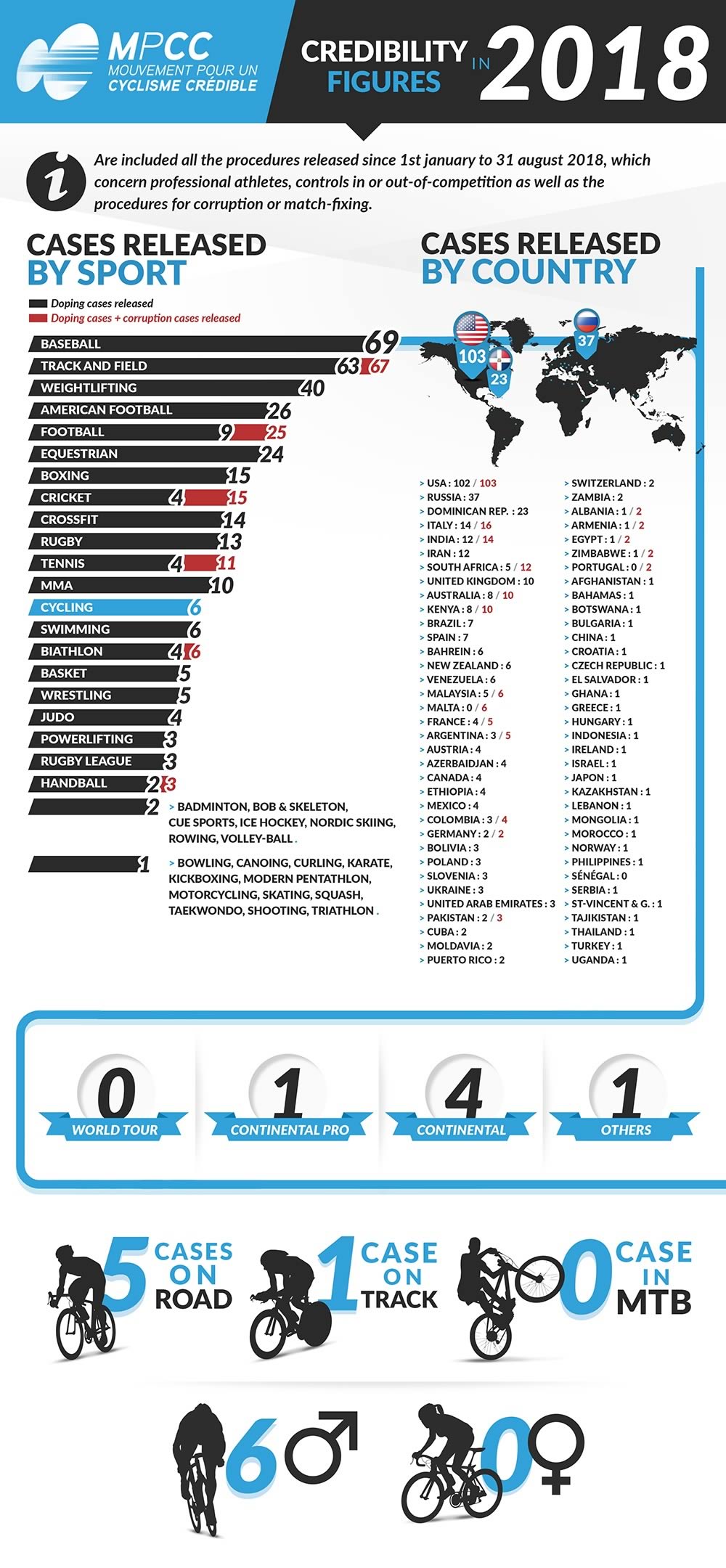
Credibility figures : 2018 Year Summary
The figures demonstrate that the credibility of a dozen of sports is more damaged than cycling.
We reckon cycling fans will be glad to see that their sport is ranked quite low (13th) in this classification of doping and corruption cases, far behind american sports, but also athletics, football and rugby. They are right to feel so, but not completely, and we are going to explain why.
It has been 5 years since we started to release this barometer, which only takes into account the cases that have been publicly revealed by the federations or the media. Among these cases, we only retain those concerning high-level or professional athletes.
This 5-year-long work could have enabled us to decipher trends. Unfortunately, we cannot really find any when it comes to cycling. With 17 cases across all the disciplines, the figures remains basically the same as the ones of the last years. 6 cases involving World Tour and Pro Conti teams: it’s 2 less than last year, but still 3 more than in 2016. Concerning road cycling, there has always been a little more than 10 cases for the last 5 years. We can however be glad that no corruption case happened in our sport. Of course, cycling is not a sport with a lot money at stake, especially on betting sites. Football or cricket, for example, are way more involved in these issues.
For the first time, MPCC took the corruption cases into account for this year barometer. Financial wrongdoing, as well as match-fixing, are now part of our study. These cases, often revealed by the media, cause huge damage to the credibility of sport, as much as doping cases. Even though the number of corruption cases is lower than doping affaires, they definitely exist: we have identified 136 of them (across all sports) in 2018. These corruption cases are spread across 50 countries, but revolve around a dozen of sports.
Corruption cases are much more scattered around the globe than doping cases. Broadly speaking, the main countries where credibility is badly damaged remain the same: United States, Russia and India can raise the size of their countries as a shield. This argument is not relevant when it comes to Italy (37 doping cases in 2017, 39 in 2018) and Dominican Republic (31 cases last year, 29 this year - essentially baseball players).
We can see that the number of doping cases that have been publicly revealed as soon as the disciplinary process or the punishment has been pronounced is increasing year after year (close to 600 this year). It does not mean that doping is on the rise. It shows that federations are now more likely to tackle their doping cases on the public scene, as they do with any other disciplinary action. There is also more transparency in how the anti-doping policy is lead. Five years ago, only twenty federations disclosed their doping cases. As of today, around fifty of them are doing so.
The one actual trend we can identify is that cycling is getting further away from the top of our doping cases classification. Though, cycling fans must mitigate their satisfaction: this is not due to a drop in doping cases, but mainly caused by this new transparency granted by the federations.
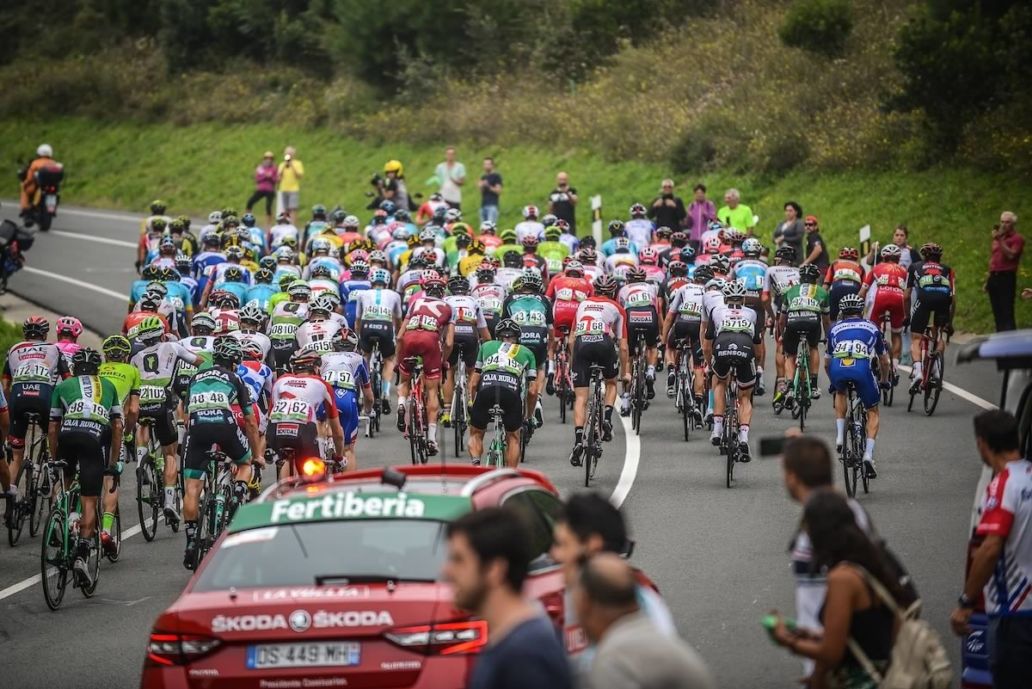
Tramadol is officially banned in cycling
On Tuesday, January 15th, Union Cycliste Internationale (UCI)'s President Mr. David Lappartient formalized the tramadol use ban in competition starting from March 1st 2019.
Since October 2013, MPCC teams doctors committed not to prescribe tramadol to their riders. Since then, MPCC repeatedly asked the World Anti-Doping Agency (WADA) to add this drug to the list of prohibited substances and methods.
MPCC is glad to see that, despite the lack of action from WADA, UCI took the lead on this topic and found a tangible solution to this major issue, one that concerns the whole world of high-level sport. MPCC would like to thank all of its members that have fought with the movement for more than five years to achieve this.
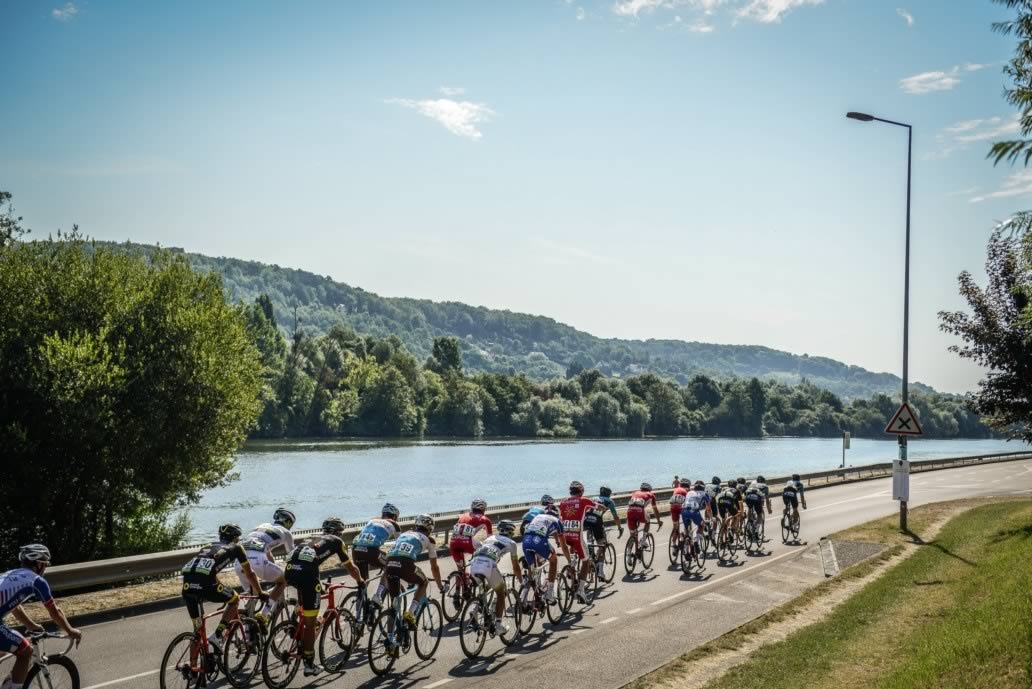
Le Gruppetto joins MPCC!
The MPCC is pleased to welcome a new sympathizer among its members! Welcome to the association Le Gruppetto!
The association "The Gruppetto" represented by Yann Mongenot explains its motivation of membership: "By our present adhesion, we wish to affirm our willingness to support the action of the MPCC and thus to indicate the determined commitment of our community to position themselves in favor of a credible cycling."
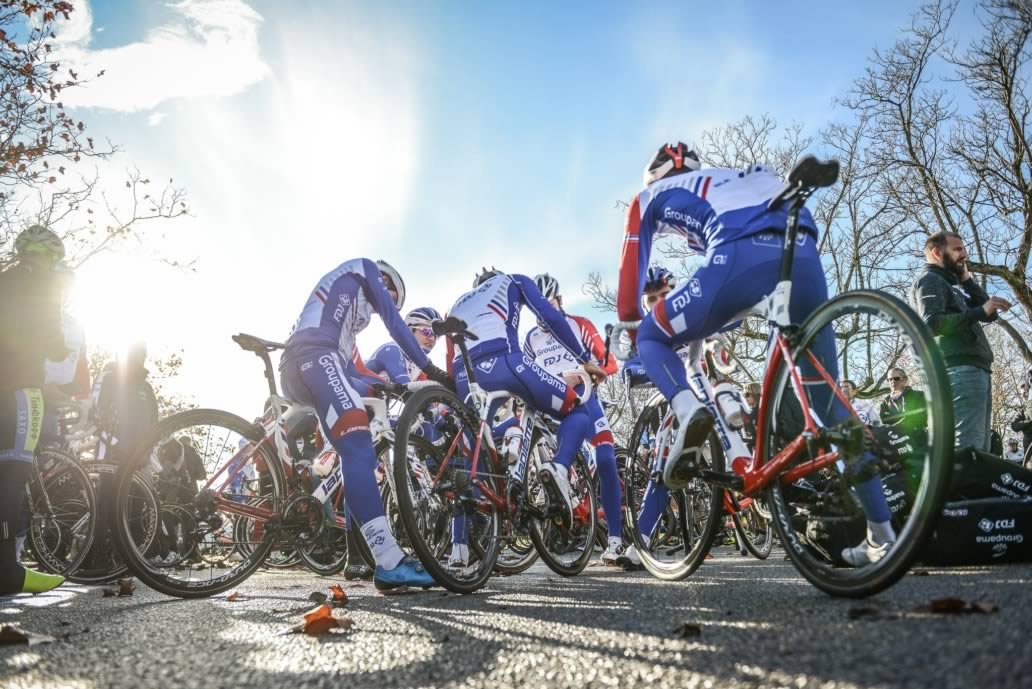
The Continental team Groupama-FDJ joins MPCC!
By requesting MPCC membership, the newly-established Groupama-FDJ continental team has decided to demonstrate its commitment for a clean sport before even starting competition. The team will be managed by Jens Blatter. The referring physician will be Jacky Maillot.
General manager of the structure, Marc Madiot declares:
"To us, the continental team is first and foremost a framework for learning a profession. A good cyclist must build himself on a sound basis. Young athletes have to consider as a defining moment of their career the day they call for the respect of the rules."
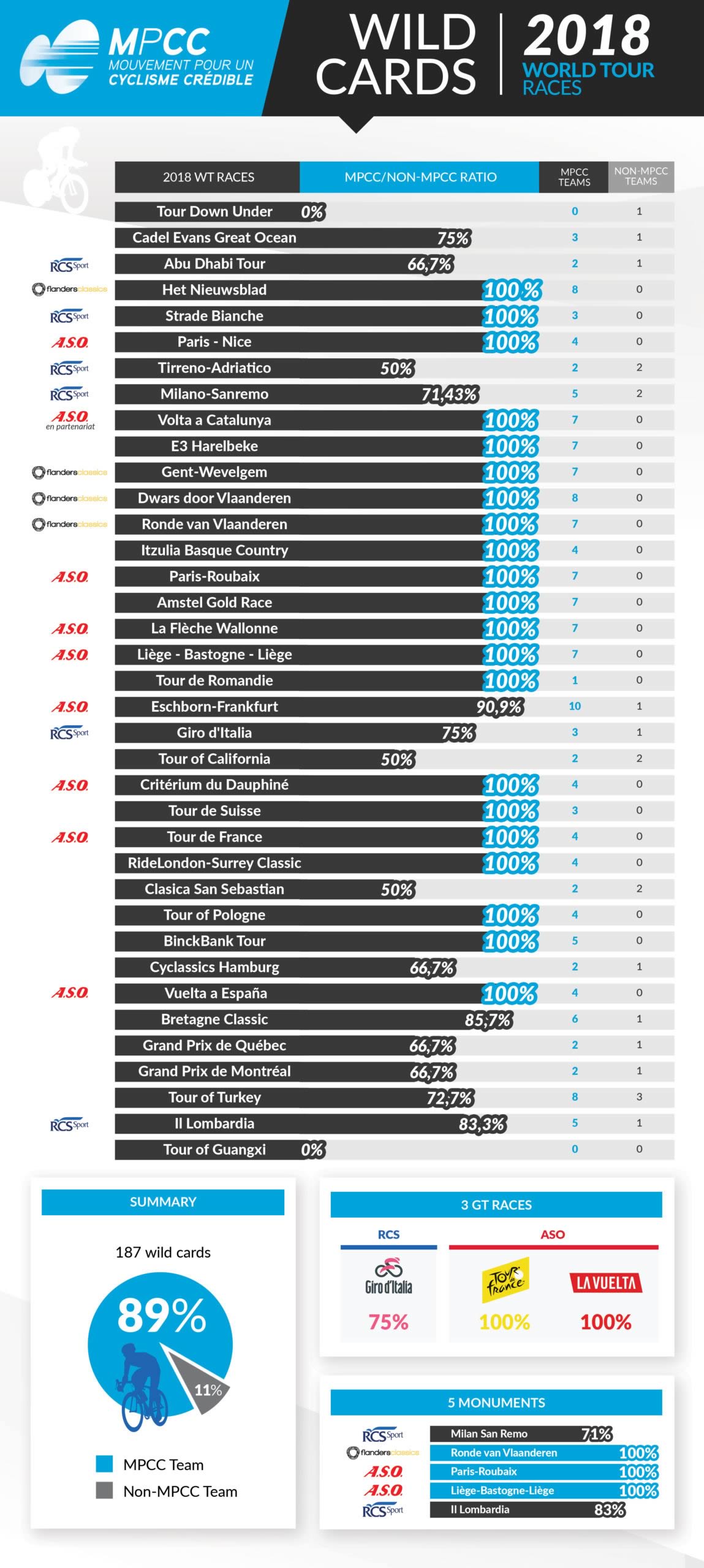
Wild Cards : 100% is the target for MPCC
This year, 89% of the wild cards were granted to MPCC teams.
To make this datavisualization, we took the 37 World Tour cycling races of the year and had a look at the wild cards that were granted on them. Among them, we separated the ones granted to continental professional teams part of the MPCC and those given to the other teams.
There is one figure to highlight : 89% of the wild cards were issued to MPCC teams. As a reminder: on these 37 races, around 3 or 4 teams are invited on stage races, and up to 11 wild cards can be given on the one-day races.
Among the 187 wild cards issued throughout the season, we isolated the ones concerning the 3 grand Tours and the 5 Monuments of the season to observe whether there is a pattern when it comes to the big and powerful organizers.
Here are the results: on two of the grand Tours (Tour de France and Vuelta a España), as well as the two monuments organised by A.S.O. (Paris-Roubaix and Liège-Bastogne-Liège), all of the Wild Cards were given to MPCC teams.
When it comes to the other grand Tour (Giro d’Italia) and two of the 5 monuments (Milan-Sanremo) organised by R.C.S., there is not as much satisfaction on our part: all of these events had non-MPCC teams starting the race.
Finally, there is a clear trend concerning the World Tour races organised on Belgian soil: all of them are 100% committed to MPCC, which is not the case in France or Germany, even though these are countries very involved in the ethical topics.
MPCC would like to highlight the outstanding commitment from some organisers which fight to strengthen the credibility of our sport. We also would like to lament the behaviour of those which do not wish to go the same way, especially given that their action is essential to the future of cycling. Thus, MPCC requests that all of the wild cards issued in 2019 be granted to teams part of the movement, and encourage teams and federations which are not part of the MPCC to commit to stricter rules.
More than 300 riders are now members of MPCC!
Less than nine months after having allowed professional riders to adhere to the MPCC, whether or not they are part of teams that are members of the movement, we can now announced that more than 300 riders have sent their membership request.
Thanks to those adhesions - which are free - the MPCC has the opportunity to go even further:
- Organising an annual MPCC/riders meeting
- Making it possible for the member riders group to have a voting right at general meetings
- Studying their proposals in order to give credibility to cycling’s image
In return, the rider will have to join the MPCC’s philosophy, promote cycling’s image by fighting against any form of doping and cheat, and respect the movement’s internal regulation, especially regarding corticoids and tramadol’s use.
MPCC strengthens the credibility of the 3 Grands Tours
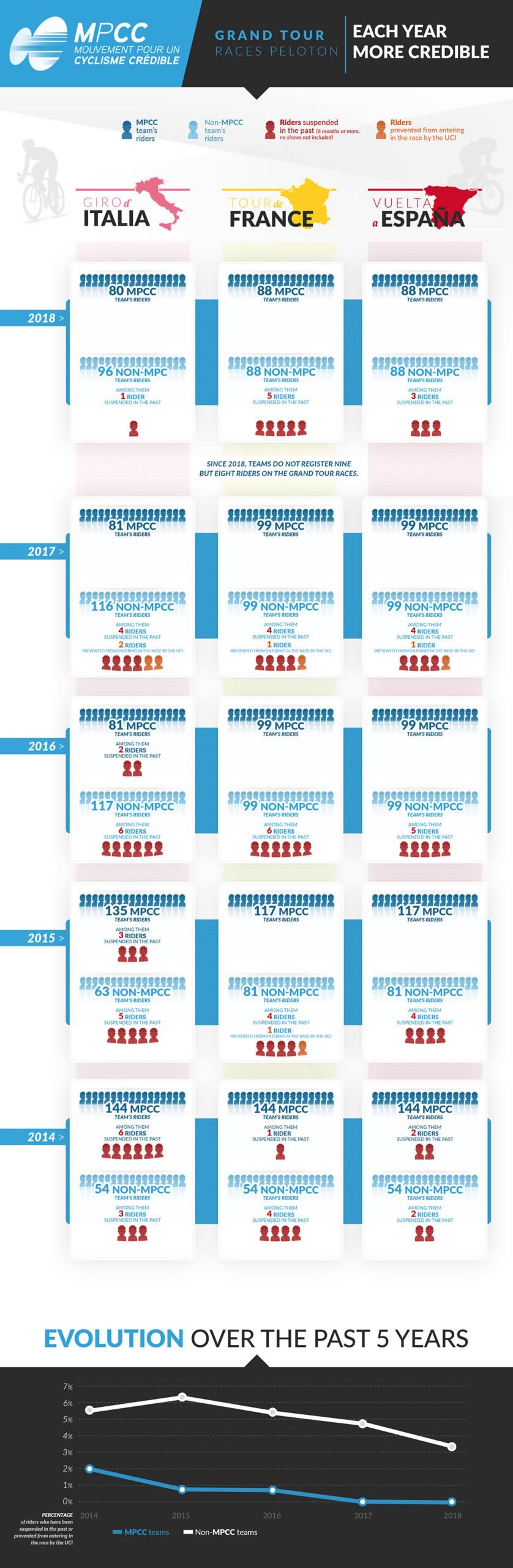
Since 2014, MPCC has been tracking the records of the starting riders of the 3 Grand Tours. In 2018, 9 of them, contracted to non-MPCC member teams, had previously been suspended for more than 6 months in their careers.
When looking at this datavisualisation, two figures catch the eye: first, the amount of riders suspended in in the past, and then the number of riders who have not been allowed to start one or the other Grand Tour by the UCI.
On a voluntary basis, our movement require our members to commit to Article 4, one of the most important of MPCC’s rules and regulations:
« MPCC teams agree not to enter riders, even in the case of a contract extension, who are convicted of (or deemed involved in) any anti-doping violation under Articles 2.1 to 2.8 of the World Anti-Doping Code, who were given a sanction of more than 6 months by the international court or national body (excluding penalties for three breaches of the ADAMS geolocation anti-doping administration and management system), within 2 years after the suspension or subject to a sanction for:
1. Abnormalities noted on the biological passport (or a violation of the biological passport regulations).
2. Damage to the image and credibility of cycling as previously defined. (…)
It is expressly agreed and accepted by the team members that in the event the rider is under contract, it will have to be terminated. The non-recruitment clause as provided in the part IV must be extensively implemented: the incriminated rider will no longer be part of the team during the 2-year period. »
MPCC is glad to see that its members, attached to the philosophy of the movement, keep committing to this rule and refrain from choosing previously suspended riders to start a Grand Tour or any other race, even after the two-year regulatory period.
The nine riders who have previously been suspended in the past are indeed all contracted to team not belonging the MPCC (8 MPCC teams have started the Giro, 9 on the other Grand Tours).
As a whole, the percentage of riders previously suspended or not allowed to start is gradually dropping year after year on the Grand Tour. Last year, it was a little less than 5%. For the year 2018, the number is a little bit over 3%. MPCC teams are leading by example. The 0% objective remains an absolute priority.
> See the Infography : Giro d'Italia 2018 - Tour de France 2018 - Vuelta a España 2018
2018 GRAND TOUR RACES PELOTON INFOGRAPHY :
Open letter dated 24 October: MPCC reacts to WADA's response
33 hours after sending an open letter to the President of the World Anti-Doping Agency, The Movement for a Credible Cycling (MPCC) has received a response by email. Here is our response to Sir Craig Reedie.
Dear Sir Craig Reedie,
Our Board would like to thank you for the lengthy response you granted us on such a short notice: this shows that MPCC is viewed as a major player of the fight against doping and thus deserves the full attention of WADA.
The movement acknowledges the content of your letter and does not content itself with it, despite the satisfaction you show about all of the topics we tackled.
On the topic of tramadol and corticoids
You state that “there is not currently any consensus among WADA’s Prohibited List Expert Group that tramadol meets the criteria for inclusion on the List” and that “the Expert Group will continue to evaluate this medication and class of drug as new studies become available”. Since 2013, MPCC member teams’ doctors committed themselves not to prescribe tramadol. In the meantime, the movement made multiple request to WADA to ban the use of this substance in competition. Year after year, tramadol has been put on the Monitoring Program without further action, a quick temporary fix for a long term issue.
MPCC expects some courage from WADA’s Expert Group as they need to make a final stand on whether or not tramadol should be banned. The use of this substance is a big concern for the cycling professionals, which are very well represented within MPCC. They are waiting for a decision on the use of tramadol: should it be banned or not, and if so, for what reasons?
You claim that you “are supportive” of the UCI’s initiative to control the use of tramadol in cycling, “primarily for health reasons”. If this requires a support from WADA, then it is a proof that there is a big issue linked to this substance. MPCC will not rest until it obtains a final decision on this issue that endangers the health of the riders, and deserves a faster and more efficient response than a mere monitoring that WADA “experts” recommend.
You add that you “continue to evaluate this medication and class of drug as new studies become available” and “maintain an ongoing dialogue with UCI and continue to make every effort to explore options for the UCI in this matter.”. MPCC, since it was created in 2007, calls for setting up regulations on corticoids. The support of the UCI towards this goal is a huge step forward that now needs to be followed by tangible measures. MPCC hopes that the “ongoing dialogue” between WADA and the UCI on this topic will speed up the process and not slow it down.
MPCC insists on how strong the concerns are for all the stakeholders in the world of cycling when it comes to the use of tramadol and corticoids. This issue, which involves both health and performance enhancement, is a key topic of the fight against doping, and extends way beyond cycling.
About the Puerto Case
You consider that the stance of the MPCC members, who account for more than half of the 1st and 2nd division pro cycling teams, “demonstrates an astonishing lack of knowledge and understanding of what has happened to date”.
MPCC only states the obvious when saying that the handling of this case had a huge negative impact in terms of image on the sport in general. MPCC wonders about the “lack of knowledge” WADA may suffer when it comes to cycling in particular and what this sport withstood since 2006 because of its inability end a “sorry episode”. This is not an episode, it has been going on for 12 years now.
MPCC does not understand that WADA, whose missions are very clear, states that it “has done everything possible (...) in a way that secures justice for clean athletes”. Does WADA really think that the clean athletes represented by MPCC, as well as all the other who are contracted to non-member teams, consider that justice has been done?
A response from you admitting that the handling of the Puerto case was not fully satisfying would have been way more representative of the terrible reality of this affair. Expressing satisfaction on this topic is not acceptable, and so is the fact that you dismissed MPCC’s arguments on the sole basis of a so-called “lack of knowledge” on the topic.
About Russia
MPCC respects the democratic nature of the decision that the Executive Committee took, considering that the decision to reinstate the Russian Anti-Doping Agency (RUSADA) was the result of a vote. Though, a very big contradiction lies when you claim that “WADA’s focus now is on finalising the process for accessing all the data from the Moscow laboratory, which is the missing piece of the puzzle, by the end of the year”. You are openly admitting that the puzzle is “incomplete”, yet accessing all the data should be a prerequisite to the reinstatement of RUSADA.
You are expecting the release of the data “by the end of the year”. If WADA fails to comply with this target, MPCC demands that WADA commit to what you wrote in your response to our open letter, meaning that you will make “RUSADA non-compliant again”. The end of the year comes in two months. The sporting world will very soon have a clear view on whether or not you can follow through on this commitment.
In addition, MPCC is glad to acknowledge that, on October 29th, the leaders of 18 National Anti-Doping Organisation (NADO) publicly condemned WADA’s decision to reinstate RUSADA. To these 18 National Anti-Doping Organisation, Sir Craig Reedie, dare you say that you remain “firmly of the view that it was the right decision for clean sport and that WADA is in a stronger position because of it”?
On the topic of the independence of WADA
MPCC takes note of your answers, but also raises that fact that you explain that “WADA launched last year a governance review process”. You specify that “among the proposals of the multi-stakeholder working group are that there should be more independent members on our Executive Committee and that the positions of President and Vice-President should also be independent along with a long list of other proposed measures”. You add “this process has clearly shown WADA’s willingness to adapt and that it wants to ensure it has the right governance structure in place to be fit for purpose in the years to come”.
This is the clear proof that the question of the independence of WADA is an important topic, otherwise such a working group would have no purpose. Thus, MPCC is legitimate to be concerned about whether or not WADA can demonstrate that it can act with full independence despite the nature of its funding.
The 18 National Anti-Doping Organisations involved in the press release of October 29th also took a stand on this topic. They openly expressed their support for the sport stakeholders who demand a complete overhaul of WADA, explaining that they want that “the President and the Vice-President of WADA not to have any affiliation with governments or international sports organisations, IOC included”
On the topic of Chris Froome’s abnormal control
Our movement will once again repeat what it said in his open letter of October 24th : “MPCC laments the way sanctions are not applied equally and procedures are not followed equally, which is devastating for the credibility of the sport, for WADA itself, and thus is devastating for the confidence which athletes ought to have in the world’s anti-doping agency and its independence and integrity.”
What is the threshold set by WADA's experts on tramadol regulation: 1000, 1600 or 2000 ng/mL?
This is about credibility and image. What we need here is to fulfil a crucial mission consisting of not feeding suspicions about a case in the center of the media attention.
The evocation of winning “a significant victory for clean cycling in securing enhanced bans for three of (our) sport’s most notorious cheats” on the day MPCC sent its open letter to WADA cannot be used as an argument to the problematic handling of Chris Froome’s abnormal control. These are two completely different matters. MPCC fails to understand why you deemed suitable to associate these two cases in your response to our open letter.
As a conclusion, MPCC asks WADA and you, Sir Craig Reedie, its President, multiple questions:
Most of the significant victories of the fight against doping since 1999, the year the World Anti-Doping Agency was created, came from police inquiries, journalistic investigations and testimonies from athletes.
Where would our sport stand had Floyd Landis and Tyler Hamilton not testified against the organized doping within the US Postal?
Where would our sport stand without Trevor Graham denunciations that allowed the reveal of the BALCO scandal?
Where would sport stand if, in 2006, the Spanish police had not set up a big operation against doping and picked up on the public accusation of Jesus Manzano, finally leading to Operation Puerto?
Where would our sport stand without the work of the German journalists on the state-sponsored doping case in Russia?
What would the records be? The primary purpose of WADA is to protect clean athletes.
Waiting for your answer, our Board convey to you, dear Sir Craig Reedie, President of WADA, our best regards.
Read MPCC's open letter to WADA
Read Sir Craig Reedie's response
510 members of the MPCC :
7 World Tour teams - 23 Pro-Continental Team - 9 Continental Teams - 6 UCI Women Team - 289 professional riders - 129 technical staff members - 6 sports agents - 9 National Federations - 9 organizers - 9 sponsors of cycling - 14 sympathizers.