
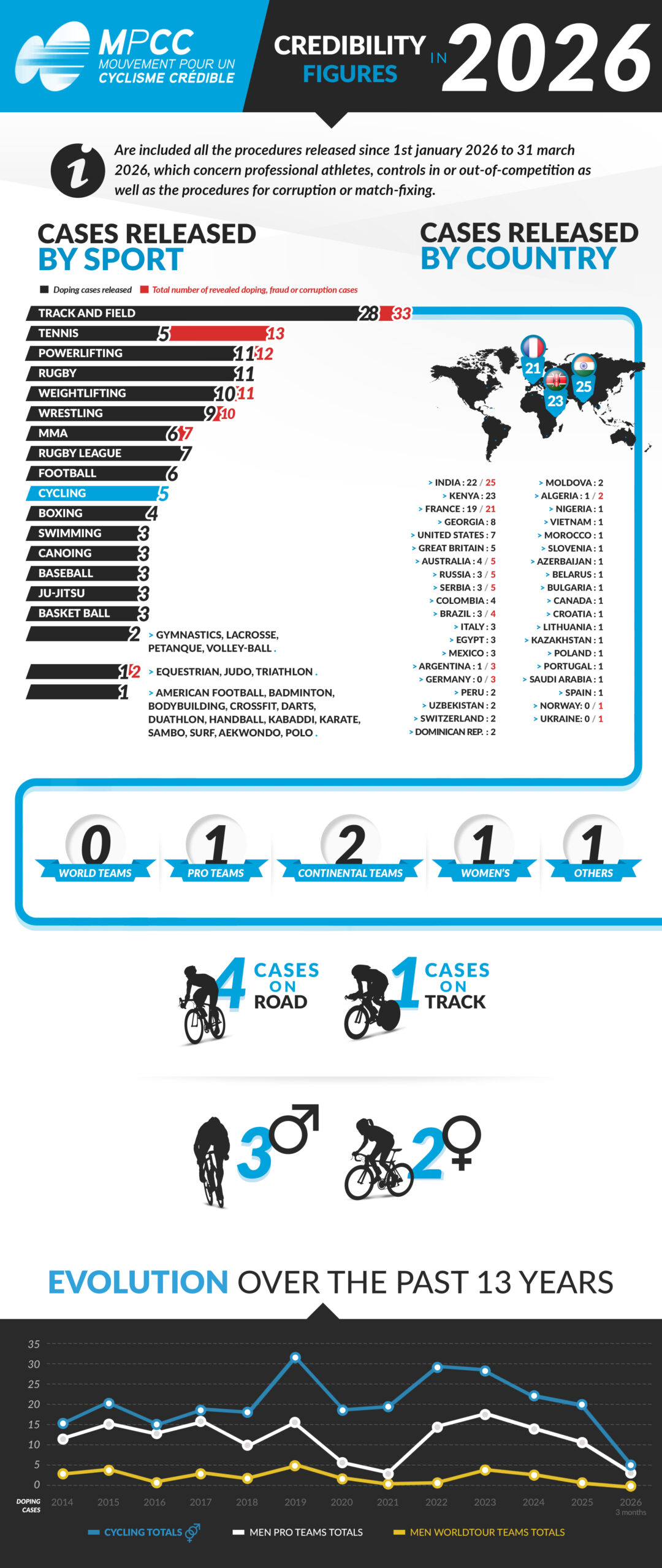
Following a particularly eventful year 2025 on the anti-doping front, 2026 has begun in relative calm. Nearly 170 cases of doping and sports fraud were uncovered across more than 30 sports during the first quarter of the year; only five were in cycling. Despite these figures, the fight against cheating remains a pressing issue.
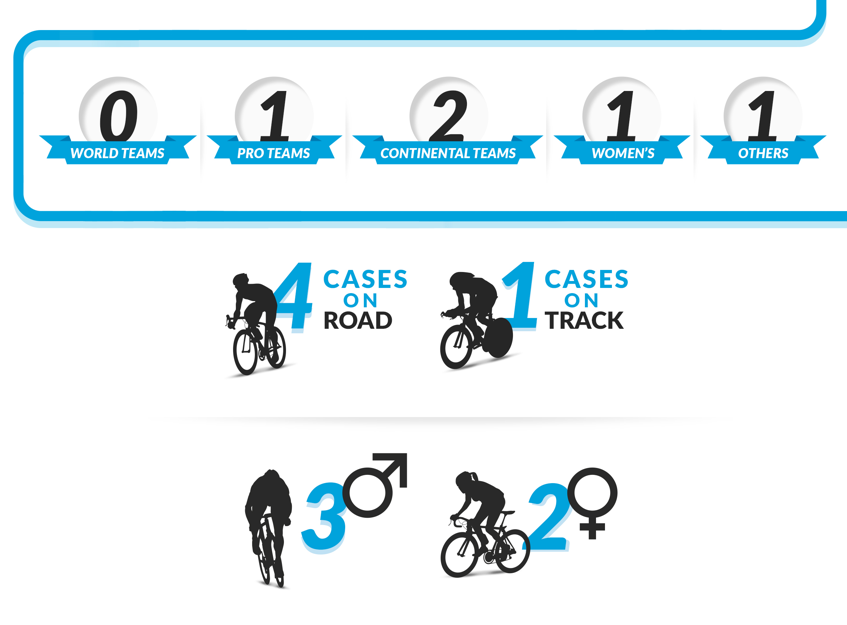
For several seasons now, the number of doping cases involving World Tour riders has been in steady decline: 4 in 2019, 4 in 2023, and just 1 in 2025, according to the latest figures published in the Credibility Figures. Thus, in the first quarter of the year, only five professional cyclists tested positive or were suspended for breaching anti-doping rules.
– 1 rider from a Pro Team who tested positive out of competition
– 2 riders competing at Continental level who were caught out by their biological passport
– 1 female rider competing at Continental level
– 1 athlete sanctioned for breaching whereabouts rules
These figures are consistent with the trend noted over the past several years, namely between 20 and 30 cases of doping and/or sports fraud per year. Whilst the majority of cases recorded in the Credibility Figures involve Continental-level riders, the rider of the Pro Team serves as a reminder that cheating might not have vanished at the top level of cycling. At the end of the first quarter of 2026, cycling was also the ninth most frequently quoted sport in doping and sports fraud cases, far behind athletics (33), tennis (13) and powerlifting (12).
 But behind these figures stand several realities. Admittedly, the biological passport, which has been mandatory for all professional teams for nearly 20 years, has proven its effectiveness, having recently helped to uncover the latest doping case in the elite of our sport (pending a final decision regarding the rider in question). Growing budgets have enabled the hiring of increasingly qualified technical staff to monitor athletes’ performance, improvements in training methods, from the study of riders’ biomechanics by specialist staff to tailored, even personalised nutrition for each rider, and the reduction in the number of race days per rider have made it possible to better support and maintain athletes’ health in the short and medium term. It is crucial that while we have seen some steps forward, we must continue to evolve and improve our anti-doping systems to make them more robust and more advanced than those who are willing to cheat.
GREY AREAS IN QUESTION
These technical—not to say scientific—advancements bear witness to the ever-increasing professionalisation of our sport, and perhaps mark the end of so-called “old-school” cycling, which was inward-looking and reliant on training methods inherited from decades of empirical practices. Whilst cycling has chosen the path of progress, it must not do so at any cost. Because other realities have come to light over the past decade and have been the reason for the MPCC’s uncompromising and unyielding stance on doping practices : the over-medicalisation in some teams (notably the use of painkillers such as Tramadol, which is now banned in competition), the use of substances that enhance performance or recovery, such as ketones, and the health effects of which are far from having been scientifically validated, and the use of performance-enhancing methods considered to be ‘grey areas’ (inhalation of carbon monoxide in altitude training camps, hypoxia masks), which border on doping. It is crucial that the major stakeholders of the sport develop clear boundaries on what this so-called grey area is, to protect the health of athletes who do not wish to put their health at risk in taking medicines intended to treat sick people, with a view to increasing their performance.
COMMITMENT FROM RIDERS
The efforts made by those involved in cycling following the various scandals that have marred the sport’s history have been immense. Team managers, riders, race organisers, governing bodies and sponsors, in particular, have been actively working to eradicate doping and to put an end to a kind of ‘culture’ that has gone unpunished for far too long. The results are there, but caution must remain the order of the day in the face of the fast changes that have been taking place over the last few years. The credibility of riders and their team managers must be at the heart of our concerns, as it is this credibility that has enabled the restoration of cycling’s image, its development and its expansion, particularly into women’s cycling.
With nearly 400 professional riders signed up as individual members, the MPCC has a broad base of support for its values. But its members can do more by spreading these values to as many stakeholders as possible – whether they are non-member teammates or fellow riders – and by speaking out publicly on issues of physical and mental health. Faced with rapid changes in professional cycling, the new generations of riders also have a role to play as they represent the future. They are therefore strongly encouraged to join our movement to remain at the forefront of credible cycling.