
As it does every year, the MPCC is taking stock of the cycling peloton by recording the number of male and female riders currently suspended. The aim of this review is to put into context the measures put in place over the years to fight doping and to highlight the approaches adopted by teams, particularly when it comes to riders returning to competition after serving their bans.
When the Festina scandal broke in 1998, cycling was hit by a seismic shock unlike anything the sport had ever experienced. Widespread doping was exposed to the general public, and the various stakeholders blamed one another for their respective levels of responsibility regarding the ‘customs and practices’ then prevalent within the peloton. As well as seriously jeopardising the credibility of cycling, this scandal also brought to light certain practices that endangered riders’ health. Far from taking this warning to heart, new players intensified the ‘arms race’ in a frenzied quest for performance, until it reached a point of no return with Operación Puerto in 2006.
Involving many of our sport’s leading figures, this latest scandal was one of the factors that led to the founding of the Movement for Credible Cycling (MPCC). The founders of the MPCC were thus responding to the inaction of certain stakeholders in cycling, while our sport remained in the eye of the storm, nearly a decade after the Festina scandal. Based on strict adherence to a code of ethics, our movement has gradually driven change. Over time, safeguards have been put in place to identify and sanction those who cheat, undermining the integrity of the sport, damaging the careers of responsible professional athletes and causing lasting damage to cycling’s reputation.
Commit to MPCC, join us !
TO ABIDE BY VALUES
An anti-doping community has developed around the World Anti-Doping Agency (WADA), established in 1999. Alongside it, international sport-specific agencies, better-resourced national anti-doping agencies, laboratories responsible for testing athletes and other anti-doping organisations have joined forces to combat doping while also providing prevention programmes.
This introduction aims to explain why the MPCC is pursuing this battle and what measures have been put in place to banish the spectre of doping, which is objectively difficult to eradicate. The foundation is a code of ethics that each of our members – from teams to riders and medical staff – is required to uphold. Joining the MPCC sends a strong signal of zero tolerance towards doping, but also demonstrates a commitment to values that benefit both the present and future of cycling.
66 RIDERS CURRENTLY BANNED
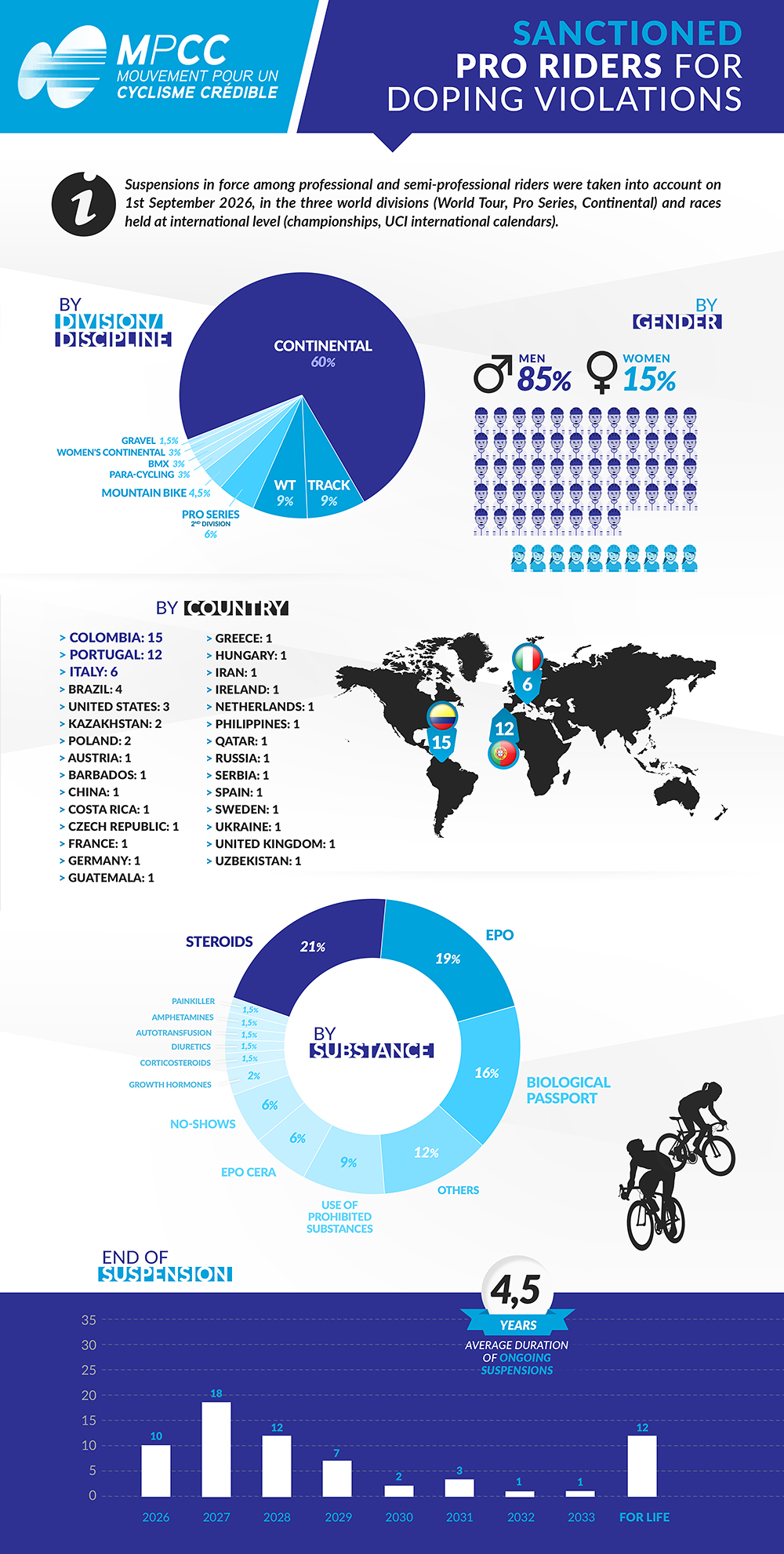
As a sign that doping persists, around twenty cases of anti-doping rule violations are still recorded each year among professional cyclists. We have therefore decided to compile an annual barometer to gauge the state of the fight against doping. As of 31 August, 66 riders were serving a suspension in disciplines governed by the Union Cycliste Internationale (road, track, BMX, mountain biking, cyclo-cross, para-cycling and gravel), two fewer than at the same time in 2025. Most of the riders who were eligible to return to competition following a suspension during the first half of 2026 were Continental-level athletes, track specialists or riders who had served very long bans – eight years in some cases – and who were now at a very advanced age for a return to competition.
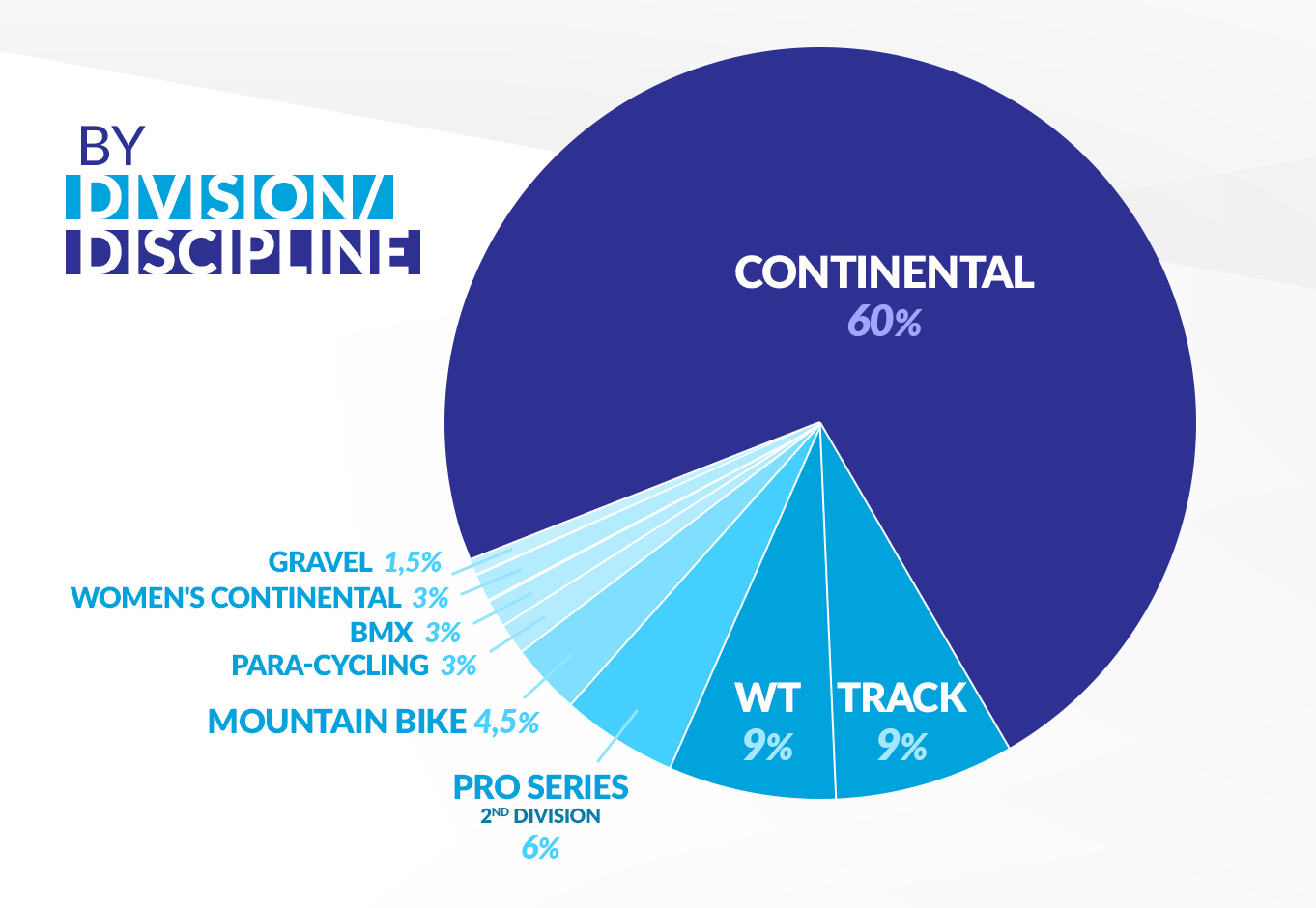
As we have noted with concern for several years, the Continental level remains the one with the highest number of anti-doping rule violations (positive tests, breaches of whereabouts rules, failure to comply with testing requirements, etc.). For example, the rider whose suspension is set to end furthest into the future, in 2033, was a member of a Continental team at the time of his offence. Having previously served an initial suspension, his ban for this repeated offence was particularly severe: eight years.
EPO STILL TOPS THE LIST OF DETECTED SUBSTANCES
Around 60 per cent of banned athletes are from the Continental level, while 10 per cent tested positive while competing on the WorldTour. This figure should, however, be put into perspective, as it includes riders who were given lifetime bans more than a decade ago. EPO and its variant EPO-CERA remain the most frequently detected substances, but their share of doping cases has fallen from 43 per cent to 25 per cent over the course of a year. This change is due to the end of the suspensions of eight riders who had tested positive for these substances. At the same time, the proportion of athletes sanctioned for abnormalities in their biological passport has risen from 7 to 16 per cent.
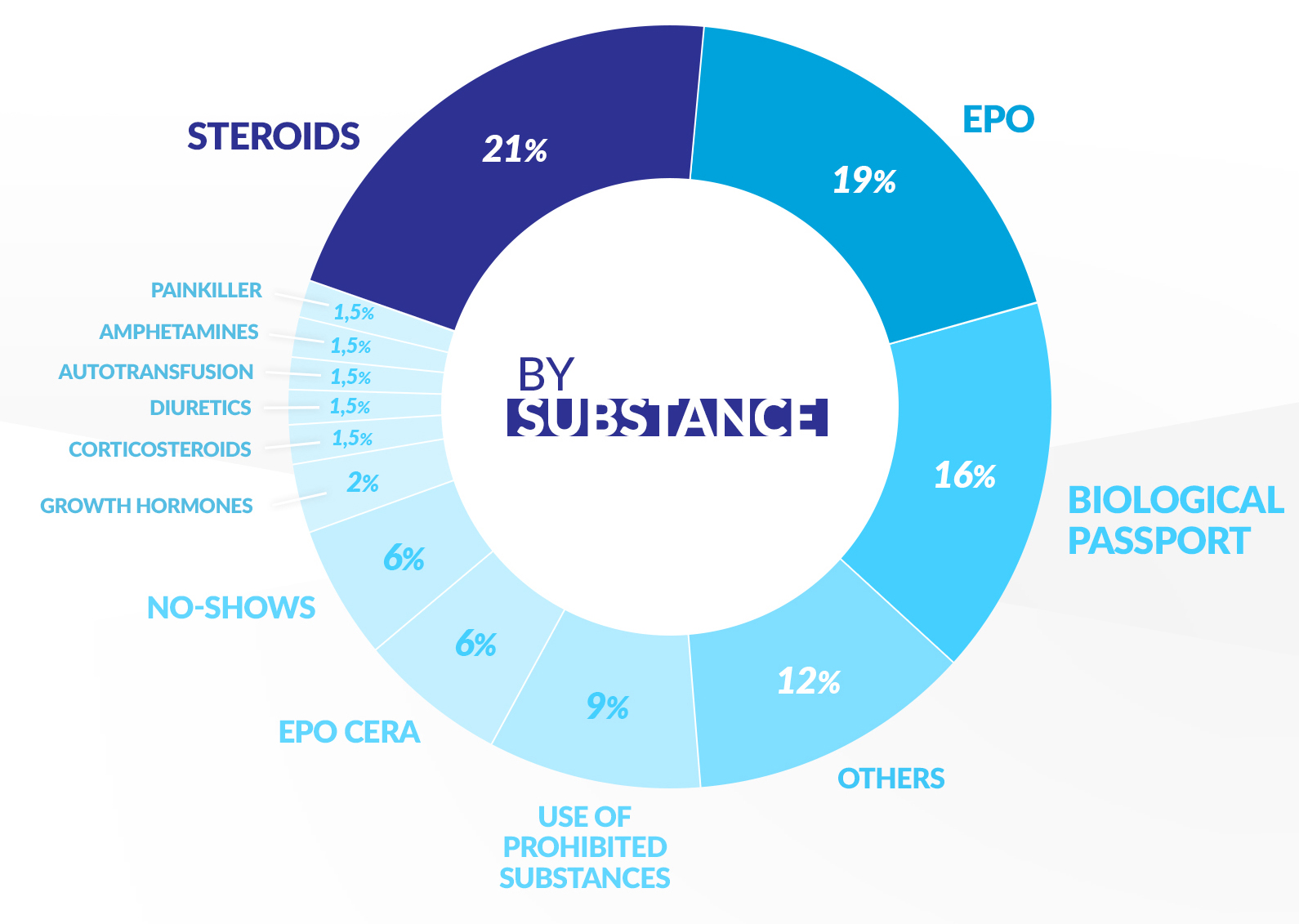
Consequently, a growing proportion of currently suspended riders have been sanctioned through this key anti-doping measure, which has been in place since 2008 and is mandatory for all WorldTour and ProTeam riders. The majority of riders sanctioned on these grounds are from Portugal, a country that, following a joint decision by the national federation and the national anti-doping agency, has extended the biological passport to Continental-level riders. Portugal is also the second most represented nationality among sanctioned riders, after Colombia. Finally, the average duration of a suspension remains at around 54 months, or four and a half years. This duration is close to the sanction usually imposed for a positive doping test (four years).
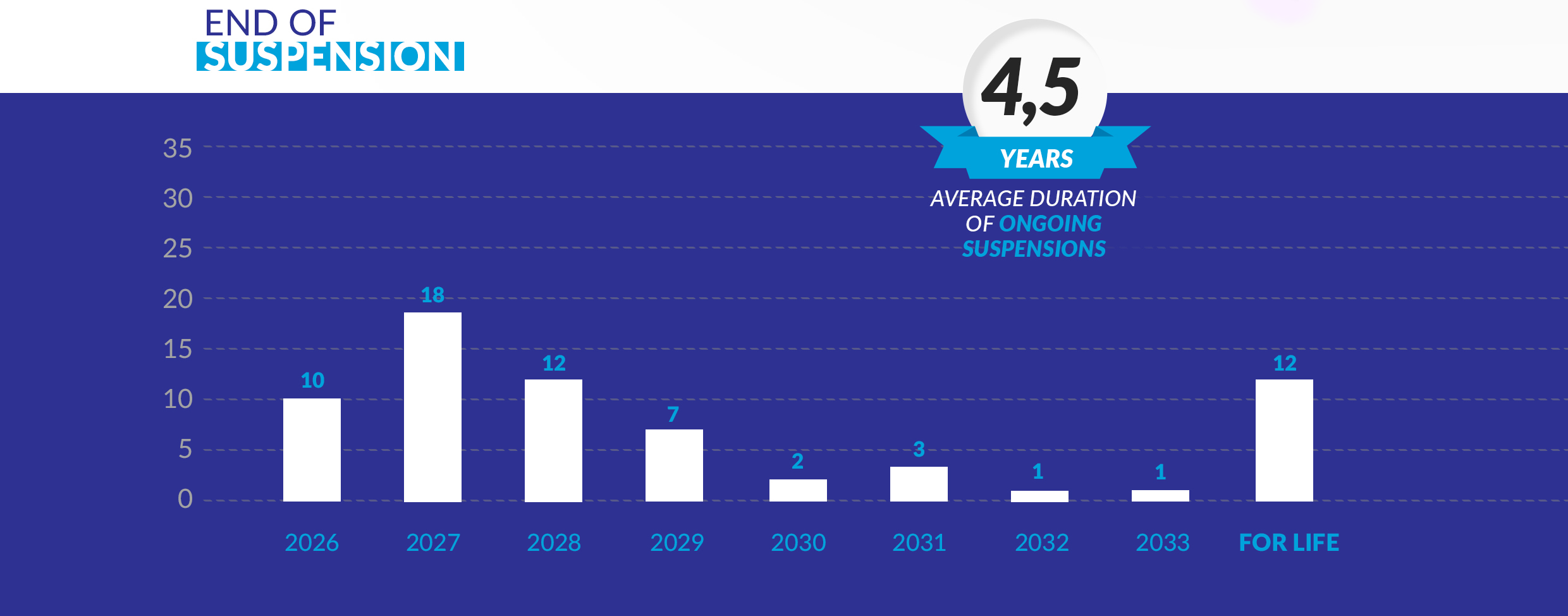
AROUND THIRTY ATHLETES BACK FROM SUSPENSION BY THE END OF 2027
Within 18 months, around thirty athletes will have served their suspensions and will be authorised to return to competition. On this matter, the MPCC’s stance is clear: no member team may sign a rider within two years of the end of their suspension, subject to the exceptions set out in the MPCC’s internal regulations. Riders who have committed offences must engage in sufficient self-reflection to gradually regain their credibility and compete at the highest level of the sport.
Indeed, our organisation regrets that two riders who were recently suspended were able to quickly find a team and take part in the most recent Tour de France. These athletes are not individual members and do not belong to MPCC member teams.
In the coming months, only one rider who was competing at WorldTour level at the time of his ban is likely to rejoin a team: Miguel Ángel López. The Colombian will be authorised to return to competition at the end of July 2027. He will then be 33 years old.