
At the end of 2025, the MPCC noted a slight decrease in the number of doping cases in professional cycling. This assessment shows that our sport is far from being among the most affected disciplines, but it must remain particularly cautious. Cycling must both question the significant development of certain medical practices known as « grey areas » among the elite and tackle « traditional » doping, particularly at Continental level.
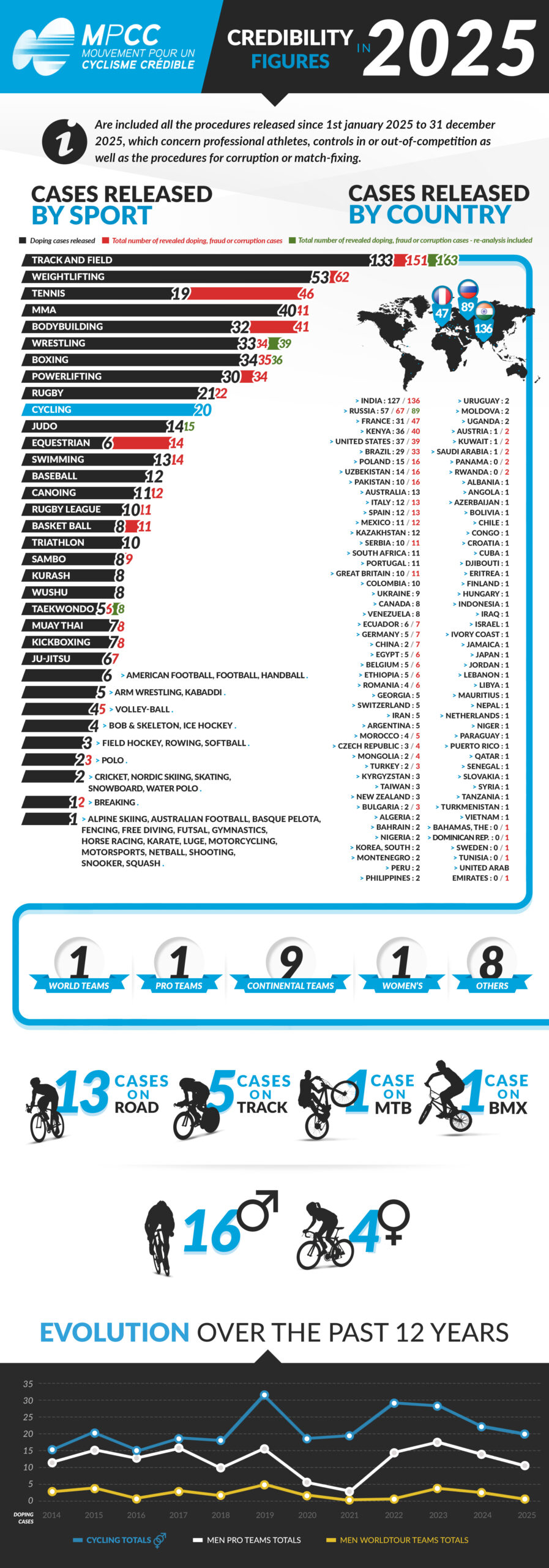
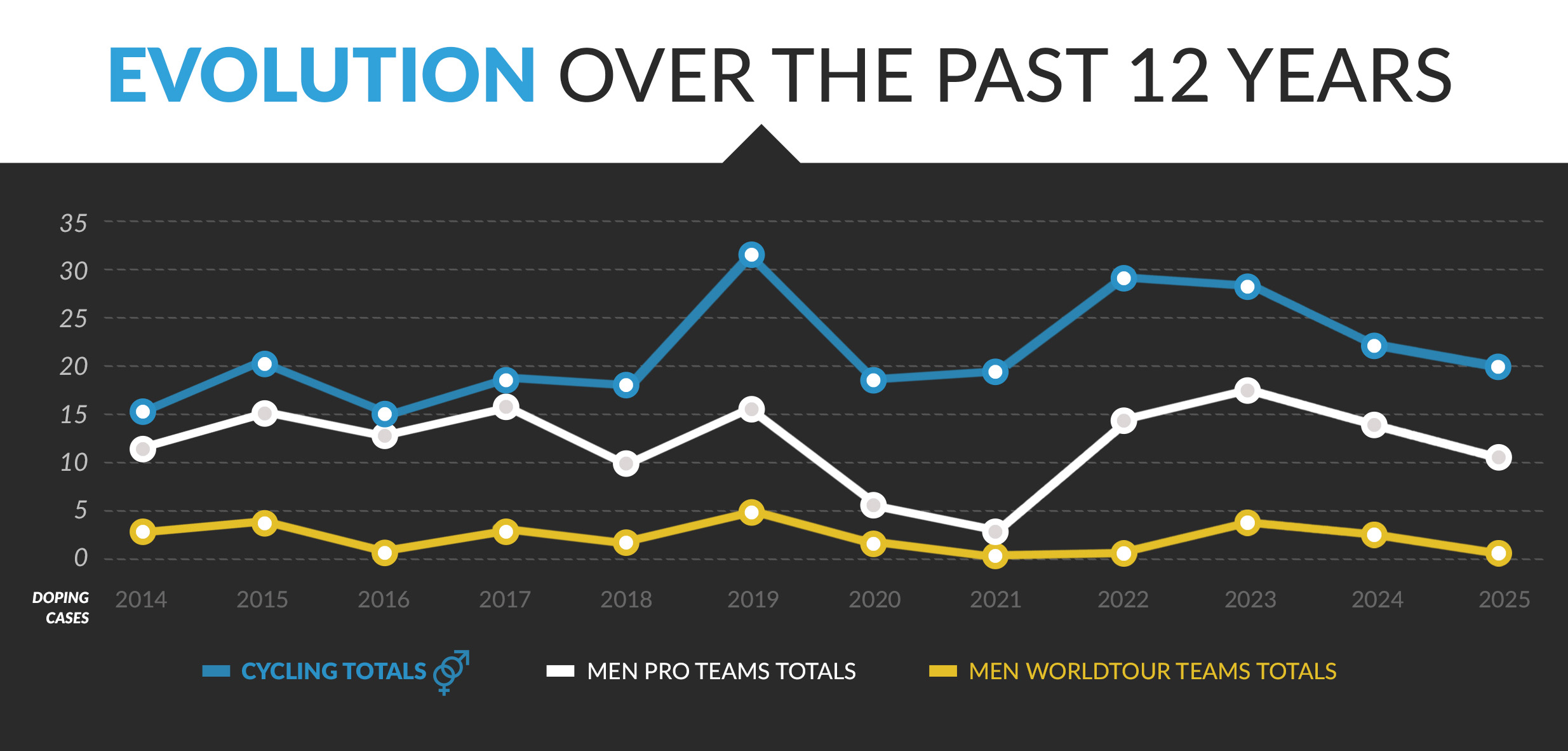
Providing an overview of the fight against doping around the world and in most sports, the Credibility Figures offer a snapshot in which cycling appears to be a model student after having been considered a weak link for many years. Over the course of 2025, 20 cases of doping were recorded among professional cyclists. This figure indicates that the number of cases revealed has been on a downward trend since 2022, when 29 cases were made public.
Cycling was only the tenth most quoted sport in doping and sports fraud cases last year, far behind athletics (163 cases), weightlifting (63) and tennis (46, including 27 for sports fraud). Athletics remains at the top of this list, despite allocating significant resources to tracking down cheating. The presence of MMA in fourth place, as mentioned in our previous publications, will be also something to watch out for in the coming years. Caution is also advised for our sport, as for the first time in two years, a World Tour rider has been suspended. This rider, who is not a member of our movement and rides for a team that is also not registered with the MPCC, was caught out by his biological passport, one of the cornerstones of the fight against doping.
Although relatively few World Tour riders have tested positive in recent years, this does not mean that the elite of our sport is 100% clean. The MPCC has always sought to question the effectiveness of anti-doping efforts, even when progress was being made. Our position is further reinforced when many teams play with the « grey areas » and increase the medicalisation of our sport. A dozen years ago, Tramadol, which we fought against, was considered a « grey area » because it alleviated riders’ pain. This substance was eventually banned, for the good of our sport and the health of the riders.
Soon, our movement took a stance on the use of certain substances in the peloton, such as ketones, and was highly critical of certain practices, including the widespread use of painkillers, which potentially endanger the mental health of riders. The MPCC’s actions have yielded results, with tramadol being added to the list of substances banned by the World Anti-Doping Agency (WADA) and the repeated inhalation of carbon monoxide being banned over a year ago. The UCI first banned this practice in February 2025 before the WADA responded by extending this rule to all sports from 2026 onwards.
WHAT ACTIONS FOR AMATEUR LEVEL ?
Of the 20 cases recorded in professional cycling, 9 were at Continental level, the equivalent of the world’s third division. The MPCC therefore invites those involved in cycling to question the antidoping policy at a lower level, as several dozen cases were recorded at amateur level in 2025. For example, 25 riders were serving bans or have been provisionally suspended by the Colombian anti-doping agency in mid-December 2025, more than half of whom compete in amateur and/or semi-professional structures.
Ensuring clean cycling at the professional level also means ensuring that it remains clean at its roots. Our sport cannot afford to be careless when it comes to the scourge of doping, within the structures that form the basis of our competitive practice, particularly with regard to its youngest athletes, who are being recruited at an increasingly early age and are better and better prepared for the demands of professionalism, particularly in terms of technique and nutrition. From the bottom to the top of our sport, all stakeholders in cycling must be involved in the fight against doping. And the MPCC is one of these stakeholders.
BROADENING THE BORDERS OF CREDIBLE CYCLING
These practices are not only contrary to fair sport, but can also be dangerous to the physical and mental health of riders, who are the main protagonists in races. The MPCC not only takes a stand in the fight against doping, which is an ongoing battle, but also wishes to broaden the issue of ‘credible cycling’ to include riders health, support for the fast growth of women’s cycling, the safety in races, etc.
These additional issues also highlight what kind of actions we should take to maintain responsible cycling, between the budgets allocated to the ITA, the main agency in charge of anti-doping controls in professional races; the promotion of safety measures among riders, teams and race organisers; and the financial participation of those involved in cycling. All these realities reinforce the MPCC in its positions and actions. We therefore encourage those who are not yet members of our movement – riders, teams, team staff, race organisers and national federations – to join us.